Info
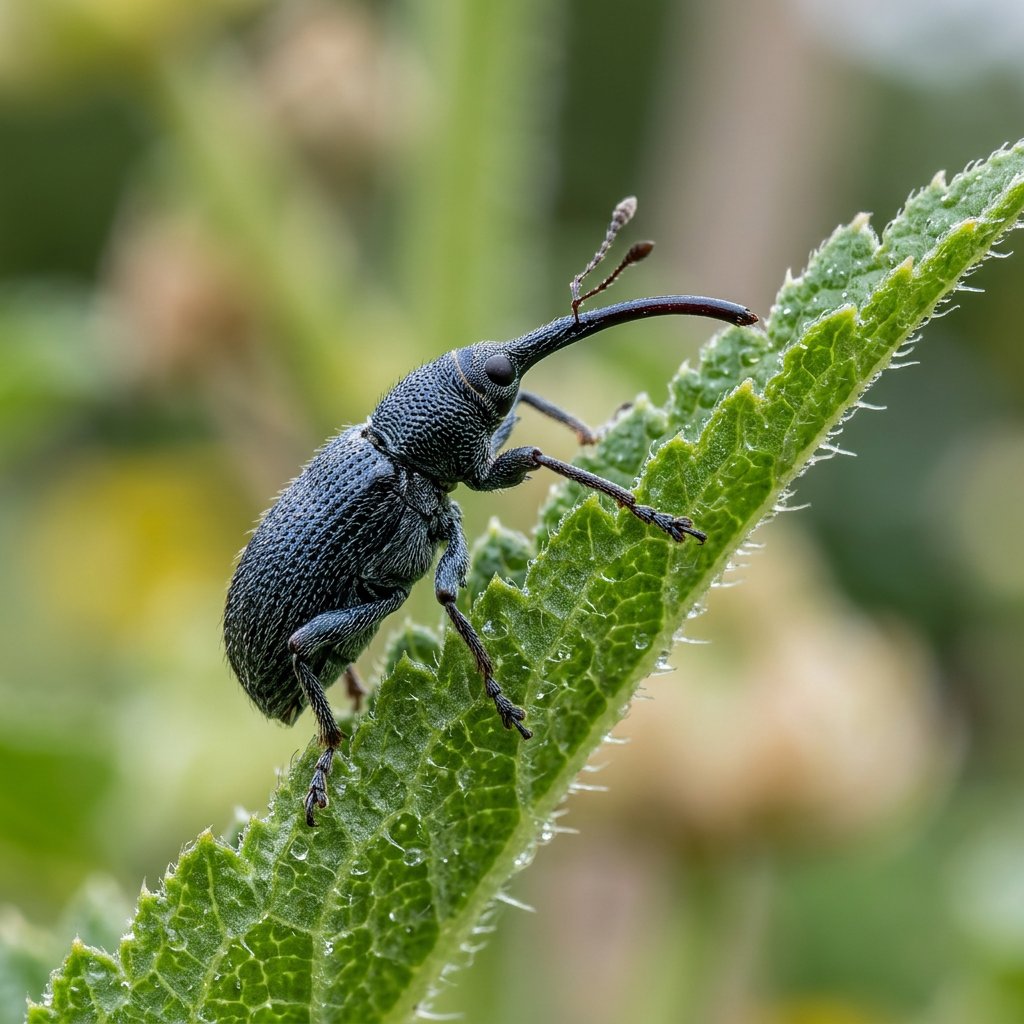
Meet the Hollyhock Weevil, a tiny, charismatic specialist with a "nose" that would make Pinocchio jealous. Originally from the Mediterranean, this little beetle has traveled the world wherever hollyhocks are grown. While some gardeners view them as a nuisance, they are fascinating examples of evolutionary precision, perfectly designed to exploit a single type of plant.
🔍 How to Identify
- 👃 The Long Snout: Their most defining feature is the rostrum—an incredibly long, needle-thin snout. In females, this "nose" can be nearly as long as their entire body!
- 🥾 Orange Boots: While their bodies are a matte, dusty gray or black, their legs are a contrasting bright orange-tan, making them easy to spot against green leaves.
- 🍐 Pear-Shaped Body: They have a robust, teardrop-shaped body covered in very fine, short hairs that give them a slightly fuzzy or velvety appearance under a magnifying glass.
🌲 Habitat & Ecology
- 🌸 The Hollyhock Specialist: You will almost exclusively find these insects on Alcea (Hollyhock) plants. They are host-specific, meaning they rely on this specific flower to complete their life cycle.
- 🏗️ Master Driller: The female uses her long snout to drill deep holes into the flower buds. She then turns around and lays her eggs inside, ensuring her larvae have a safe, food-filled nursery right among the developing seeds.
- 🍃 Garden Signature: If you see tiny, perfectly circular "shot holes" in your hollyhock leaves or notice that your seed pods are empty and dusty, you likely have a colony of these weevils nearby.
⚠️ Safety & Toxicity
- 🛡️ Harmless to Humans: Despite their intimidating "spear-like" snouts, Hollyhock Weevils are completely harmless. They do not bite, sting, or carry any diseases.
- 🐶 Pet Friendly: They are non-toxic to cats and dogs. If a curious pet happens to snack on one, there is no cause for alarm.
- 🌿 Plant Impact: While they are "foes" to the seeds of your hollyhocks, they rarely cause enough damage to kill the plant itself. They are more of a cosmetic nuisance than a deadly threat.
✨ Fun Fact
- ⭐ Tiny Mandibles: Even though it looks like a long needle, the tip of that snout actually contains tiny, functioning mouthparts. It works less like a straw and more like a miniature power drill with teeth at the end!
More Details








