Info
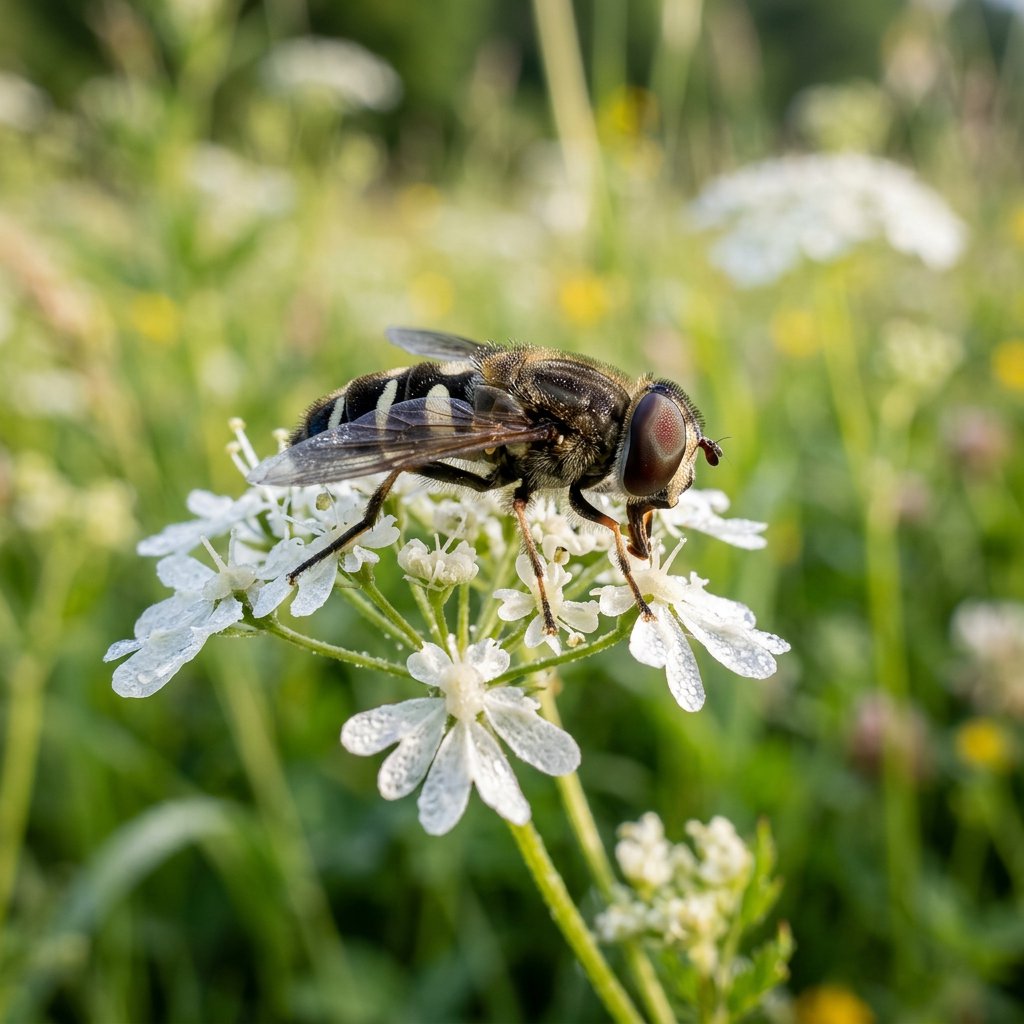
Often called the Great Pied Hoverfly, this master of disguise is one of the gardener’s most valuable allies. While its bold black-and-white stripes might make it look like a wasp at first glance, it is actually a harmless fly that excels at two things: aerial acrobatics and pest control. These "stealth bombers" of the insect world are famous for their ability to hover perfectly still in mid-air before darting away in the blink of an eye.
🔍 How to Identify
- ⚪ The "Comma" Marks: The most defining feature is the three pairs of creamy-white, comma-shaped marks on its dark abdomen. Unlike wasps, these markings do not meet in the middle.
- 🪰 The Face and Eyes: It has massive, reddish-brown compound eyes that take up most of its head. In males, the eyes actually touch at the top, while in females, they are slightly separated.
- ✨ Thorax Texture: The mid-section (thorax) is a shiny, metallic olive-green or bronze color and is covered in fine, downy hairs.
🌲 Habitat & Ecology
- 🌿 The Aphid Assassin: While the adults enjoy sipping nectar from flowers like Fennel or Daisies, their larvae are voracious predators. A single larva can consume hundreds of aphids during its development, making them better for your roses than many store-bought sprays.
- 🗺️ The Great Migration: These aren't just local residents; they are impressive travelers. Many individuals migrate hundreds of miles across seas and mountain ranges to find the best breeding grounds, often arriving in large "pulses" during the summer.
⚠️ Safety & Toxicity
- ✅ Status: Completely harmless.
- 🛡️ The Great Bluff: This insect is a "Batesian mimic," meaning it evolves to look like a stinging wasp to scare off birds. However, it has no stinger, cannot bite humans, and possesses no venom. It is a gentle pollinator that is safe to have around children and pets.
✨ Fun Fact
Unlike many other hoverflies, Scaeva pyrastri has tiny hairs on its eyes! You would need a magnifying glass to see them, but these "hairy eyes" help distinguish it from its many lookalike cousins.
More Details








