Info
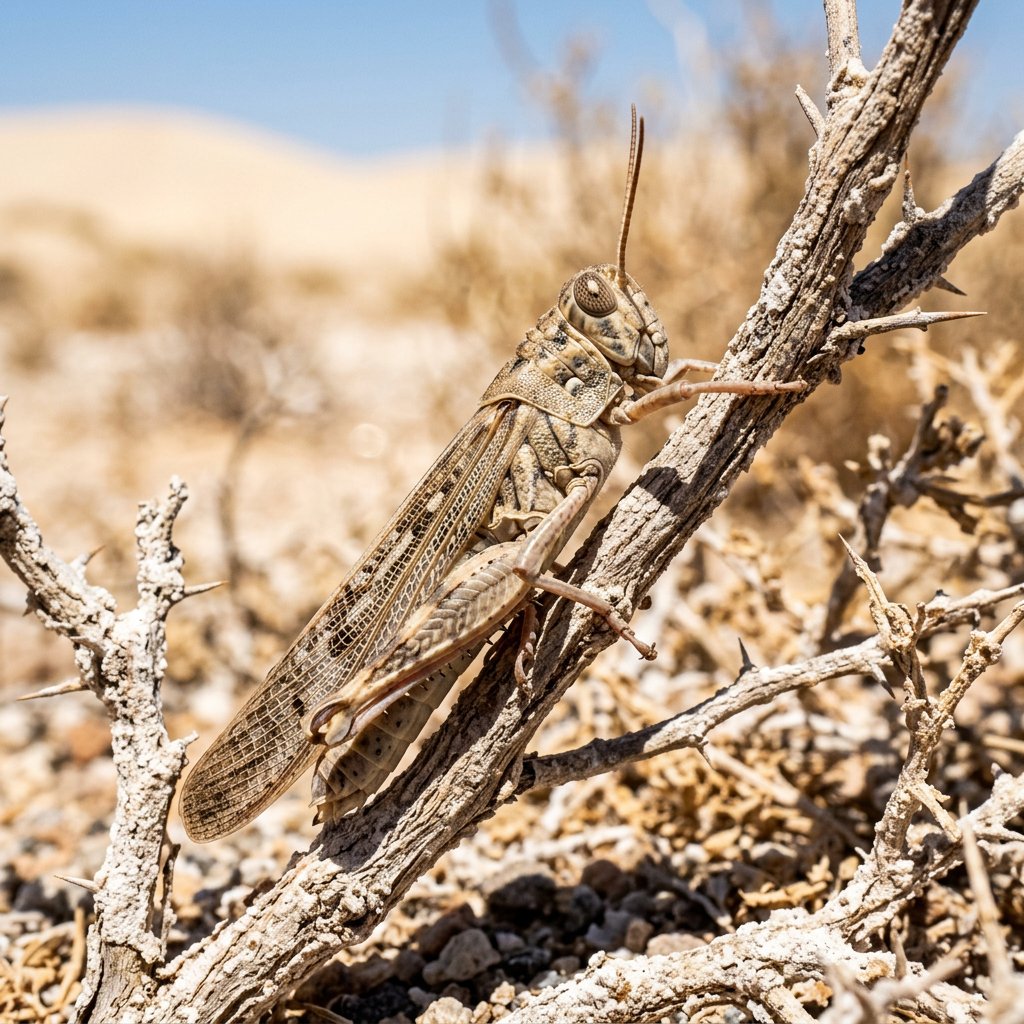
Often called the "Desert Locust," this insect is the stuff of ancient legends and modern agricultural nightmares. While it starts life as a shy, solitary grasshopper, a shift in population density triggers a "Dr. Jekyll and Mr. Hyde" transformation. This biological switch turns a lonely insect into a ravenous, swarming traveler capable of crossing oceans and changing its entire body color.
🔍 How to Identify
- 🦟 Wings: Long, translucent forewings that extend well beyond the tip of the abdomen, providing the aerodynamic power needed for long-distance migration.
- 🎨 The "Phase" Colors: In their solitary phase, they are usually a camouflaged green or drab brown. When they enter the "gregarious" (swarming) phase, they turn a bright, cautionary yellow with distinct dark markings.
- 🦵 Powerful Hind Legs: Like most grasshoppers, they possess large, muscular back legs designed for high-impact jumping to escape predators before taking flight.
🌲 Habitat & Ecology
- 🌪️ Master of Winds: These insects don't just fly; they hitch rides on the wind to travel up to 90 miles in a single day. They are primarily found in the arid and semi-arid regions of Africa, the Middle East, and Southwest Asia.
- 🍴 The Ultimate Generalist: A Desert Locust is not a picky eater. A single swarm can consume as much food in one day as 35,000 people, devouring everything from cereal crops and ornamental garden plants to the bark of trees.
- 🌵 Drought Survival: They are specialists in surviving harsh environments, laying their eggs in moist sand after rare desert rains to ensure their offspring have fresh greenery to eat upon hatching.
⚠️ Safety & Toxicity
- 🛡️ Safe for Humans: The Desert Locust does not sting, and they do not possess venom. They are generally not aggressive toward people or household pets.
- 🌾 Agricultural Threat: While they won't bite you, they are a major threat to food security. If you see them in large numbers in a garden, they can strip every leaf from a plant in minutes.
- 🚫 Chemical Warning: In areas where swarms are managed, locusts may be sprayed with pesticides. It is best to avoid handling them in regions where active control measures are being taken.
✨ Fun Fact
The transformation from a solitary grasshopper to a swarming locust is triggered by touch! When locusts are forced together by a lack of food, their hind legs bump into each other. This physical stimulation releases serotonin in their brains, causing them to change color and seek out the company of a swarm within mere hours.
More Details








