Info
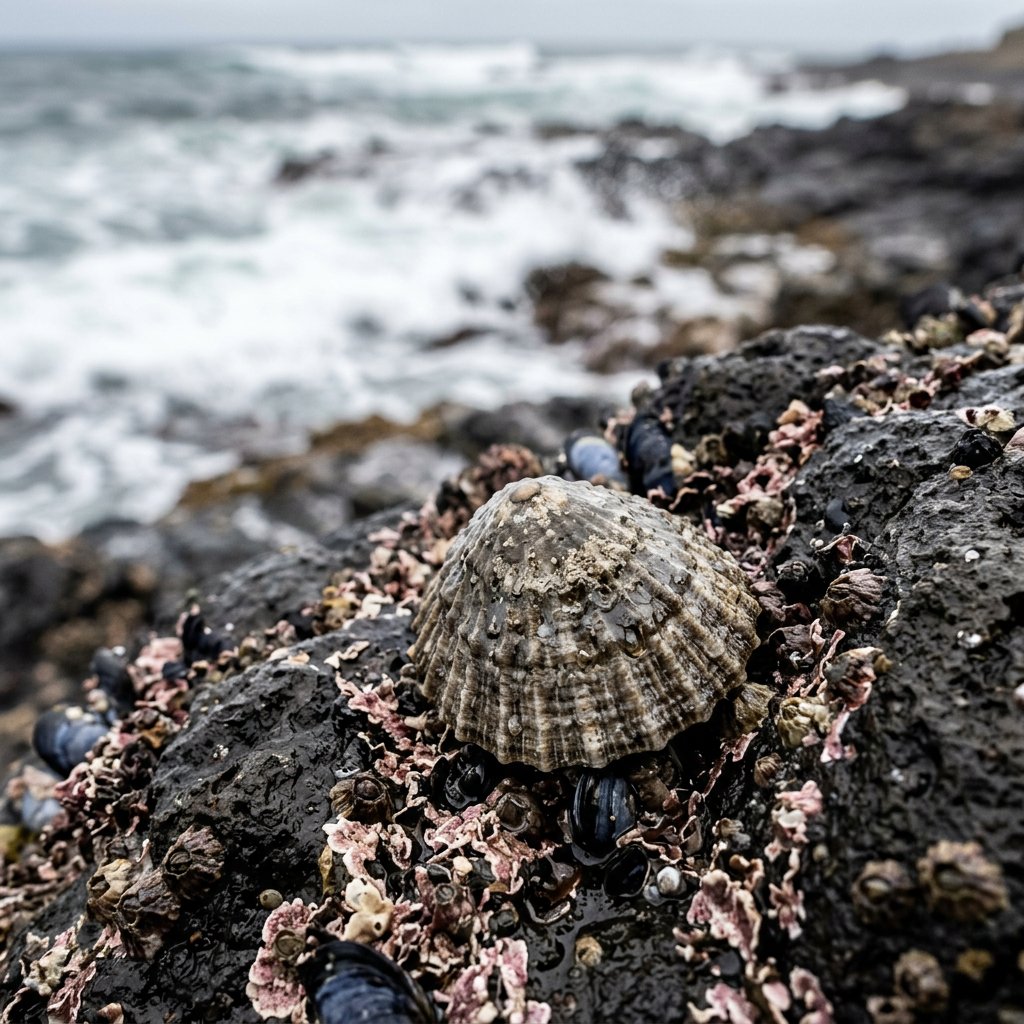
Known as Peron’s Limpet, this rugged coastal dweller is often mistaken for a fossil or a strange armored beetle by beachgoers. While it may look like an "ocean bug" at first glance, it is actually a highly specialized marine mollusk. Native to the southern coasts of Australia, it spends its life as a master of the "intertidal zone," defying the crashing waves by clinging to rocks tighter than any industrial glue.
🔍 How to Identify
- 🐚 The Ribbed Shell: Its most striking feature is its sunburst-like shape, featuring 15 to 20 thick, radiating ridges that give it a star-shaped or "cogwheel" appearance.
- 🖐️ The Muscular Foot: If flipped over (which is quite difficult!), you’ll see a large, fleshy, orange or cream-colored "foot" that acts as a powerful suction cup.
- 🎨 Camouflaged Colors: The exterior is typically a weathered off-white or grey, often covered in a thin layer of green algae to help it blend in with the rocky reef.
🌊 Habitat & Ecology
- 🌊 The High-Energy Zone: These creatures live primarily on rocky shores where wave action is intense. Their low-profile, aerodynamic shell allows water to flow over them without knocking them loose.
- 🥗 The Tiny Lawnmower: Despite being slow, they are active grazers. At high tide, they crawl across the rocks using a "radula" (a tongue-like organ with tiny teeth) to scrape off microscopic algae and biofilm.
- 🏠 Home Scarring: They are famous for "homing" behavior. After a night of foraging, they return to the exact same spot on a rock, eventually wearing a perfect circular groove into the stone that fits their shell like a lock and key.
⚠️ Safety & Toxicity
- ✅ Harmless: Peron’s Limpet is non-venomous and does not bite or sting. It is safe for curious children and beachcombers to observe.
- 🐚 Sharp Ridges: While the animal is harmless, the shell's ridges can be quite sharp. Handlers should be careful not to scrape their fingers, especially if the shell has become encrusted with sharp barnacles.
- 🚫 Avoid Prying: Never try to force a limpet off a rock with your fingernails or tools. Not only can you crack their shell, but the suction is so strong you are more likely to injure the animal’s internal organs before it lets go.
✨ Fun Fact
The teeth on a limpet's radula are considered one of the strongest biological materials known to man—even stronger than spider silk! They contain a mineral called goethite, which allows them to scrape food off solid rock without wearing their teeth down.
More Details








