Info
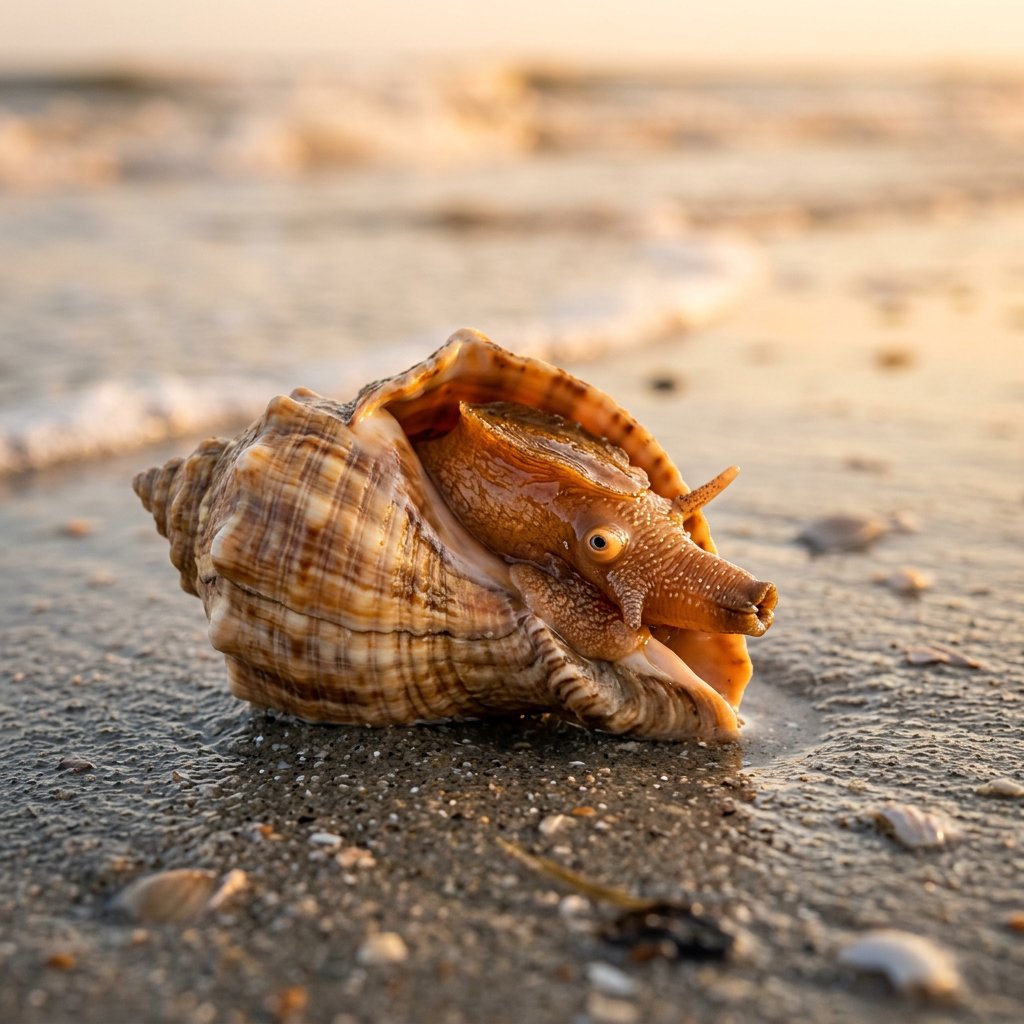
Often mistaken for a common garden snail or a strange aquatic "bug" due to its name, the Lightning Whelk (Sinistrofulgur sinistrum) is actually a magnificent predatory sea snail. It is most famous for being "left-handed," meaning its shell spirals in the opposite direction of almost every other snail on Earth. As the state shell of Florida, it holds a prestigious place in coastal history and folklore.
🔍 How to Identify
- 🐚 Left-Handed Opening: If you hold the shell with the point facing up, the opening (aperture) will be on the left side. This "sinistral" growth is its most defining feature.
- ⚡ Lightning Patterns: The shell is typically a creamy gray or tan, decorated with long, jagged, reddish-brown streaks that look like lightning bolts.
- 🍐 Pear-Like Shape: It has a wide, heavy body that tapers down into a long, elegant "tail" known as the siphonal canal.
🌊 Habitat & Ecology
- 🏖️ Coastal Prowlers: These mollusks prefer the shallow, sandy, or muddy bottoms of bays and estuaries. They are frequently spotted by beachcombers at low tide along the Gulf of Mexico and the South Atlantic coast.
- 🐌 A Patient Predator: They are not scavengers; they are carnivores. The Lightning Whelk uses the edge of its heavy shell like a pry bar to force open the shells of clams and oysters before consuming the soft animal inside.
⚠️ Safety & Toxicity
- ✅ Harmless to Humans: They are entirely non-venomous and do not bite or sting. They are safe for curious beach-goers to observe.
- 🐚 Physical Hazard: The main "danger" comes from the shell itself. Large specimens are very heavy, and broken shells on the beach can be razor-sharp, posing a risk for bare feet.
- 🐾 Pet Safety: While not toxic, pet owners should ensure dogs don't try to chew on the shells, as the hard, calcified material can break teeth or cause internal blockages if swallowed.
✨ Fun Fact
Native American tribes once considered the Lightning Whelk a sacred object. Because its "left-handed" spiral follows the direction of the sun across the sky in the northern hemisphere, it was often used as a ritual drinking cup or carved into beautiful jewelry known as gorgets.
More Details








