Info
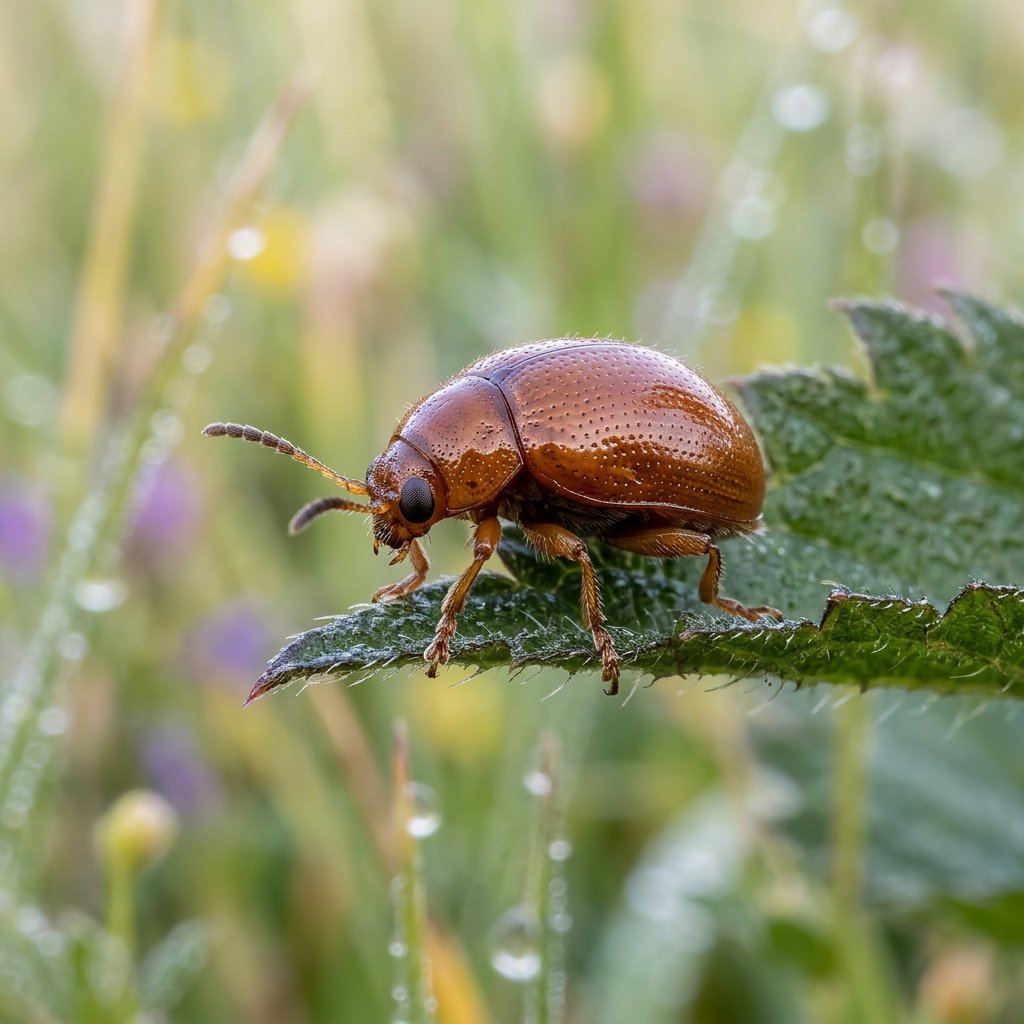
Known as the "Globe Leaf Beetle" or "Artichoke Flea Beetle," the Sphaeroderma is nature’s tiny, jumping orange bead. These beetles are masters of disguise, often mistaken for small, unspotted ladybugs or even seeds due to their perfectly hemispherical shape. While they might nibble on your garden thistles or artichokes, they are fascinating acrobats that rely on powerful "spring-loaded" legs to vanish in the blink of an eye when a predator approaches.
🔍 How to Identify
- 🐞 The Shape: They have a distinctively convex, dome-like body that looks like a tiny half-sphere (which is where the name Sphaeroderma, or "Sphere-skin," comes from).
- 🟠 The Color: Most species are a shiny, uniform reddish-orange or tawny yellow, lacking the spots found on ladybugs.
- 🦵 The Jumpers: Look closely at the hind legs; they have significantly thickened thighs (femurs) designed for explosive jumping, much like a flea.
🌲 Habitat & Ecology
- 🍽️ The Leaf Miners: While the adults chew small holes in leaves, the larvae are "leaf miners." They live entirely inside the layers of a leaf, eating the soft green tissue and leaving behind winding brown trails.
- 🌿 Favorite Hosts: They are highly specialized and are most commonly found on members of the Asteraceae family, particularly thistles, artichokes, and knapweeds.
- 🛡️ Defense Strategy: When threatened, they don't just fly; they use their high-pressure leg muscles to catapult themselves away, making them very difficult for collectors or predators to catch.
⚠️ Safety & Toxicity
- ✅ Status: Completely harmless to humans and pets.
- 🚫 No Sting or Bite: These beetles do not possess any venom, stingers, or mouthparts capable of piercing human skin. They are "foes" only to your artichoke plants, and even then, they rarely cause enough damage to kill a healthy plant.
✨ Fun Fact
Despite their tiny size (usually only 2–4mm), a Flea Beetle can jump over 50 times its own body length to escape danger—the human equivalent of leaping over a 30-story building!
More Details








