Info
Known as the Wild Cherry Sphinx, this impressive moth is a master of stealth that blends seamlessly into the bark of its favorite fruit trees. As a member of the hawkmoth family, it is a powerful, aerodynamic flyer often mistaken for a hummingbird when it hovers over flowers at dusk. While its large, "horned" caterpillar might look like a miniature dragon, this insect is a gentle giant of the orchard and woodland edge.
🔍 How to Identify
- 🦋 Bark-Like Wings: The forewings are long and narrow, featuring a sophisticated pattern of ash-gray, charcoal, and white streaks that perfectly mimic wood grain.
- 🖤 Velvet Thorax: It features a distinct dark, brownish-black patch on its "shoulders" (thorax), which is often framed by lighter gray borders.
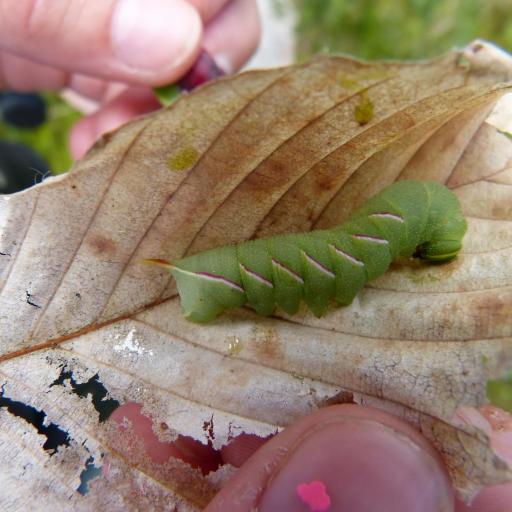
- 🐛 The "Horned" Larva: The caterpillar is a vibrant lime green with seven diagonal white stripes—frequently edged with lavender or purple—and a sharp-looking black horn on its rear end.
🌲 Habitat & Ecology
- 🍒 Orchard Specialist: You are most likely to find them near wild cherry, plum, apple, or hawthorn trees. The caterpillars are specialized feeders that rely on the foliage of the Rosaceae family to grow.
- 🌙 Nighttime Acrobat: Adults are strictly nocturnal. They emerge at twilight to seek out pale, fragrant flowers that stay open at night, using their incredibly long tongues (proboscis) to drink nectar while hovering mid-air.
⚠️ Safety & Toxicity
- ✅ Harmless: Both the adult moth and the caterpillar are completely non-toxic and incapable of stinging or biting.
- 🛡️ The Horn Bluff: The "horn" on the caterpillar's tail is a soft, fleshy appendage used solely to scare off predators like birds. It is not a stinger and poses no threat to curious children or pets.
✨ Fun Fact
Sphinx moths are the "fighter jets" of the insect world. The Wild Cherry Sphinx can reach flight speeds of nearly 12 miles per hour, and their rapid wingbeats are so powerful they can be heard as a low-frequency hum by human ears!
More Details








