Info
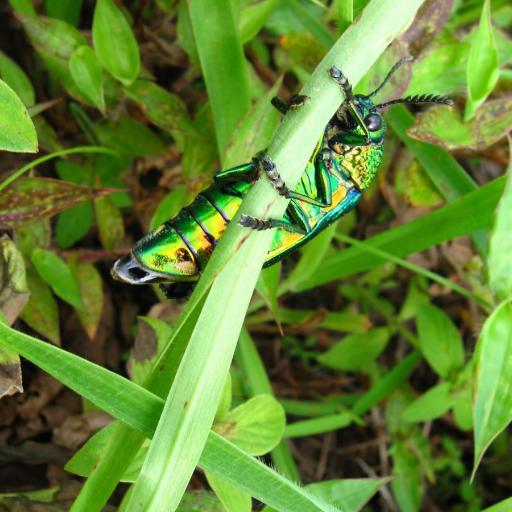
Known as the living emeralds of the insect world, Sternocera beetles—often called "Jewel Beetles"—are famous for their breathtaking, metallic shells. These robust insects have been prized for centuries, with their discarded wing covers used to decorate royal textiles and intricate jewelry in Asia and Africa. Watching one fly in the sunlight is like seeing a polished gemstone take flight.
🔍 How to Identify
- 💎 Iridescent Elytra: Their wing covers (elytra) are thick, hard, and display a brilliant metallic luster, typically in shades of emerald green, deep blue, or copper.
- 🪲 Bullet-Shaped Body: They possess a large, sturdy, and cylindrical body shape, often growing up to 2 inches (5 cm) in length, making them quite easy to spot.
- 🕳️ Punctured Texture: If you look closely at their shells, they are often covered in tiny, microscopic pits or "punctures" that give their metallic sheen a unique, textured depth.
🌲 Habitat & Ecology
- ☀️ Sun Worshipers: These beetles are highly active during the hottest parts of the day. They rely on the sun's heat to energize their flight muscles, often shimmering on the high branches of trees.
- 🍃 Tree Specialists: Adult Sternocera are typically found in dry woodlands or tropical forests, where they feed on the leaves of specific host trees, such as Acacia.
- 🪵 Wood Recyclers: As larvae, they live underground or within decaying wood, playing a vital role in the ecosystem by breaking down organic matter and cycling nutrients back into the soil.
⚠️ Safety & Toxicity
- ✅ Harmless: Sternocera beetles are "gentle giants." They do not have stings, and their mouthparts are designed for chewing leaves, not biting humans.
- 🛡️ Armor Defense: Their primary defense is their incredibly hard exoskeleton and their ability to quickly drop to the forest floor and "play dead" when they feel vibrations from a predator.
- 🐾 Pet Interaction: While they are non-toxic, their shells are exceptionally hard. If a pet tries to eat one, it could potentially cause a choking hazard or minor digestive irritation due to the tough chitin.
✨ Fun Fact
In the 19th century, the "Beetle-wing" embroidery style became a high-fashion trend in Europe; thousands of Sternocera wing cases were exported from India to be sewn onto lace dresses, creating a natural "sequin" that never fades or loses its shine.
More Details








