Info
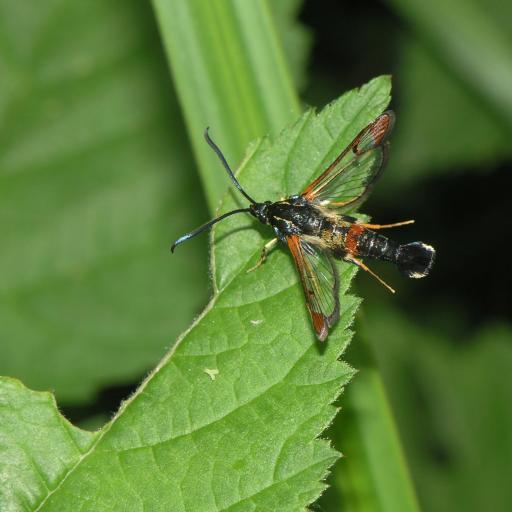
The Red-tipped Clearwing is a master of disguise and a true "wolf in sheep’s clothing"—or rather, a moth in a wasp’s costume. Often mistaken for a stinging insect due to its transparent wings and slender body, this day-flying moth spends its life dancing around willow trees. Its scientific name, formicaeformis, literally translates to "ant-shaped," highlighting its incredible ability to mimic other insects to avoid being eaten.
🔍 How to Identify
- 🪟 Transparent Wings: Unlike most moths covered in thick scales, this species has large "clear" windows in its wings, making it look more like a wasp or a fly at first glance.
- 🔴 Crimson Wingtips: The most defining feature is the vibrant red-orange patch at the very tips of the forewings, which gives the insect its common name.
- 🐜 Slender Abdomen: It possesses a dark, elongated body often marked with a thin red band, further enhancing its mimicry of a slender wasp or ant.
🌲 Habitat & Ecology
- 🌿 Willow Specialist: You will almost always find this insect near water or in damp meadows where Willows (Salix species) grow. The larvae are "wood-borers," living inside the twigs and stumps of willow trees.
- ☀️ Sunlight Lover: While most moths are creatures of the night, the Red-tipped Clearwing is strictly diurnal. It is most active in bright afternoon sunshine, darting between flowers to feed on nectar.
⚠️ Safety & Toxicity
- 🛡️ Completely Harmless: Despite its intimidating "wasp-like" appearance, this insect has no stinger and cannot bite. It is a gentle pollinator that relies entirely on its looks for protection.
- 🌳 Minor Garden Pest: While the larvae tunnel into willow wood, they typically target already damaged branches or "galls" caused by other insects, rarely causing enough damage to harm a healthy tree.
✨ Fun Fact
Because these moths are so difficult to spot with the naked eye, scientists often use "chemical trickery" to find them. They use synthetic pheromones that mimic the scent of a female moth, luring the males out of hiding from deep within the willow thickets!
More Details








