Info
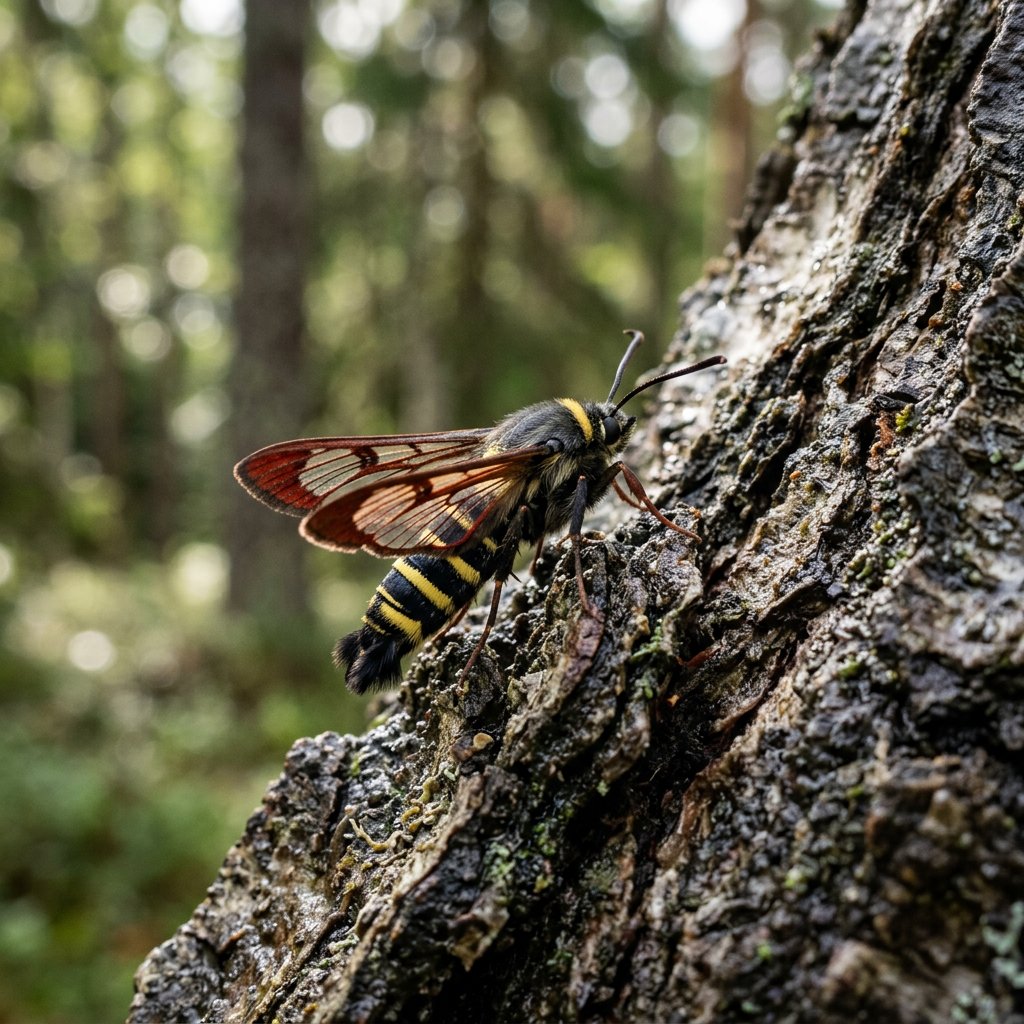
The Welsh Clearwing is a master of disguise and one of the most elusive gems of the insect world. Often mistaken for a stinging wasp at first glance, this harmless moth uses "Batesian mimicry" to scare off predators while it searches for its favorite birch trees. It is a rare sight, prized by nature enthusiasts for its striking colors and "clear" architectural wings.
🔍 How to Identify
- 🦋 The Wings: Unlike most moths, their wings are largely transparent with dark, delicate veins and a bold black spot near the center, giving them a glass-like appearance.
- 🐝 Body Mimicry: The body is slender and dark blue-black, marked by two distinct thin yellow bands on the abdomen, perfectly imitating the look of a narrow-waisted wasp.
- 🧶 The Tail Tuft: One of its most identifying features is a large, bushy orange-red "fan" at the tip of the tail, which it often pulses or spreads while resting.
🌲 Habitat & Ecology
- 🌳 The Birch Connection: This moth is a specialist that relies almost exclusively on old, mature Birch trees (Betula). The females lay eggs in the crevices of rough bark, particularly on trees that get plenty of sunlight.
- 🕰️ Life in the Dark: The larvae are "wood-borers," spending two to three years eating the inner bark and wood of the tree. You can often tell they are present by looking for small, neat exit holes at chest height on birch trunks.
- ☀️ Sun Lovers: Adults are active during the day, especially in the warmth of the morning sun, though they are notoriously difficult to spot as they spend much of their time high in the canopy.
⚠️ Safety & Toxicity
- ✅ Status: Completely harmless.
- 🛡️ The Great Bluff: While the Welsh Clearwing looks like it possesses a formidable stinger, it has no biting or stinging parts. It is entirely safe for humans and pets; its "scary" look is purely a survival strategy to avoid being eaten by birds.
✨ Fun Fact
The Welsh Clearwing is so difficult to find that scientists often use "perfume traps." They use synthetic pheromones that mimic the scent of a female moth to lure the elusive males out of the treetops so their populations can be studied and protected!
More Details








