Info
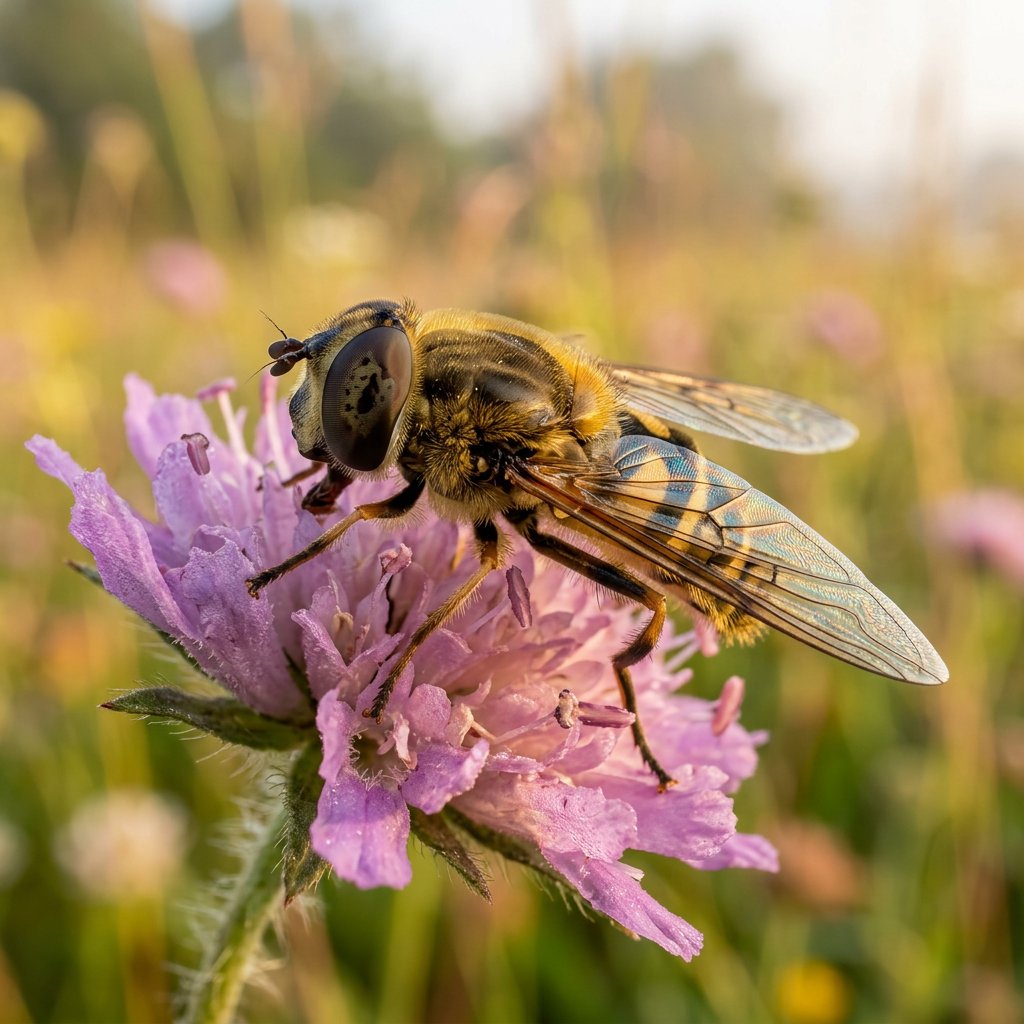
Often called the Common Hoverfly or the Glass-wing Hoverfly, this little aviator is a master of disguise. While it wears the flashy "caution" colors of a wasp to scare off predators, it is actually a harmless, nectar-loving gardener’s assistant. If you see one suspended perfectly still in mid-air before darting away, you’ve just met one of nature’s most precise pilots.
🔍 How to Identify
- 👀 The Eyes: Like most hoverflies, they have massive, wrap-around compound eyes that take up most of their head, giving them 360-degree awareness.
- 🎨 The "Wasp" Pattern: The abdomen features bold yellow bands on a black background. A key identifier for S. vitripennis is that the yellow bands often reach the very edge of the abdominal segments.
- 🪽 Glassy Wings: True to its name (vitripennis means "glass-wing"), its wings are exceptionally clear and lack the smoky tint found in some of its cousins.
- 🦵 The Dark Leg: To tell it apart from its near-identical twin (Syrphus ribesii), look at the hind legs; in S. vitripennis, the base of the hind femur is usually black.
🌲 Habitat & Ecology
- ⚔️ Aphid Assassins: While the adults enjoy sipping nectar from daisies and cow parsley, their larvae are voracious predators. A single larva can consume hundreds of aphids before it pupates, making them a "biological pesticide" for your roses.
- 🚁 Aerial Acrobatics: They are famous for their ability to "hover" in one spot despite wind gusts, a feat made possible by flapping their wings up to 300 times per second in a figure-eight motion.
- 🌼 Pollination Power: They are secondary only to bees in their importance as pollinators. They are particularly attracted to flat, open flowers where nectar is easy to reach with their short mouthparts.
⚠️ Safety & Toxicity
- ✅ Total Friend: Despite the yellow-and-black "danger" suit, they have no stinger and cannot bite. They are completely safe to have in the garden.
- 🛡️ Mimicry: Their only defense is "Batesian mimicry"—looking like something that hurts (a wasp) so that birds leave them alone. They are essentially the ultimate "all bark and no bite" of the insect world.
✨ Fun Fact
Hoverflies are the inspiration behind some of the world's most advanced micro-drone technology! Scientists study their "halteres" (tiny knob-like structures behind the wings) to understand how they maintain such incredible stability and balance during high-speed maneuvers.
More Details








