Info
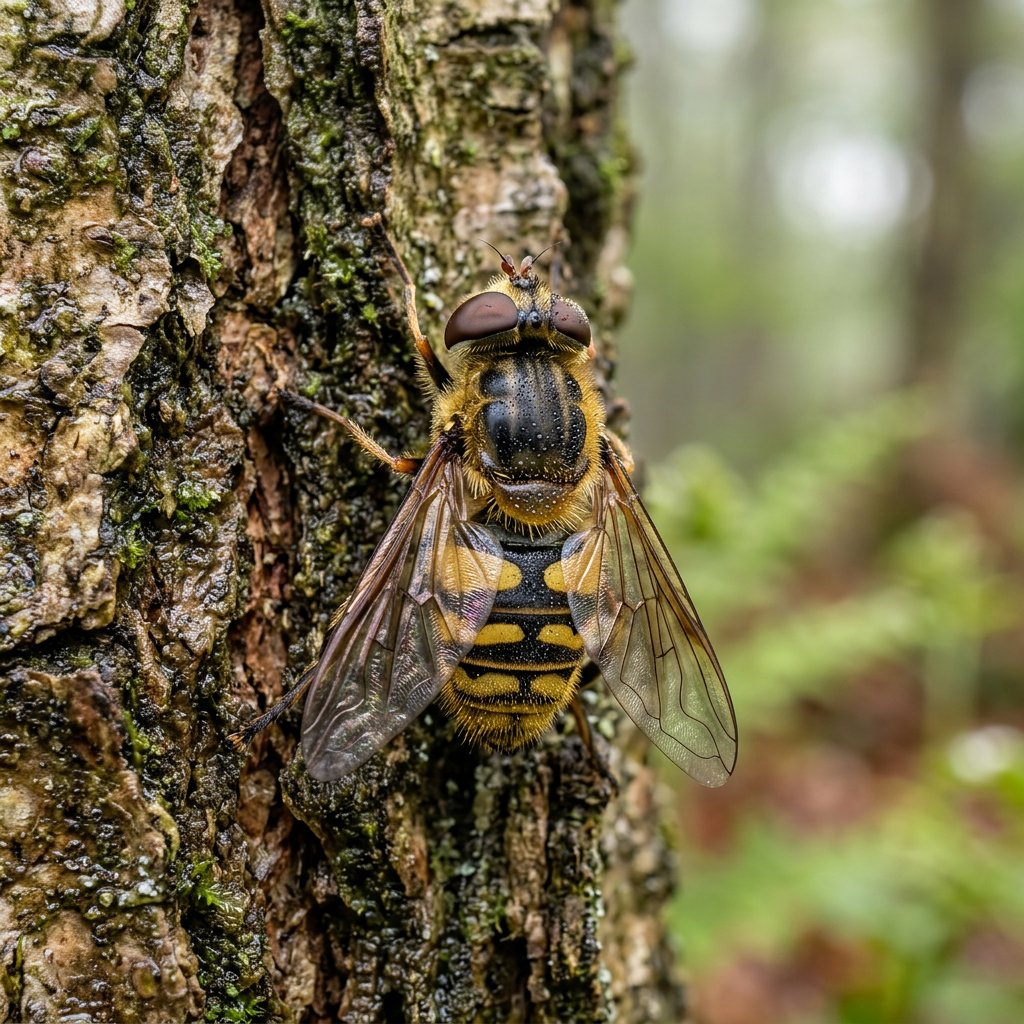
Meet the master of disguise. The Temnostoma vespiforme is a hoverfly that has perfected the art of "Batesian mimicry"—the biological equivalent of wearing a high-quality Halloween costume to scare off bullies. While it looks like a fierce yellowjacket, it is actually a gentle visitor to your garden that spends its life imitating those who can actually sting.
🔍 How to Identify
- 🪰 The Great Pretender: It features bold, bright yellow bands on a black body, perfectly mimicking the warning colors of a social wasp.
- 👀 Fly Eyes: Look closely at the head; unlike wasps, which have smaller eyes and long antennae, this fly has massive, wrap-around eyes and very short antennae.
- 🦵 The Front-Leg Wave: To sell the "wasp" look, it often holds its dark-colored front legs out and waves them in front of its head to mimic the long, twitching antennae of a real wasp.
- ✈️ Stationary Flight: As its name suggests, it can hover perfectly still in mid-air—a feat most wasps cannot perform with such precision.
🌲 Habitat & Ecology
- 🪵 The Recycler: The larvae (maggots) of this fly are "saproxylic," meaning they live inside moist, decaying wood. They are particularly fond of fallen birch or beech logs, where they help break down timber back into the soil.
- 🌸 Floral Diet: As adults, they leave the logs behind to search for nectar and pollen. They are excellent pollinators and are frequently seen hovering around wild flowers in sun-dappled forest clearings.
- 🌳 Forest Bound: You are most likely to spot them in or near old-growth forests or wooded parks where dead wood is left to rot naturally.
⚠️ Safety & Toxicity
- 🛡️ Harmless Bluff: This insect is 100% harmless. It has no stinger, no venom, and no interest in your food. It relies entirely on its "scary" appearance to keep birds and humans at a distance.
- 🐶 Pet Safe: Because it doesn't sting or bite, it poses no threat to curious dogs or cats who might try to snap at it.
✨ Fun Fact
The Temnostoma vespiforme is so committed to its act that it even mimics the sound of a wasp. By vibrating its wings at a specific frequency, it produces a low-pitched buzz that mimics the "angry" tone of a stinging insect to further discourage predators!
More Details








