Info
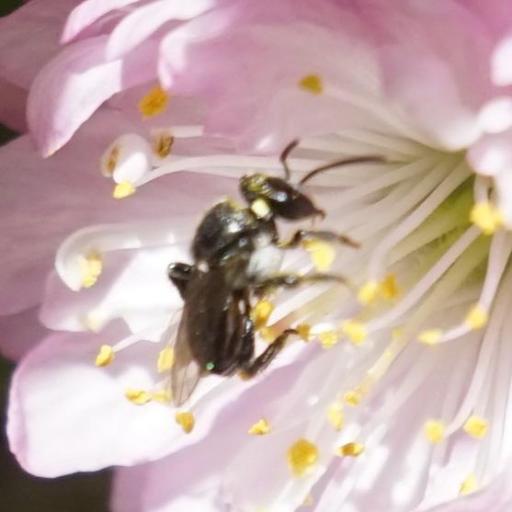
Known affectionately as the Sugarbag Bee, Tetragonula carbonaria is Australia’s most famous stingless bee. Though often mistaken for a tiny black fly at first glance, these remarkable insects are social engineers that create one of the most beautiful structures in the natural world: a perfect geometric spiral honeycomb. They have been cherished for thousands of years by Indigenous Australians for their unique, tangy "sugarbag" honey.
🔍 How to Identify
- 🐝 Miniature Profile: They are incredibly small, usually measuring only 4–5 mm in length. Unlike the bulky, fuzzy European honeybee, these are sleek and jet-black.
- 🌀 Spiral Architecture: The most definitive way to identify them is by their hive; they build their brood cells in a distinct, mesmerizing clockwise or counter-clockwise spiral.
- 🦵 Pollen Baskets: Look closely at their hind legs; you will often see large, visible clumps of bright yellow or orange pollen being carried back to the colony.
🌲 Habitat & Ecology
- 🌺 Master Pollinators: These bees are vital to the Australian ecosystem. They are "generalist" foragers, meaning they visit a huge variety of native flowers, but they are especially famous for their work in macadamia orchards.
- 🪵 Hollow Homes: In the wild, they prefer nesting in the hollow trunks of ancient hardwood trees. In urban areas, they are popular "pets" kept in specialized wooden boxes (OATH boxes) by backyard conservationists.
⚠️ Safety & Toxicity
- ✅ Stingless Status: These bees are 100% stingless. They do not possess a functional stinger, making them completely safe to keep around children and curious pets.
- 🤏 Defensive Nipping: If their hive is physically attacked, they may swarm and "bite" or deposit sticky resin on the intruder. However, these nips are barely felt by humans and cause no lasting harm or irritation.
✨ Fun Fact
The spiral shape of their honeycomb is a mathematical marvel. Scientists believe that individual bees follow a simple set of local rules—much like a 3D printer—which results in the grand, complex fractal pattern without a single "architect" leading the way!
More Details








