Info
Known commonly as the Sword-grass Brown, this velvety Australian native is a master of the shadows. Often found fluttering through the dappled sunlight of damp forests, it earns its name from its caterpillars' obsession with the sharp-edged Gahnia grass. It is a peaceful resident of the bush, known for its striking "eyes" that seem to peer out from the undergrowth.
🔍 How to Identify
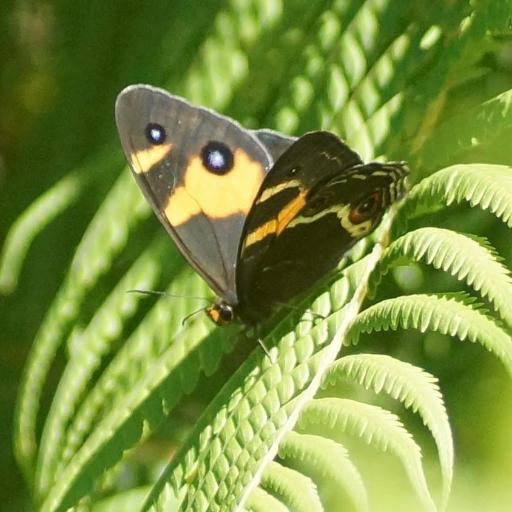
- 🦋 The Eyespots: Large, circular ocelli (eyespots) with blue centers and orange rings decorate both the forewings and hindwings, designed to startle hungry birds.
- 🎨 Wing Coloration: The base color is a deep, smoky chocolate brown, highlighted by bold creamy-orange bands that slice across the upper wings.
- 🍂 Underwing Camouflage: When its wings are closed, the underside is a muted, marbled brown, allowing the butterfly to vanish against dead leaves and tree bark.
🌲 Habitat & Ecology
- 🌿 Host Plant Specialist: This butterfly is a "specialist," meaning its life cycle depends almost entirely on Gahnia (Sword-grass). Without these tall, sharp-leaved sedges, the Sword-grass Brown cannot survive.
- 💧 Moisture Lovers: You will rarely find them in dry, open plains. They gravitate toward "wet sclerophyll" forests, swampy margins, and shaded creek lines where the air remains humid.
- 🕵️ Low-Level Flyers: Unlike many butterflies that soar high in the canopy, this species prefers to stay low to the ground, weaving through tall grasses and ferns in a distinctive, bobbing flight pattern.
⚠️ Safety & Toxicity
- ✅ Gentle Neighbor: The Sword-grass Brown is entirely harmless. It does not bite or sting, and it carries no toxins that would harm curious pets or children.
- 🛡️ Natural Defense: Its only defense is its "scare tactic" eyespots, which trick predators into thinking they are looking at the face of a much larger animal rather than a fragile insect.
✨ Fun Fact
The Sword-grass Brown is a favorite among scientists studying evolution! In areas where different subspecies meet, they create "hybrid zones" where the wing patterns blend together, resulting in unique, one-of-a-kind markings that vary from one gully to the next.
More Details








