Info
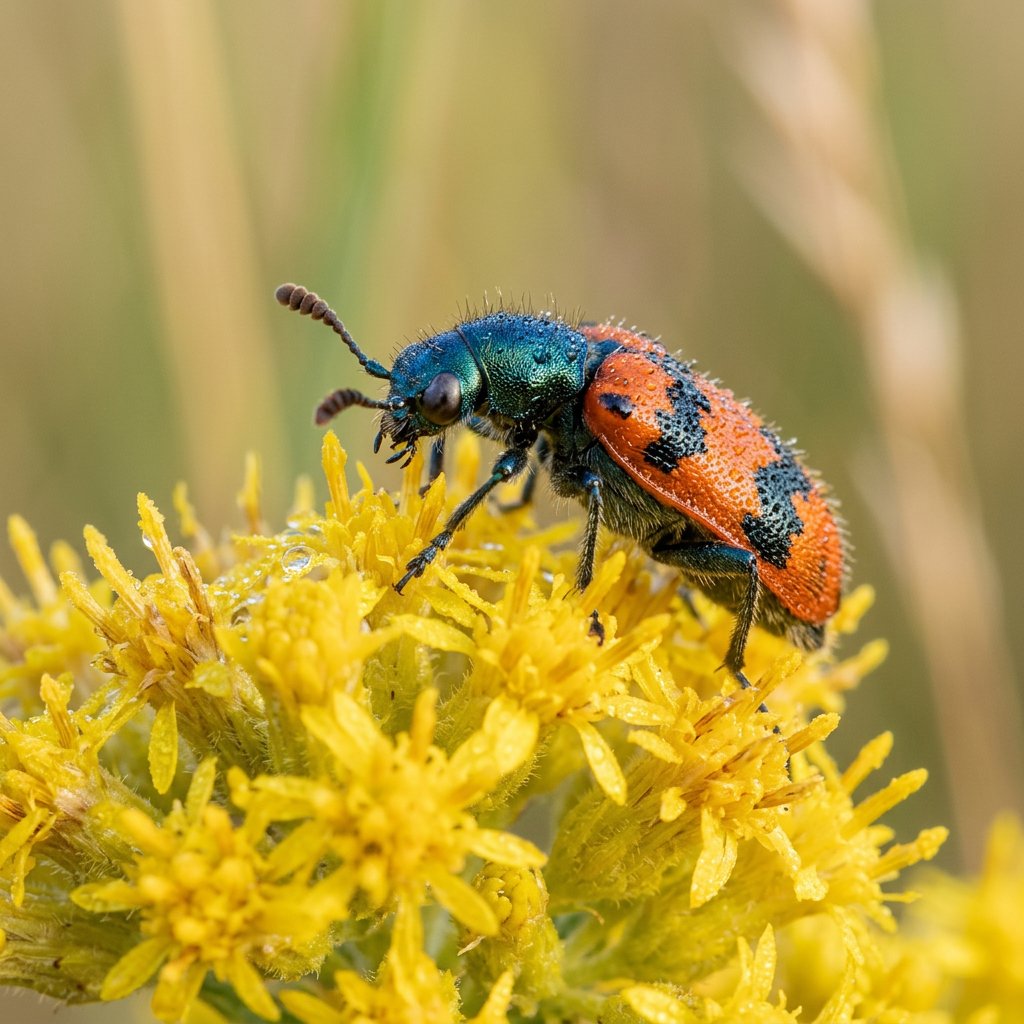
The Nuttall’s Checkered Beetle (Trichodes nutalli) is a tiny, living jewel often found sunbathing on prairie wildflowers. With its iridescent metallic body and striking "caution" stripes, it might look like a dangerous stinging insect at first glance, but it is actually a beneficial predator and pollinator. This beetle belongs to the Cleridae family, a group of insects celebrated by collectors for their intricate, woven-looking patterns.
🔍 How to Identify
- 🎨 Bold Patterning: The wing covers (elytra) are a deep, metallic violet-blue or black, interrupted by three distinct, wavy bands of bright orange or red.
- ☁️ Hairy Appearance: If you look closely, the entire body is covered in fine, erect hairs that help it collect pollen as it moves from flower to flower.
- 📏 Elongated Shape: It has a classic "checkered beetle" silhouette—long, narrow, and slightly cylindrical, usually reaching about 7 to 11 mm in length.
🌲 Habitat & Ecology
- 🌸 Flower Frequenters: You are most likely to spot adults on bright, flat-topped flowers like Goldenrod, Yarrow, or Daisies. They visit these blooms to feed on pollen and nectar, but they aren't strictly vegetarian—they will also snack on other small insects they encounter.
- 🐝 Nest Invaders: While the adults are peaceful sun-seekers, the larvae have a darker side. They are "cleptoparasites," meaning they live inside the nests of solitary bees and wasps, where they consume the host's larvae and the food stores provided for them.
⚠️ Safety & Toxicity
- ✅ Perfectly Safe: These beetles are completely harmless to humans. They do not sting, and they do not possess any potent venom or irritating sprays.
- 🌿 Garden Friend: They are considered beneficial insects in a garden setting because they help with pollination and their presence indicates a healthy, diverse local ecosystem. They pose no threat to pets or curious children.
✨ Fun Fact
The Nuttall’s Checkered Beetle uses "Batesian Mimicry." By sporting the high-contrast red and black colors of more dangerous insects like velvet ants or certain wasps, they trick birds and other predators into thinking they are a painful snack, even though they are actually quite defenseless!
More Details








