Info
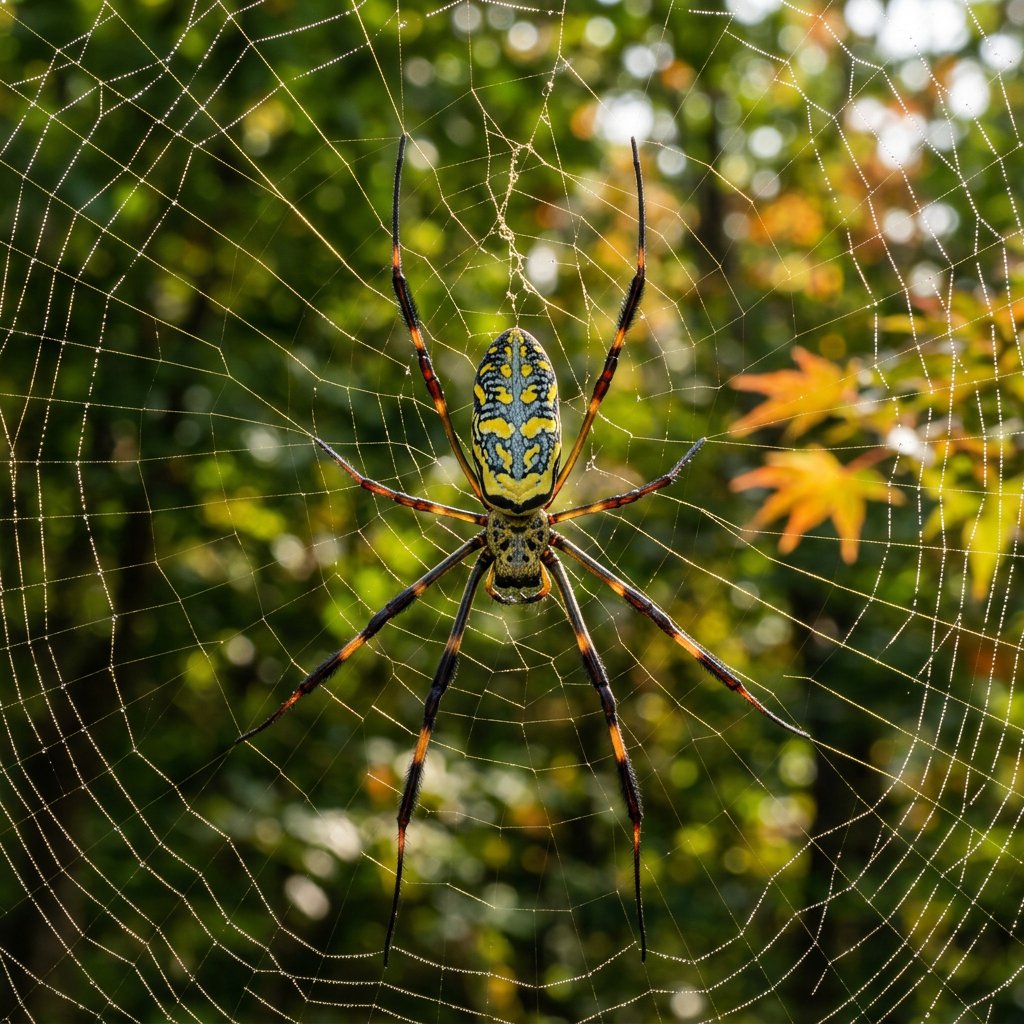
Meet the Joro Spider, a vibrant weaver that looks like it stepped out of a neon dream. Originally from East Asia, this striking orb-weaver has recently become a viral sensation due to its sudden appearance in the Southeastern United States. Named after the Jorōgumo of Japanese folklore, these spiders are famous for their massive, golden-tinted webs and their status as the "gentle giants" of the backyard.
🔍 How to Identify
- 🎨 The Abdomen: The female is unmistakable with a cylindrical body featuring bright yellow and bluish-gray horizontal bands, accented by a bold splash of red near the rear.
- 🕷️ The Legs: They possess long, spindly, jet-black legs decorated with bright yellow "rings" at the joints, giving them an elegant, high-contrast look.
- 🕸️ The Web: Look for massive, three-dimensional "orb" webs that can span several feet. In the right light, the silk has a distinct golden shimmer.
🌲 Behavior & Ecology
- 🦟 Pest Controller: The Joro is a gardener's best friend. They are one of the few predators that actively hunt and eat brown marmorated stink bugs, as well as mosquitoes and biting flies.
- 🌬️ Sky Travelers: Baby Joro spiders move to new territories through "ballooning," a process where they release silk threads into the wind to fly across miles of forest and suburbia.
- 🏗️ Architectural Feats: Their webs are exceptionally strong and often consist of three layers: a central orb and two "disorganized" outer layers to protect the spider from birds.
⚠️ Safety & Toxicity
- 🛡️ Non-Aggressive: While their size can be intimidating, Joro spiders are incredibly shy and will almost always retreat to the edge of their web if disturbed.
- 🩹 Low Risk: They are technically venomous (as are almost all spiders), but their fangs are rarely large enough to penetrate human skin. If a bite does occur, it is generally less painful than a bee sting and is not medically significant for humans or pets.
✨ Fun Fact
In Japanese mythology, the Jorōgumo is a legendary spider-demon that can live for 400 years and transform into a beautiful woman to lure unsuspecting travelers. Fortunately, the real-life Trichonephila clavata is much more interested in eating flies than enchanting humans!
More Details








