Info
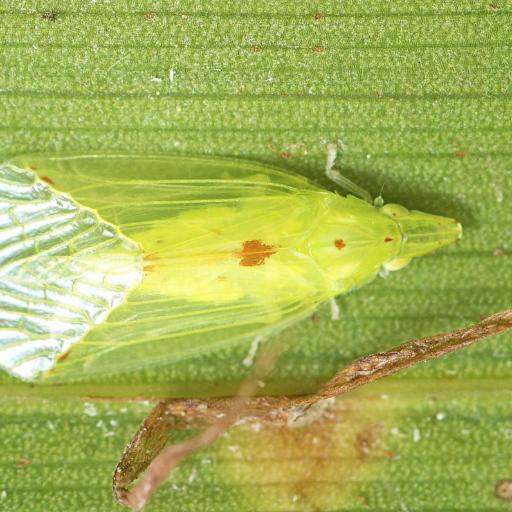
The Tropiduchid Planthopper is a master of disguise, often looking more like a tiny, emerald-green leaf or a piece of architectural origami than a living insect. Found primarily in tropical and subtropical regions, these delicate creatures are often nicknamed "Wedge-shaped Planthoppers" due to their sleek, aerodynamic profile. While they might startle you with their sudden, lightning-fast leaps, they are completely harmless observers of the garden world.
🔍 How to Identify
- 📐 Body Shape: Most species have a distinctively flattened, wedge-shaped body that tapers toward the rear, allowing them to blend perfectly against stems.
- 🏁 Wing Venation: Their wings are their most striking feature—usually transparent or pale green with a complex, grid-like pattern of veins that often ends in a clear "nodal line" across the wing.
- 👃 The "Snout": Many Tropiduchids have a head that is subtly elongated into a pointed snout or "vertex," giving them a sharp, streamlined appearance.
🌲 Habitat & Ecology
- 🍃 Dietary Habits: These insects are specialized "sap-suckers." They use their needle-like mouthparts to drink nutrients from the phloem of various plants, though they rarely cause significant damage in a home garden.
- 💃 The Great Escape: When threatened, they don't fly away immediately. Instead, they use powerful hind legs to "snap" into the air, vanishing in the blink of an eye—a behavior that often confuses predators.
- 🌴 Tropical Residents: While they love lush, humid environments, they are most frequently spotted on the undersides of broad leaves or hidden along the midrib of a plant to stay invisible to birds.
⚠️ Safety & Toxicity
- ✅ Harmless to Humans: Tropiduchidae are "friends" of the observer. They do not bite, sting, or carry diseases that affect humans or pets.
- 🌱 Plant Impact: While they feed on plants, they are generally considered minor aesthetic pests. In rare cases, large populations can stress a plant, but they are far less destructive than aphids or scale insects.
✨ Fun Fact
Many species of Tropiduchid nymphs (the "babies") grow long, waxy white filaments from their tails. These "wax tails" make them look like bits of floating lint or fungus, tricking predators into biting a mouthful of tasteless wax instead of the insect itself!
More Details








