Info
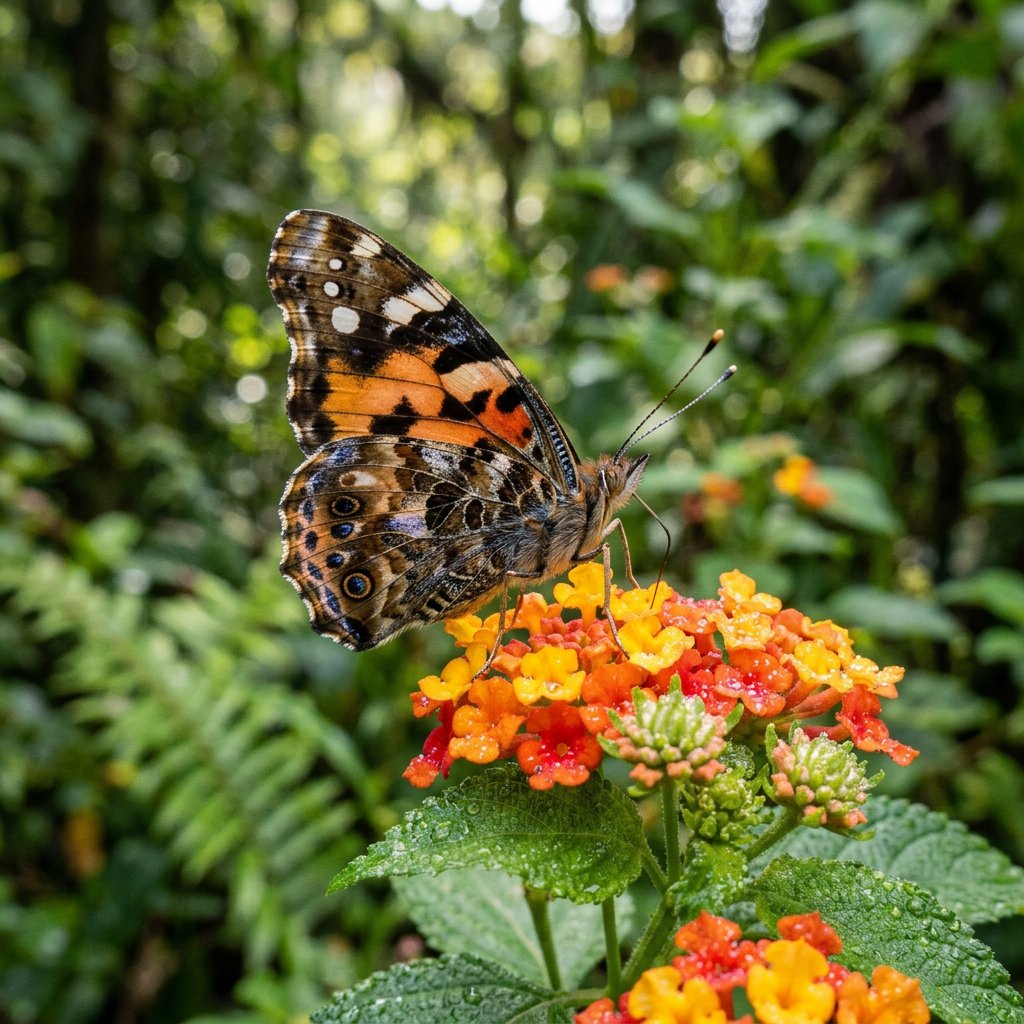
Often confused with its global cousin, the Painted Lady, the Brazilian Painted Lady (Vanessa braziliensis) is a vibrant jewel of South American meadows. This butterfly is a master of camouflage when its wings are closed, resembling a dried leaf, but it reveals a "sunset" of oranges and pinks when it takes flight. Found primarily in the grassy pampas and high-altitude regions of South America, it is a vital pollinator that brings movement and color to subtropical landscapes.
🔍 How to Identify
- 🦋 Upper Wing Pattern: The top of the wings features a stunning marbled pattern of deep orange, rose-pink, and dark brown, with black tips adorned by several white spots.
- 🎨 The Blue Eyespots: The most reliable way to distinguish it from similar species is by the two small, distinct blue-centered eyespots on the underside of the hindwings.
- 📏 Wing Shape: It possesses a somewhat "scalloped" or jagged wing edge, which helps it blend into foliage when resting with its wings folded.
🌲 Habitat & Ecology
- 🌸 Nectar Enthusiast: These butterflies are frequent visitors to open fields, sunny gardens, and roadsides, where they use their long proboscis to sip nectar from a variety of wildflowers.
- 🌿 Specific Host Plants: The larvae (caterpillars) are surprisingly picky eaters, primarily feeding on plants in the Asteraceae family, such as "Everlasting" flowers (Gamochaeta and Achyrocline).
- 🌎 Sun Seekers: You will often find them "basking"—spreading their wings wide on a flat stone or leaf—to absorb the sun's heat, which gives them the energy needed for high-speed flight.
⚠️ Safety & Toxicity
- ✅ Completely Harmless: The Brazilian Painted Lady is a "friend" to the garden. It has no stinger, does not bite, and possesses no chemical defenses that would irritate human skin.
- 🐾 Pet Safety: These butterflies are non-toxic to cats and dogs. While a curious pet might try to chase one, the butterfly’s erratic flight pattern usually makes it an impossible target to catch!
✨ Fun Fact
The Vanessa genus is famous for its "cosmopolitan" nature. While the Brazilian species stays in South America, its close relatives are known to perform incredible migrations across the Sahara Desert and the Mediterranean Sea!
More Details








