Info
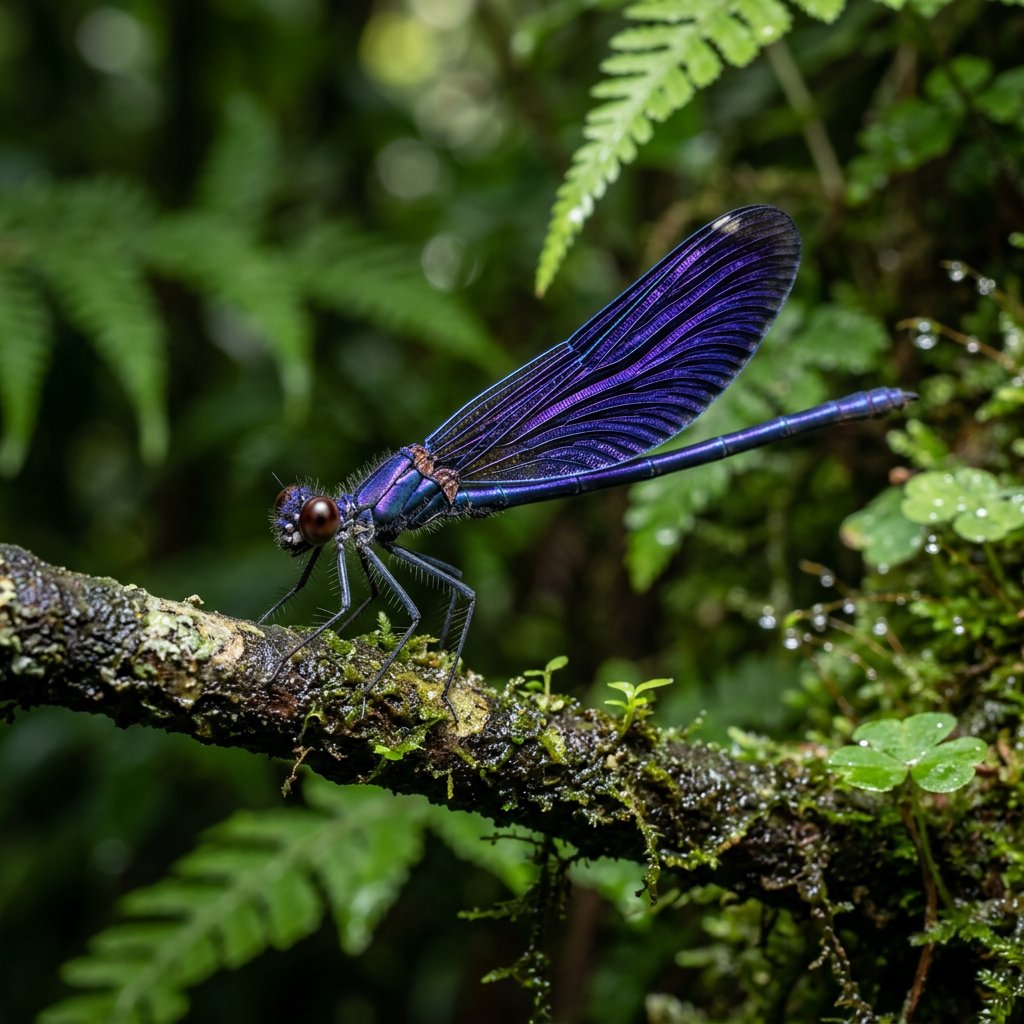
Known as the Amethyst Flashwing, this stunning damselfly looks less like an insect and more like a living gemstone dancing over a shaded forest stream. Found primarily in the lush rainforests of Southeast Asia, it is a master of the air that guards its territory with shimmering pride. Its presence is often a hallmark of a healthy, pristine aquatic environment.
🔍 How to Identify
- 💎 The Wings: The most striking feature is the deep, metallic violet or amethyst-purple sheen on the wings of the males, which appears to glow when hit by sunlight.
- 🟢 Body Color: While the wings steal the show, the body is a brilliant, iridescent metallic green or bronze that changes hue depending on the angle of the light.
- 📐 Resting Posture: Unlike dragonflies that rest with wings spread wide, the Amethyst Flashwing holds its wings together vertically over its back when it lands on a leaf.
🌲 Habitat & Ecology
- 🌊 Forest Streams: These damselflies are "specialists" that require clean, fast-flowing freshwater streams shaded by dense forest canopies. They are rarely found in open urban areas.
- 🦟 Aerial Predator: They are fierce hunters of the sky, acting as natural pest control by snatching midges, mosquitoes, and other small flying insects mid-air.
- 🛡️ Territorial Displays: Males are highly territorial; they will perform elaborate "shimmering" flights to ward off rivals and attract females to their chosen stretch of the stream.
⚠️ Safety & Toxicity
- ✅ Harmless: The Amethyst Flashwing is a "gentle giant" of the damselfly world. They do not possess a stinger and do not bite humans.
- 🛡️ Fragile Beauty: They are completely non-toxic to pets and children. However, they are very delicate; if one lands on you, it is best to observe without touching to avoid damaging their intricate wings.
✨ Fun Fact
The brilliant purple of their wings isn't caused by a purple pigment. Instead, it is "structural color"—the microscopic physical structure of the wing surface reflects light in a specific way that creates that dazzling amethyst glow!
More Details








