Info
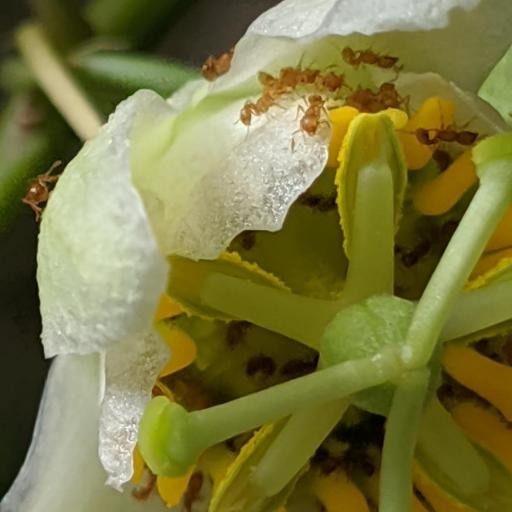
Known as the "Electric Ant" or "Little Fire Ant," Wasmannia auropunctata is a tiny hitchhiker that has traveled from Central and South America to tropical and subtropical regions worldwide. Despite its miniature size, it is a formidable invader that can take over entire gardens, driving away native insects and even blinding local wildlife. It gets its name from its powerful, burning sting that feels far too big for its microscopic body.
🔍 How to Identify
- 📏 Microscopic Size: These ants are incredibly small, usually measuring only about 1.5 mm (1/16th of an inch) in length—about the size of a pinhead.
- 🎨 Golden Color: They typically range from light orange to a golden brownish-yellow, often appearing slightly translucent under bright light.
- 🐢 Slow Movement: Unlike common house ants that scurry quickly when disturbed, these ants move at a remarkably slow, deliberate, and "clumsy" pace.
🌲 Habitat & Ecology
- 🛡️ Supercolonies: Unlike many ant species that protect their own turf, Little Fire Ants form massive networks of interconnected nests. They don't fight with "neighbor" colonies, allowing them to build an unstoppable army that dominates vast areas of land.
- 🐜 Ecological Bully: They are highly aggressive toward other small creatures. In areas they inhabit, you will notice a significant drop in the number of spiders, beetles, and native ant species.
- 🍯 Aphid Farming: They have a "mutualistic" relationship with sap-sucking insects like aphids. They protect these pests from predators in exchange for sugary honeydew, which can indirectly lead to plant diseases in your garden.
⚠️ Safety & Toxicity
- ⚡ The "Electric" Sting: The sting causes an intense, burning, needle-like pain that can last for several hours. Some people describe it as a lingering "electric" sensation or a persistent itch.
- 🐾 Threat to Pets: These ants are a major concern for pet owners. Because the ants often forage in the eyes of animals for moisture, repeated stings can cause "tropical keratopathy"—a clouding of the cornea that can lead to permanent blindness in cats and dogs.
- 👩🌾 Agricultural Hazard: Because they live in trees and bushes as well as on the ground, they frequently fall onto the necks and arms of gardeners and farmers, leading to multiple painful stings.
✨ Fun Fact
- 🧬 The Cloning Kings: This ant species has one of the strangest reproductive systems in nature. In many populations, queens produce new queens by cloning themselves, and males produce new males by "hijacking" the DNA in eggs to clone themselves. This means the males and females often evolve as entirely separate genetic lineages!
More Details








