Info
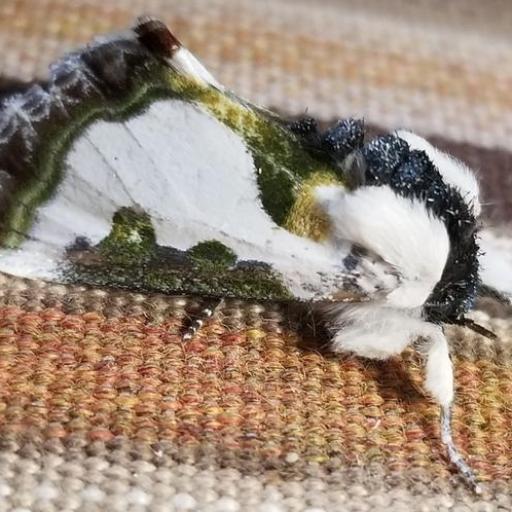
Nature’s sense of humor is on full display with Xerociris wilsonii. Commonly known as the Wilson’s Bird-Dropping Moth, it has evolved one of the most effective—if unglamorous—disguises in the insect world. By perfectly mimicking a fresh splash of bird waste, this moth successfully hides from hungry predators while resting in plain sight on green leaves.
🔍 How to Identify
- 🎨 The Disguise: The wings feature a stark, mottled pattern of "chalky" white and "slaty" gray-black, mimicking the uric acid and waste texture of a bird dropping.
- 📐 Resting Posture: When at rest, it holds its wings in a steep, roof-like tent shape that breaks up its insectoid silhouette.
- 🧶 Tufted Legs: Look for fuzzy, tufted scales on its legs and thorax; these add "organic" texture to its camouflage, making it look less like a living creature and more like debris.
🌲 Habitat & Ecology
- 🍇 Host Plants: You will most likely spot this moth near wild grapes (Vitis) or Virginia Creeper. The caterpillars are specialists that feed on these vines, often blending in with the stems.
- 🌙 Night Owl: While it spends its days perfectly still on top of leaves, it is a nocturnal flyer. It is frequently attracted to backyard light fixtures or UV "black lights" during the summer months.
⚠️ Safety & Toxicity
- 🛡️ Harmless: This moth is a "gentle giant" of the mimicry world. It does not bite, sting, or possess any chemical defenses that are dangerous to humans.
- 🐾 Pet Friendly: It is non-toxic to cats and dogs. If your curious pet happens to find one, the biggest "danger" is the moth losing its camouflage and flying away.
✨ Fun Fact
This moth is a master of Crypsis. It doesn't just look like a bird dropping; it purposely sits on the upper surface of leaves. Most moths hide underneath leaves to stay dry, but Xerociris wilsonii stays on top because that is where a predator would naturally expect to see bird waste!
More Details








