Info
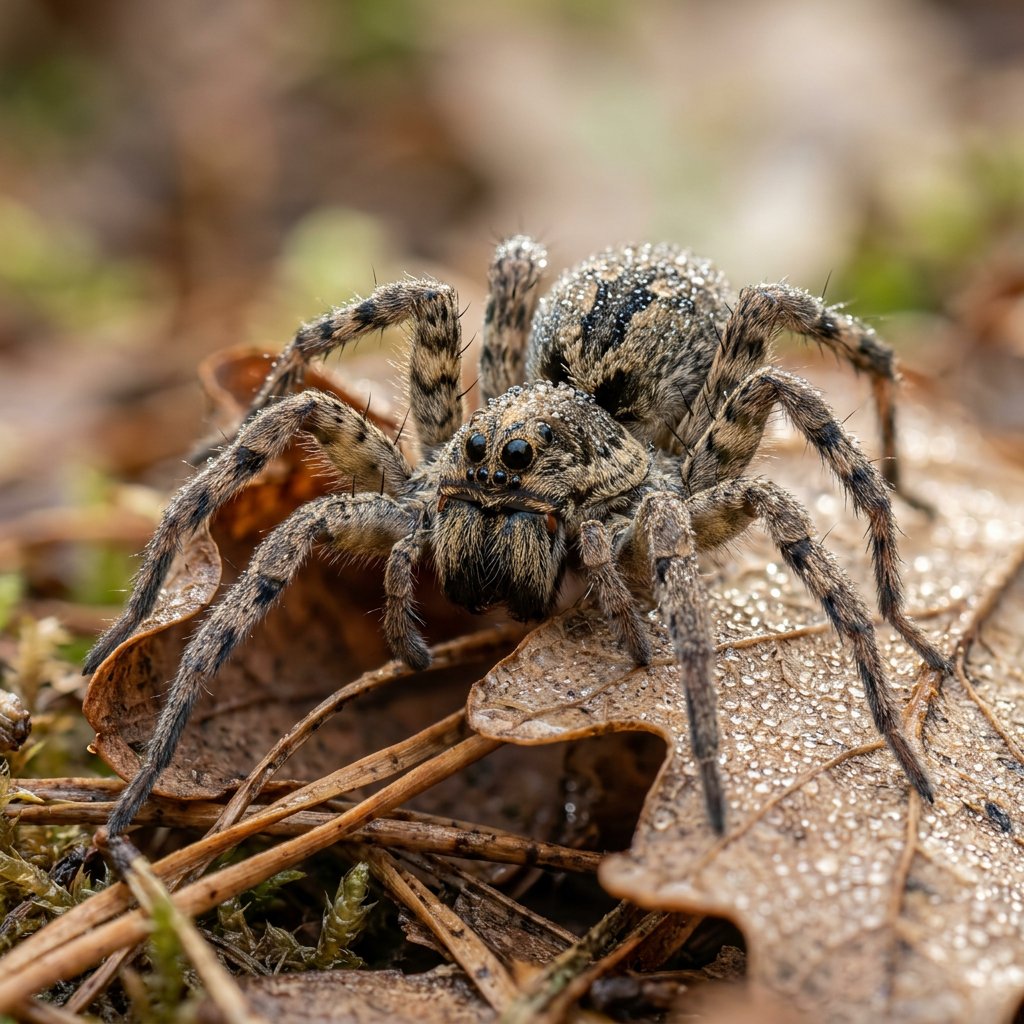
Often called the Oak-thicket Wolf Spider, this tiny arachnid is a master of camouflage among the leaf litter. While the name "Wolf Spider" might sound intimidating, these are solitary wanderers that act as the cleanup crew of the forest floor. Instead of sitting in a web, they use their incredible speed and eyesight to hunt down garden pests on foot.
🔍 How to Identify
- 🏎️ The Racing Stripe: They feature a distinct, pale longitudinal band running down the center of their dark grey or brownish "head" (cephalothorax).
- 👀 Wolf Eyes: Look closely to see two large, forward-facing eyes that provide excellent depth perception, sitting above a row of four smaller eyes.
- 🍂 Camouflage Coloring: Their bodies are mottled with earthy tones of silver, charcoal, and brown, making them nearly invisible against dry soil or dead leaves.
🌲 Habitat & Ecology
- ☀️ Sun Seekers: This species loves the "edge effect," meaning you’ll find them in sunny clearings, forest borders, and open woodlands where sunlight hits the ground.
- 🐜 The Ground Hunter: As active predators, they do not spin webs to catch food. Instead, they patrol the soil, pouncing on ants, small beetles, and flies with lightning-fast reflexes.
- 🏠 Home Body: They are usually found in the "litter layer"—the crunching leaves and twigs on the ground—rather than up in the trees or inside your house.
⚠️ Safety & Toxicity
- 🛡️ Peaceful Neighbors: This spider is shy and will almost always choose to sprint away rather than defend itself. They are not aggressive toward humans.
- 🩹 Minor Irritant: While they do have venom (used to subdue insects), it is not medically significant to humans or pets. A bite is extremely rare and usually results in nothing more than minor, temporary redness.
✨ Fun Fact
Wolf spider mothers are the "minivans" of the nature world! After their spiderlings hatch, the mother carries the entire brood—sometimes dozens of tiny spiders—on her back for several days until they are large enough to hunt on their own.
More Details








