Info
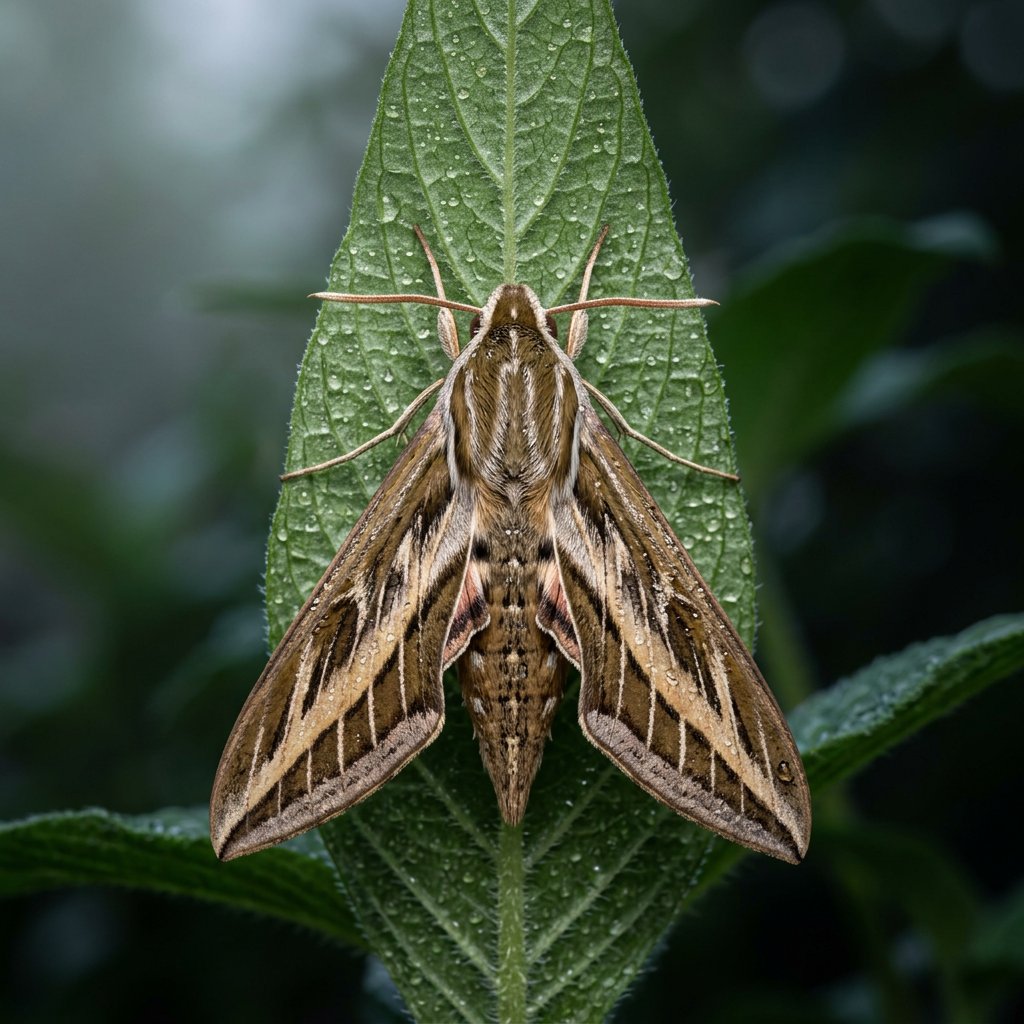
Looking like a miniature fighter jet crafted from polished wood, the Tersa Sphinx Moth is a marvel of biological aerodynamics. Often mistaken for a hummingbird at dusk, this sleek pollinator is a welcome "friend" in most gardens, darting between flowers with incredible speed and precision. Its streamlined design allows it to be one of the fastest fliers in the moth world.
🔍 How to Identify
- 🚀 Aerodynamic Shape: The moth has incredibly long, pointed forewings and a sleek, torpedo-shaped body that tapers to a sharp point at the tail, resembling a high-speed aircraft.
- 🪵 Wood-Grain Patterns: The wings are decorated with sophisticated shades of sandy brown, tan, and dark chocolate, creating a "streaked" appearance that perfectly mimics wood grain or dried leaves.
- 👀 The "Snake" Larva: Before becoming a moth, the caterpillar is easily identified by its large, startling "eyespots" on its thorax, which it uses to mimic a small snake to scare off predators.
🌲 Habitat & Ecology
- 🌸 The Hovering Pollinator: You’ll most likely spot them during the "golden hour" or at night, hovering mid-air over deep-throated flowers like Pentas, Honeysuckle, or Four O'clocks to drink nectar with their long proboscis.
- 🍃 Garden Residents: They are common in residential gardens across the Americas, particularly where their favorite host plants, like Firebush (Hamelia patens) and Starclusters (Pentas), are present.
- 🌓 Crepuscular Life: Unlike many moths that are strictly nocturnal, the Tersa Sphinx is crepuscular, meaning it is most active during the twilight hours of dawn and dusk.
⚠️ Safety & Toxicity
- 🛡️ Harmless Friend: Despite their sharp-looking "stinger" tail and rapid, buzzing flight, Tersa Sphinx Moths are completely harmless. They have no mechanism to bite or sting humans or pets.
- 🦋 Non-Toxic: They do not possess any defensive toxins. Their primary defense is camouflage as an adult and mimicry (looking like a snake) as a caterpillar.
✨ Fun Fact
The Tersa Sphinx is a master of "convergent evolution." It has evolved to look and behave so much like a hummingbird—including the ability to fly backward and hover perfectly still while feeding—that even experienced birdwatchers are often fooled by them at sunset!
More Details








