Info
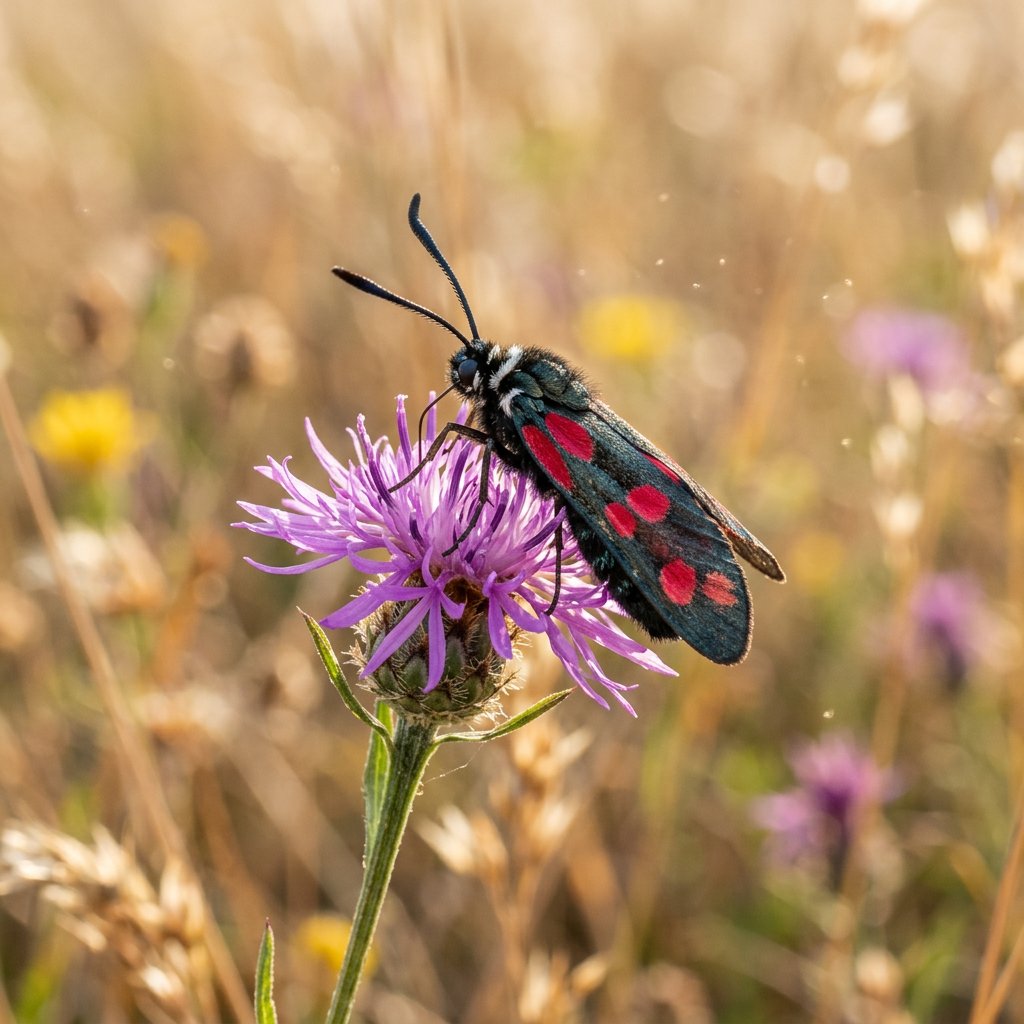
Often called the Variable Burnet, this striking moth is a master of disguise and a bold daytime traveler. Unlike most moths that hide in the shadows of the night, the Zygaena ephialtes flaunts its vibrant colors in broad daylight, confidently signaling to every bird in the meadow that it is definitely not on the menu.
🔍 How to Identify
- 🦋 The Wings: It features deep, midnight-blue or black forewings adorned with five or six distinct spots. These spots are "variable"—in some regions they are bright crimson, while in others they are creamy white or yellow.
- 📡 The Antennae: Look for thick, club-shaped antennae that end in a blunt point, a signature look for the burnet moth family that often leads people to mistake them for butterflies.
- 🧥 The Body: A stout, hairy body with a subtle metallic sheen. When at rest, it holds its wings in a "tent" shape over its back.
🌲 Habitat & Ecology
- 🌞 Sun Seekers: You will primarily find them in warm, dry grasslands, flower-rich meadows, and the sunny edges of forests. They are particularly fond of purple flowers like Thistles and Knapweed.
- 🛡️ The Mimicry Game: This moth is a classic example of "Müllerian mimicry." It evolves its colors to look like other local toxic species. By sharing a "uniform" with other dangerous insects, they all benefit from predators learning to leave anything with that pattern alone.
- 🐛 Specific Diet: As caterpillars, they are very picky eaters, mostly munching on Crown Vetch (Securigera varia), from which they sometimes sequester defensive chemicals.
⚠️ Safety & Toxicity
- 🧪 Toxic Defense: These moths are chemically "armed." They have the rare ability to produce hydrogen cyanide within their own bodies and store it as a defense mechanism.
- 🚫 Don't Taste: While they do not bite or sting, they are highly toxic if ingested. If handled roughly, they may secrete a yellow, foul-smelling fluid (reflex bleeding) that can irritate sensitive skin or eyes. Keep them away from curious pets.
✨ Fun Fact
- 🧪 Cyanide Immunity: Zygaena ephialtes is so well-adapted to its own chemical weapons that it can survive in an environment saturated with cyanide gas that would be instantly fatal to almost any other insect!
More Details








