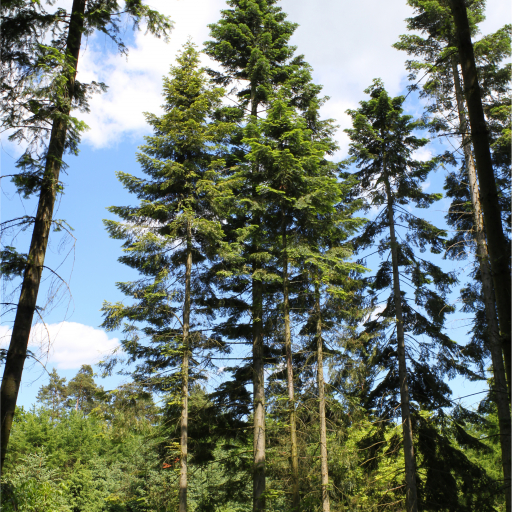
Plant Overview
The Grand Fir, scientifically known as Abies grandis, is a towering titan of the Pacific Northwest, often reaching heights that make it a true skyscraper of the forest. Known affectionately as the "Great Silver Fir" or "Giant Fir," it is prized for its symmetrical, pyramid-like shape and needles that release a refreshing burst of citrus aroma when crushed. For generations, its fragrant boughs have been used to bring the crisp scent of the wild indoors during the winter months.
🔍 How to Identify
- 🍃 The Needle Arrangement: Unlike many other firs, the needles are distinctly flat and spread out horizontally in two rows along the twig, giving the branch a flat, neatly "combed" appearance.
- ⚪ Silver Linings: If you flip a needle over, you will find two bright white stripes (stomatal bands) running along the underside, which creates a beautiful shimmering effect when the wind catches the canopy.
- 🌲 Smooth Bark: Young trees have smooth, grayish-brown bark covered in small, resin-filled blisters. As the tree matures, the bark becomes thick and furrowed with deep ridges to protect it from the elements.
🏡 In Your Garden
- 💧 Soil and Thirst: This tree craves deep, moist, and well-draining soil. It is particularly sensitive to drought and hot, stagnant air, so it thrives best in regions with cool, damp summers rather than arid, wind-swept plains.
- 🏗️ The Taproot Factor: The Grand Fir develops a deep taproot very early in its life. Because of this, it hates being moved once it is established; it is best to choose its "forever home" in your landscape carefully to avoid transplant shock.
- 🚀 Fast Growth: If you have the space, this is one of the fastest-growing firs available. However, ensure it is planted far away from power lines or house foundations, as it can quickly dominate a small yard.
⚠️ Safety & Toxicity
- ✅ General Safety: The Grand Fir is generally considered non-toxic to humans and common household pets like dogs and cats.
- 🍯 Sticky Resin: While not poisonous, the sticky resin found in the bark blisters can cause mild skin irritation or "dermatitis" for sensitive individuals.
- 🧤 Physical Hazard: The needles, while softer than spruce needles, can still be a choking hazard or cause minor mouth irritation if chewed on by curious pets or toddlers.
✨ Fun Fact
The Grand Fir is often called the "perfume of the forest" because its needles contain high levels of limonene—the same natural compound found in lemons and oranges—making it one of the most fragrant conifers in the world!

Detailed Care Instructions
To grow Abies Grandis, also known as grand fir, follow these steps:
- Climate: Check if your climate is suitable for growing Abies Grandis. It is primarily found in cool, temperate regions with moist soil and high rainfall.
- Soil: Abies Grandis prefers well-draining, loamy or sandy soil that is slightly acidic to neutral pH (around 5.5-7.0). The soil should be moist but not waterlogged.
- Location: Choose a site with full to partial sun exposure, preferably a location protected from strong winds.
- Propagation: You can propagate Abies Grandis through seeds or by purchasing seedlings from reputable nurseries. Seeds must be stratified (cold-treated) for a few weeks before planting to simulate natural germination conditions. Seedlings can be planted directly into the prepared soil.
- Planting: Dig a hole slightly larger and deeper than the root system of the seedling. Place the seedling in the hole, ensuring it sits at the same depth it was planted in the nursery container. Backfill the hole with soil, gently firming it around the seedling.
- Watering: Water the plant regularly, especially during the first year of growth, to ensure the soil remains evenly moist but not waterlogged. Water deeply but avoid overwatering, as excessive moisture can lead to root rot.
- Mulching: Apply a layer of organic mulch, such as wood chips or bark, around the base of the plant to retain moisture, suppress weed growth, and insulate the roots.
- Pruning: Minimal pruning is required for Abies Grandis. Remove any dead, damaged, or diseased branches as needed. Prune for shape if desired, but avoid excessive pruning that could harm the tree's health.
- Fertilizing: Abies Grandis is not heavy feeder, but you can apply a slow-release balanced fertilizer in early spring to provide essential nutrients.
- Protection: Monitor for pests and diseases regularly. Common pests include aphids, spider mites, and adelgids. Treat infestations promptly using environmentally-friendly methods, or consult with a horticulturist if necessary.
Remember to research specific guidelines for your region, as conditions may vary. Patience is key, as Abies Grandis is a slow-growing tree that may take several years to reach its full potential.

Place in a bright room that is sun drenched almost all day. Or directly in a south-facing window.

Abies Grandis, a coniferous tree species, is native to the western regions of North America. When it comes to watering this plant, it is important to take into consideration its age and growth stage, as well as the climate in which it is planted. Here are some general tips on how to water Abies Grandis:
1. Check the soil moisture level: Before watering, check the soil moisture level by poking a finger into the soil. If the soil feels dry to the touch at a depth of 2-3 inches, it's time to water.
2. Water deeply: Abies Grandis prefers deep watering over frequent, shallow watering. This means that when it's time to water, give the tree a good soak, making sure that the water penetrates deep into the soil.
3. Water during the cooler parts of the day: It is best to water Abies Grandis either early in the morning or late in the evening when temperatures are cooler. This will allow the plant to absorb more water without losing it to evaporation.
4. Avoid overwatering: While Abies Grandis needs adequate water, overwatering can lead to issues such as root rot. It is best to allow the soil to dry out a bit between watering sessions.
5. Mulch: Adding a layer of mulch around the base of the tree can help retain moisture in the soil, reducing the need for frequent watering.
Overall, it's important to observe the plant and adjust your watering routine as needed based on its specific needs.
To fertilize this plant, first test the soil pH to ensure it falls between 5.0 and 7.5. If the pH is too high or low, adjust it accordingly. In early spring, apply a slow-release, high-nitrogen fertilizer around the base of the plant, being careful not to get it on the foliage. Water the fertilizer in well. Repeat this application in late spring or early summer. Do not fertilize after mid-summer as this can stimulate new growth that may not have time to harden off before winter.
Abies Grandis is a type of coniferous tree that belongs to the Pinaceae family. It prefers well-drained soil that is rich in nutrients and organic matter. The soil should be slightly acidic with a pH range between 5.0 and 6.5. It is important to avoid using soil that is saturated with water, as this can lead to root rot and other issues. A good soil mix for Abies Grandis can consist of peat moss, sand, and perlite or vermiculite to improve drainage. Additionally, incorporating compost or other organic matter into the soil can provide essential nutrients for optimal growth.
To propagate this particular species of plant, you will need to collect cuttings of woody stems that are about six to eight inches in length. Using a sharp and sterile knife, cut the stems at a 45-degree angle just below a node - where a leaf attaches to the stem. Remove any leaves that are within the first inch of the cutting's bottom.
Next, dip the bottom of the cutting in rooting hormone powder and plant it in a potting mixture that is well-draining. Make sure to keep the soil moist and the cutting in a warm and humid environment. You can place a clear plastic bag over the pot to create a mini greenhouse effect.
Rooting typically occurs in four to six weeks, at which point you can transplant the cutting into a larger container or directly into the ground. Water regularly and provide a partially shaded location until the plant is well-established.








