Plant Overview
Often called the Nikko Fir, this stately evergreen is a majestic jewel of the Japanese mountains. While many firs are known for being "fussy" and demanding pristine mountain air, the Nikko Fir is the resilient diplomat of the family, famously tolerating city smog and pollution far better than its cousins. It is highly prized by collectors for its formal, festive silhouette and its striking, upright purple cones.
🔍 How to Identify
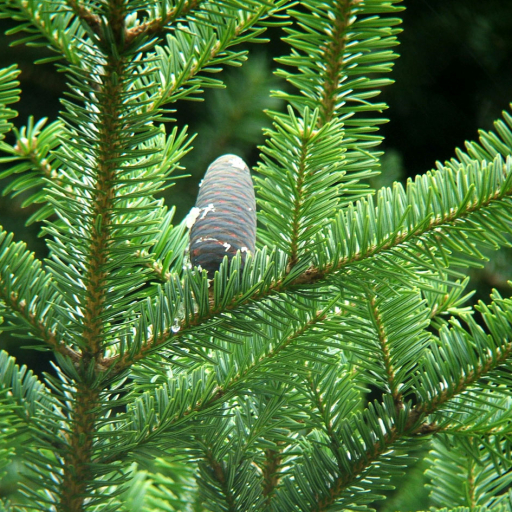
- 🌲 The Foliage: The needles are stiff, dark green, and notched at the tips. They are arranged in a "V" shape along the twig, revealing two brilliant silvery-white bands on their undersides that shimmer when caught in a breeze.
- 🎨 The Cones: One of its most beautiful features is the upright, candle-like cones. They emerge in a stunning shade of deep violet-purple or blue before maturing into a woody brown.
- 🪵 The Bark: In its youth, the bark is smooth and gray, but as it matures, it develops a distinctive scaly texture that peels slightly, giving the trunk a rugged, ancient appearance.
🏡 In Your Garden
- 🌫️ Urban Resilience: This is the go-to fir for gardeners near cities. Its ability to withstand atmospheric pollution makes it a rare "urban-friendly" conifer that maintains its lush look even in less-than-perfect air.
- 💧 Cool Roots: Despite its toughness, it hates "hot feet." It thrives in moist, well-drained, acidic soil. To keep it happy, apply a thick layer of organic mulch around the base to keep the soil temperature cool during the summer heat.
⚠️ Safety & Toxicity
- 🟢 Status: Generally non-toxic.
- 🐾 Details: The Nikko Fir is not considered poisonous to pets or humans. However, the stiff, sharp needles can cause minor mechanical irritation to the mouth or digestive tract if swallowed by curious pets.
- 🧤 Sap Sensitivity: The sticky resin (sap) is harmless but can cause mild skin irritation or "contact dermatitis" in individuals with very sensitive skin. Wearing gloves while pruning is recommended.
✨ Fun Fact
The name "Nikko" comes from the Nikko region of Japan (specifically Nikko National Park), where these trees dominate the high-altitude landscape and have been admired for centuries by monks and travelers alike.

Detailed Care Instructions
To grow Abies homolepis, also known as the Nikko fir, follow these steps:
- Climate and location: Abies homolepis thrives in cool temperate regions. It prefers a well-drained soil with a slightly acidic to neutral pH. Choose a location that offers partial shade to protect the plant from intense sunlight.
- Seed collection: Collect seeds from mature cones. Harvest the cones in autumn when they are fully ripened and have turned brown. Allow the cones to dry further indoors before extracting the seeds.
- Seed preparation: Soak the extracted seeds in water for 24 hours. After soaking, stratify the seeds by placing them in a sealed plastic bag with some moist peat moss or vermiculite. Keep the bag in the refrigerator for about 4-8 weeks to simulate a cold winter.
- Potting and germination: After the stratification period, sow the seeds in containers filled with a well-draining seed-starting mix. Plant the seeds at a shallow depth, just covering them lightly with the soil. Place the containers in a cool and shaded area.
- Watering and care: Keep the soil consistently moist but not waterlogged. Mist the soil surface if it starts to dry out between watering. Provide good air circulation to prevent damping off, a fungal disease that can affect young seedlings.
- Transplantation: Transplant the seedlings into individual pots once they have developed a few true leaves. Use a well-draining potting mix and provide adequate root space. Place the pots in a partially shaded area.
- Hardening off: After the last frost, gradually expose the seedlings to outdoor conditions. Start with a few hours of direct sunlight per day and gradually increase the duration over a week or two. This process, known as hardening off, helps the plants adjust to the outdoor environment.
- Planting in the ground: When the seedlings are about 15-20 cm tall and well-established, choose a suitable planting site in your garden or landscape. Prepare the soil by loosening it and adding organic matter. Dig a hole deep and wide enough to accommodate the root ball of the seedling. Plant it in the hole, ensuring that the top of the root ball is level with the surrounding soil.
- Watering and maintenance: Water the seedlings deeply after transplanting and continue to keep the soil moist but not waterlogged during the first year. Mulch around the base of the plant to retain moisture and suppress weed growth. Provide regular watering during hot and dry periods.
- Pruning and shaping: As the Abies homolepis matures, you can prune and shape it to maintain a desired form. Prune off any dead or damaged branches. Avoid heavy pruning, as this can harm the tree's shape and overall health.
Remember that Abies homolepis is a slow-growing tree, so patience is key. With proper care and suitable growing conditions, it will reward you with its beautiful foliage and graceful form.

Place in a bright room that is sun drenched almost all day. Or directly in a south-facing window.

Abies Homolepis is a type of coniferous evergreen plant that requires consistent watering to thrive. It is important to water this plant deeply, allowing the water to penetrate the soil and reach the roots. It is advisable to water the plant at least twice a week, especially during the hot and dry seasons. When watering, avoid getting water on the leaves as this can lead to fungal growth.
One way to ensure that the Abies Homolepis is receiving adequate water is to check the soil regularly. The soil should be moist but not waterlogged. If the soil is dry to the touch, it is time to water the plant.
When watering, use a gentle stream of water and direct it towards the base of the plant. Avoid splashing water on the foliage or needles as this can cause damage to the plant.
In addition to regular watering, it is important to provide the Abies Homolepis with adequate drainage. This can be achieved by planting the tree in well-draining soil and ensuring that the planting site is not in a low-lying area that may collect water.
Overall, consistent and appropriate watering is essential to the health and survival of Abies Homolepis. By providing this plant with the right amount of water, it will thrive and remain lush and green throughout the year.
To fertilize this plant, apply a balanced slow-release fertilizer in early spring or late fall. Use a fertilizer with an N-P-K ratio of 10-10-10 or 14-14-14. Apply the fertilizer evenly around the base of the plant, avoiding direct contact with the foliage. Water thoroughly after fertilizing. Avoid over-fertilizing as it can damage the roots and reduce growth.
Abies Homolepis is a type of plant that requires specific soil in order to grow properly. It is important to use soil that is well-draining, with a pH level between 5.0-7.5. The soil should also be rich in organic matter and nutrients, which can be achieved by adding compost or other organic fertilizers. It is important to avoid using soil that is too compact or heavy, as this can inhibit root growth and cause the plant to struggle. Instead, look for a loose, light soil that will allow air and water to flow easily through the roots. With the right soil conditions, Abies Homolepis can thrive and produce beautiful foliage and cones.
To propagate this plant, one can start with collecting the seeds in the fall when the cones have matured and released their seeds. The seeds can then be stratified for 3-4 weeks in a cool, moist environment to simulate the plant's natural winter dormancy. After stratification, the seeds can be sown in a mixture of sand and peat moss and kept moist but not waterlogged.
Alternatively, stem cuttings can be taken in the early summer when the plant is actively growing. Cuttings should be taken from the current year's growth and should be about 4-6 inches long, with the lowest set of leaves removed. Dip the cut end of the stem in rooting hormone and plant it in a mixture of perlite and peat moss. Keep the cutting in a humid environment and water regularly until it has rooted and new growth appears.
Division can also be used to propagate this plant. In the spring or fall, carefully dig up the plant and divide its roots into smaller sections, making sure each section has healthy roots and above-ground growth. Replant the divisions in a prepared bed or container and water thoroughly.








