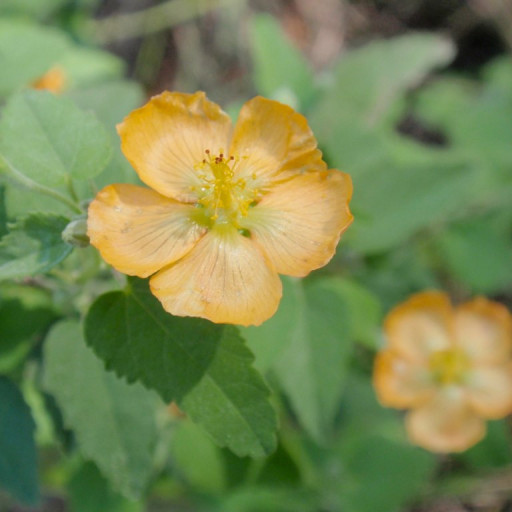
Plant Overview
Known as the Sweet Indian Mallow or Silverleaf Indian Mallow, this resilient shrub is a master of survival in harsh, sun-baked environments. Native to parts of North America, Africa, and India, it is often celebrated by xeriscape gardeners for its "ghostly" appearance. Its shimmering, silver-toned foliage makes it a popular choice for moon gardens, where the leaves seem to glow under the light of the night sky.
🔍 How to Identify
- 🍃 Velvety Foliage: The most striking feature is the heart-shaped leaves, which are covered in a dense layer of tiny, star-shaped hairs. This gives them a soft, felt-like texture and a distinct silvery-green color.
- 🌼 Cup-Shaped Blooms: It produces small, delicate five-petaled flowers that range from pale yellow to a warm apricot-orange. These blooms usually tuck themselves among the leaves.
- 🌵 Branching Structure: It grows as a woody, multi-branched shrub, typically reaching 2 to 4 feet in height, though it can grow taller in ideal conditions.
🏡 In Your Garden
- ☀️ The Sun Shield: The silver hairs on its leaves aren't just for looks; they reflect intense sunlight and trap moisture, allowing the plant to thrive in high-heat areas where other plants would wither.
- 💧 Taproot Sensitivity: This plant develops a long, deep taproot to find water deep underground. Because of this, it is notoriously difficult to transplant once established—it's best to pick a permanent "forever home" for it from the start.
- 🦋 Pollinator Magnet: While it looks delicate, it is a powerhouse for local wildlife, providing a nectar source for bees and acting as a host plant for several species of checkered-skipper butterflies.
⚠️ Safety & Toxicity
- ✅ Generally Safe: Abutilon fruticosum is not known to be toxic to humans, dogs, or cats, making it a "worry-free" addition to a family landscape.
- 🧤 Mild Irritant: For people with very sensitive skin, the tiny hairs (trichomes) on the leaves can occasionally cause a mild, itchy sensation if handled frequently. Wearing gloves during heavy pruning is a good precaution.
✨ Fun Fact
The genus name Abutilon is believed to be derived from an Arabic word for a plant resembling a mallow, and in some regions, the strong fibers in the stems of this plant were historically used to create twine and cordage.

Detailed Care Instructions
To grow Abutilon fruticosum, also known as the Indian mallow or flowering maple, follow these steps:
- Choose a location: Abutilon fruticosum prefers a warm and sunny spot. Ensure that the area receives at least 6 hours of direct sunlight per day.
- Soil preparation: The plant thrives in well-draining soil with a slightly acidic to neutral pH level (around 6.0 to 7.0). Amend the soil by adding organic matter such as compost or well-aged manure to improve drainage and fertility.
- Planting: Dig a hole that is large enough to accommodate the root ball of the Abutilon fruticosum plant. Place the plant in the hole, ensuring that the top of the root ball is level with the surface of the soil. Fill the hole with soil and gently firm it around the base of the plant. Leave enough space between each plant to allow for growth.
- Watering: Keep the soil consistently moist but not waterlogged. Water the plant deeply once or twice a week during the growing season, reducing the frequency during winter. Use mulch around the base of the plant to retain moisture and suppress weed growth.
- Fertilization: Abutilon fruticosum benefits from regular fertilization. Apply a balanced slow-release fertilizer in early spring and mid-summer according to the manufacturer's instructions. Avoid over-fertilizing, as this can lead to excessive leaf growth at the expense of flowers.
- Pruning: Prune Abutilon fruticosum in early spring to remove any dead or damaged branches. This will help stimulate new growth and maintain a tidy shape. Additionally, pinch back the growing tips of the plant to encourage branching and increased flower production.
- Pests and diseases: Monitor the plant regularly for pests such as aphids, whiteflies, and spider mites. Treat any infestations promptly with appropriate insecticides or natural remedies. Abutilon fruticosum is generally resistant to diseases but may occasionally experience issues like root rot or powdery mildew. Ensure proper soil drainage and provide good air circulation around the plant to prevent such problems.
- Propagation: Abutilon fruticosum can be propagated by collecting and planting seeds, taking stem cuttings, or by dividing mature plants. Sow seeds in a seed-starting mix and keep them warm and moist until germination occurs. For stem cuttings, take 4-6 inch cuttings from a healthy plant, remove any lower leaves, and dip the cut end in rooting hormone before placing in a well-draining potting mix.
With proper care and attention, your Abutilon fruticosum plant should grow and produce beautiful flowers.

Place in a bright room that is sun drenched almost all day. Or directly in a south-facing window.

A good approach to watering Abutilon Fruticosum is to monitor the soil closely and water it when the top inch of soil is dry to the touch. Provide enough water to moisten the soil to a depth of 6 to 8 inches. Avoid overwatering or letting the soil dry out completely. Watering in the early morning or evening is recommended to reduce the chances of water evaporating before it is absorbed by the plant. Use room temperature, non-chlorinated water when watering, as this will help prevent any damage that can be caused to roots by chemicals in tap water.
To fertilize this plant, begin by selecting a high-quality, balanced, slow-release fertilizer with a nitrogen-phosphorus-potassium (N-P-K) ratio of 10-10-10 or 20-20-20. Dilute the fertilizer according to the package instructions and apply it to the soil around the base of the plant, being careful not to get any on the leaves. Water thoroughly after fertilizing. Repeat this process every 2-3 months during the growing season (spring and summer) for best results. Avoid fertilizing during the fall and winter months, as the plant is dormant and does not require as many nutrients.
The ideal soil for planting this particular species of plant should be a well-draining, slightly acidic soil with a pH range of 5.0 to 6.5. The soil should be rich in organic matter and nutrients, as the plant requires a lot of nutrients to grow and thrive. Additionally, it is recommended to mix in some sand or perlite into the soil to improve drainage. When planting in containers, a high-quality potting mix that is specifically formulated for acid-loving plants should be used. Avoid using heavy clay soils, as they tend to retain too much moisture and can lead to root rot. Overall, choosing the right soil is essential for the success of Abutilon Fruticosum plants.
Abutilon fruticosum plant can be propagated through stem cuttings. First, select a healthy stem with at least three nodes and cut it at a 45-degree angle with a clean and sharp pair of scissors or pruning shears. Remove any leaves from the bottom 2/3 of the cutting. Dip the cut end in rooting hormone to encourage root development.
Next, prepare a potting mixture by mixing equal parts of peat moss and perlite or sand. Moisten the mixture with water until it feels like a damp sponge. Insert the cutting about an inch deep into the potting mixture and lightly tamp the mixture around it.
Cover the pot with a plastic bag to create a humid environment for the cutting. Place the pot in bright, indirect light and maintain a temperature of around 70-75°F. Check the pot every few days and water as needed to keep the potting mixture moist but not waterlogged.
In about 3-4 weeks, the cutting should have rooted and produced new growth. Once the new growth is established, the cutting can be transferred to a larger pot or planted directly in the garden.








