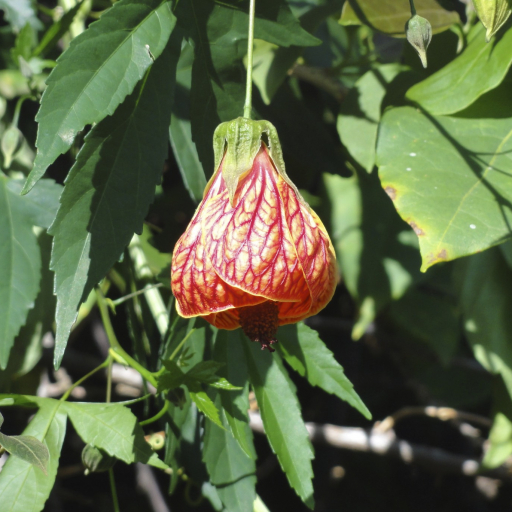
Plant Overview
Commonly known as the "Flowering Maple" or "Chinese Lantern," Abutilon pictum is a vibrant evergreen shrub that captures the heart with its Victorian-era charm. Despite its common name, it isn't a maple at all; it is actually a member of the Mallow family, making it a close relative of the Hibiscus and Okra. Native to South America, this plant is beloved for its pendulous, bell-shaped blooms that look like delicate paper lanterns hanging from a festive string.
🔍 How to Identify
- 🍁 The Foliage: It sports deeply lobed, palm-shaped leaves that bear a striking resemblance to maple leaves. In many cultivars, these leaves are "variegated," appearing splashed with gold or creamy white.
- 🏮 The Flowers: The blooms are unmistakable—pendulous, bell-shaped flowers, usually in shades of orange or yellow, featuring a dramatic "painted" network of deep crimson or maroon veins.
- 🌿 Growth Habit: It has a naturally upright and somewhat "leggy" growth habit. The stems are slender and woody, often leaning gracefully under the weight of the numerous flower bells.
🏡 In Your Garden
- 🌤️ Light & Heat Nuance: While it loves bright light to fuel its heavy blooming, the Flowering Maple has thin, delicate leaves that can wilt or scorch in intense, direct midday sun. It performs best in "dappled" light or a spot that receives morning sun and afternoon shade.
- ✂️ Shape Management: Because it grows rapidly and can become sparse, gardeners should "pinch" the growing tips regularly. This encourages the plant to branch out, creating a bushier, more flower-packed specimen rather than one tall, thin stalk.
- 💧 Thirst Levels: It is not a drought-tolerant plant. Because it transpires quickly through its large leaf surface area, it prefers consistently moist soil. If the soil dries out completely, the plant will "protest" by dropping its flower buds prematurely.
⚠️ Safety & Toxicity
- ✅ Status: Generally non-toxic and safe for homes with curious pets and children.
- 🧤 Skin Sensitivity: While the plant is not poisonous, the leaves are covered in very fine, soft hairs that can occasionally cause mild skin irritation or "itchiness" for people with sensitive skin during heavy pruning.
- 🐱 Pet Friendly: It is widely recognized as a safe, non-toxic choice for cat and dog owners looking to add tropical flair to their space.
✨ Fun Fact
The striking yellow spots and "mosaic" patterns found on the leaves of many Abutilon pictum varieties are actually caused by a specialized plant virus! Unlike most plant diseases, this "Abutilon Mosaic Virus" is kept by gardeners on purpose because it creates such a beautiful, ornamental variegation without harming the plant's overall health.

Detailed Care Instructions
Here are some steps to help you grow an Abutilon Pictum plant:
- Choose a suitable location: Abutilon Pictum plants prefer a location with partial shade or filtered sunlight. They can tolerate some direct sunlight, especially morning sun, but avoid intense afternoon sun as it can scorch the leaves.
- Prepare the soil: Ensure the soil is well-draining and rich in organic matter. You can amend the soil with compost or well-rotted manure to improve fertility and drainage.
- Planting: Dig a hole slightly larger than the plant's root ball. Place the plant in the hole, ensuring the top of the root ball is level with the surrounding soil. Backfill the hole with soil, gently firming it around the roots.
- Watering: Keep the soil evenly moist but not waterlogged. Water deeply when the top inch of soil feels dry. Avoid overwatering, as it can lead to root rot.
- Mulching: Apply a layer of organic mulch, such as bark chips or compost, around the base of the plant. Mulching helps retain soil moisture, regulate temperature, and suppress weeds.
- Pruning: Prune lightly in early spring to remove any dead or damaged branches and to shape the plant. Abutilon Pictum plants can be pruned to maintain a desired size and shape.
- Fertilizing: Apply a balanced, slow-release fertilizer in spring and again in mid-summer to promote healthy growth. Follow the package instructions for application rates.
- Pests and diseases: Monitor the plant for common pests such as aphids, mealybugs, or spider mites. Treat any infestations promptly with organic insecticides or insecticidal soap. Also, watch for signs of fungal infections such as leaf spots or powdery mildew. If these occur, remove affected foliage and treat with fungicides if necessary.
- Winter care: Abutilon Pictum plants are generally hardy in USDA zones 8-10. In colder regions, protect the plant from freezing temperatures by either moving it indoors or providing a protective cover such as burlap. Resume regular care in spring.
Remember to research and cater to the specific needs of your Abutilon Pictum plant, as individual environmental conditions and care requirements can vary.

Place in a window with dappled sun or a spot in the middle of a room. Or directly in a window facing west or east.

To water this particular plant, you will need to first check the soil moisture. Stick your finger into the soil about an inch deep to evaluate the moisture level. If the soil feels dry to the touch, it's time to water the plant. Be careful not to overwater it, as the plant prefers well-draining soil and can be susceptible to root rot if the soil is too wet. Allow the water to soak into the soil thoroughly before draining any excess water from the saucer or planter. Water the plant again only when the soil feels dry to the touch. It's also important to note that this plant prefers room temperature water, so avoid using water straight from the tap if it's too cold or too hot.
To fertilize this plant, use a balanced, water-soluble fertilizer once every two weeks during the growing season. Mix the fertilizer with water according to the package instructions, and apply it to the soil around the base of the plant. Be careful not to over-fertilize, as this can lead to nutrient burn and other issues. Water the plant thoroughly after fertilizing to help distribute the nutrients throughout the soil.
Abutilon Pictum is a flowering plant that belongs to the Malvaceae family. It requires moist, well-drained soil that is rich in nutrients. The ideal soil for Abutilon Pictum should be slightly acidic to neutral with a pH of 6.5 to 7.5. The plant prefers fertile soil that is well-aerated and has good drainage to prevent waterlogging.
A good potting mix for Abutilon Pictum should contain equal parts of perlite, peat moss, and vermiculite along with some sand to increase the soil's drainage capability. Adding organic matter such as compost to the soil can improve its fertility and water retention capacity. The plant also benefits from the addition of slow-release fertilizers that are rich in phosphorus, nitrogen, and potassium for optimal growth and blooming.
It is important to note that Abutilon Pictum is sensitive to excessive moisture and may develop root rot if the soil is too wet. Therefore, it is important to ensure that the soil is not too compacted and has sufficient drainage to allow excess water to drain freely.
Abutilon Pictum is a flowering plant that belongs to the family Malvaceae. It is commonly propagated through stem tip cuttings. Here are the steps to propagate Abutilon Pictum:
- Choose a healthy stem that is about 4-6 inches long and has several leaves.
- Cut the stem just below a node (the point where a leaf meets the stem).
- Remove the lower leaves from the stem, leaving only a few at the top.
- Dip the cut end of the stem into rooting hormone powder.
- Plant the stem in a pot filled with well-draining soil.
- Water the soil lightly, enough to moisten it but not saturate it.
- Cover the pot with a plastic bag or a clear plastic container to create a greenhouse-like environment.
- Place the pot in a warm and bright location, but not in direct sunlight.
- Monitor the soil moisture and keep it consistently moist, but not wet.
- After a few weeks, the stem will start to produce roots and new growth.
- Once the new growth is established, the plant can be gradually acclimated to direct sunlight and eventually transplanted into a larger pot or the garden.
Note: The ideal time to propagate Abutilon Pictum is in the spring or early summer when the plant is actively growing.
Common pests of the chinese-lantern include Spider mites, aphids, thrips. Make a habit of checking your chinese-lantern frequently for pests so that any infestations can be caught and managed early.








