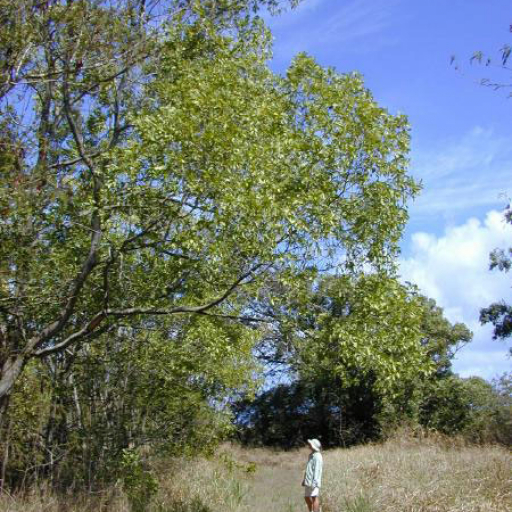
Plant Overview
Often called the Earleaf Acacia or Northern Black Wattle, this sun-loving tree is a master of adaptation. Its name comes from its peculiar seed pods that twist and curl into the shape of a human ear. In many tropical regions, it is celebrated for its ability to grow rapidly in poor soils where other trees might struggle, providing quick shade and vibrant yellow blooms.
🔍 How to Identify
- 🍃 The "Faux" Leaves: The tree doesn't have traditional leaves; instead, it uses "phyllodes," which are flattened, sickle-shaped leaf stalks that are thick, leathery, and curved like a crescent moon.
- 🌼 Golden Spikes: During blooming season, it produces fragrant, creamy-yellow flower spikes that look like tiny, fuzzy caterpillars hanging in pairs from the leaf axils.
- 👂 Ear-Shaped Pods: The most iconic feature is the woody seed pod, which twists and spirals into a shape remarkably similar to a human ear before splitting to reveal black seeds.
🏡 In Your Garden
- 🌱 The Soil Architect: This tree is a nitrogen-fixer, meaning it actually improves the quality of the soil it grows in. It is often used to reclaim "dead" land or prevent erosion on steep slopes.
- ☀️ Space and Sun: It requires full sun to thrive and grows incredibly fast. However, be mindful of its aggressive root system; keep it well away from pipes, sidewalks, and house foundations to avoid structural damage.
- 🌏 Invasive Awareness: Because it is so hardy and produces thousands of seeds, it can be invasive in regions like Florida. Always check your local ecology guidelines before planting it near wild areas.
⚠️ Safety & Toxicity
- ✅ Low Risk: The Earleaf Acacia is generally considered non-toxic to humans and common household pets.
- 🚫 Seed Caution: While not considered poisonous, the seeds and woody pods are not meant for consumption and could cause mild digestive upset or a choking hazard if swallowed by curious toddlers or pets.
- 🤧 Allergy Note: The heavy, sweet-scented pollen from the yellow flower spikes can be a trigger for those who suffer from seasonal hay fever.
✨ Fun Fact
- ✨ Evolutionary Cheat Code: The "leaves" of this tree are an evolutionary trick. By using thickened leaf stalks to perform photosynthesis instead of thin, delicate leaves, the tree dramatically reduces water loss, allowing it to stay lush even during intense heat!

Detailed Care Instructions
To grow Acacia auriculiformis, also known as earleaf acacia, you can follow these steps:
- Obtain Acacia auriculiformis seeds or young saplings from a reputable nursery or supplier.
- Prepare the soil by ensuring it is well-drained, as Acacia auriculiformis prefers sandy or loamy soil. It can tolerate a wide range of pH levels.
- Select a location with full sun exposure, as these plants thrive in bright sunlight.
- Dig a hole that is slightly larger than the size of the root ball of the sapling or create a furrow if sowing seeds directly.
- Place the sapling or seeds in the hole or furrow and cover it with soil. Ensure the sapling is planted at the same depth as it was in the pot, and space multiple saplings around 6 to 10 feet apart if you're planting a group.
- Water the plant thoroughly after planting, and continue to water regularly, especially during the establishment phase. However, avoid over-watering, as Acacia auriculiformis prefers slightly dry conditions once established.
- Apply a layer of organic mulch around the base of the plant to help retain moisture and suppress weed growth.
- Prune the plant occasionally to maintain desired shape and size. Acacia auriculiformis responds well to pruning but avoid excessive pruning, as it can lead to stress or damage.
- Fertilize the plant with a balanced, slow-release fertilizer annually in early spring or as per the instructions on the fertilizer package. This will help promote growth and healthy foliage.
- Monitor the plant for any signs of pests or diseases, and take appropriate measures if necessary. Acacia auriculiformis is generally resistant to pests and diseases, but it is always good to inspect the plant regularly.
By following these guidelines, you should be able to successfully grow Acacia auriculiformis, a beautiful and hardy plant native to Australia and known for its attractive foliage and yellow flowers.

Place in a bright room that is sun drenched almost all day. Or directly in a south-facing window.

To water this plant, you should first determine the soil moisture level. Stick your finger or a moisture meter about an inch deep into the soil to check for moisture. If the soil feels dry, it's time to water. Use a watering can or hose to water the plant at the base, avoiding getting the leaves wet. Ensure that the water reaches the roots. Only water when the top inch of soil feels dry to the touch. Be cautious not to overwater the plant as this can lead to root rot and ultimately, plant death.
To fertilize this plant, you should first ensure that it is healthy and well-hydrated. Then, apply a balanced, slow-release fertilizer around the base of the plant, taking care not to over-fertilize. It is best to apply fertilizer during the growing season, which is typically from spring to early fall. Always follow the manufacturer's instructions for the specific fertilizer you are using. Additionally, it is important to monitor the plant's growth and adjust fertilization as necessary.
Acacia Auriculiformis prefers a well-draining soil that is rich in nutrients. The soil should have a pH level that is slightly acidic to neutral, between 6.0 to 7.5. It is also important to ensure that the soil is not compacted and that it is loose and free-draining. A mixture of sand, peat moss, and compost or organic matter is ideal for growing Acacia Auriculiformis. The soil should also be well-aerated and have good water-holding capacity. When planting, it is important to ensure that the soil is evenly moist and well-drained, but not waterlogged. Overwatering can lead to root rot and other problems. Overall, the key to growing Acacia Auriculiformis successfully is to provide it with a healthy, nutrient-rich soil that is well-draining and moisture-retentive, without being waterlogged.
There are several methods of propagating this plant, but one common method is through seed propagation. After harvesting the seeds, they should be scarified to break down the seed coating that prevents germination. This can be done by nicking the seed coat with a knife or by soaking the seeds in hot water. After scarification, the seeds should be planted in a well-draining seed-raising mix and kept moist until they germinate.
Another propagation method is through stem cuttings. Select a healthy stem from the parent plant and cut it at a 45-degree angle. Remove any leaves from the bottom half of the stem and dip the cut end in rooting hormone. Plant the cutting in a well-draining potting mix and keep it moist while it develops roots.
Layering is another method of propagation, which involves bending a low lying branch or stem to the ground and pinning it in place. After a few months, the stem will root where it is in contact with the soil. Once rooted, the branch can be cut from the parent plant and transplanted to its new location.
Lastly, Acacia Auriculiformis can also be propagated through tissue culture. This involves taking tissue samples from the parent plant and growing the cells in a specialized lab environment to form new plants. This method is generally reserved for commercial growers and researchers.








