Plant Overview
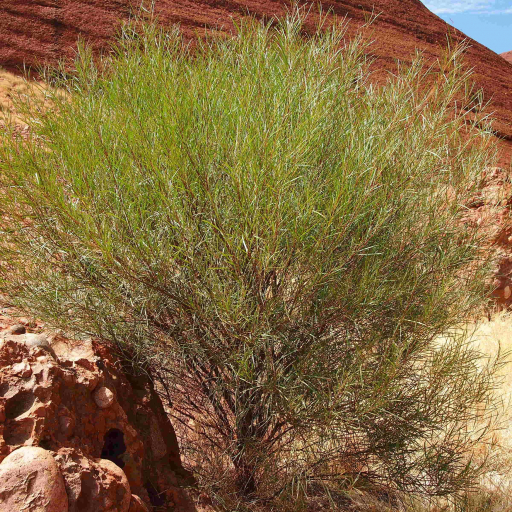
Named after the majestic domes of Kata Tjuta (The Olgas) in Australia’s Red Centre, the Acacia olgana—commonly known as the Mount Olga Wattle—is a desert survivor with a royal presence. This striking wattle stands as a symbol of the rugged outback, offering a shimmering silver-green canopy that contrasts beautifully against red desert sands. It is a favorite among native plant enthusiasts for its ability to bring a touch of the "Red Centre" to arid-style gardens.
🔍 How to Identify
- 🌿 Foliage: It features long, narrow "leaves" (technically called phyllodes) that are slightly curved and have a distinct silvery-green or greyish hue, which helps the plant reflect intense sunlight.
- 🌼 Blooms: Unlike many wattles that produce round puffballs, this species displays dense, cylindrical spikes of brilliant gold. These "catkins" often appear in pairs and provide a stunning floral show.
- 🪵 Structure: It typically grows as a multi-stemmed shrub or a shapely small tree. Its bark is rough, fibrous, and dark, adding a rugged texture to its silhouette.
🏡 In Your Garden
- 🏜️ Desert Logic: Because it hails from rocky ranges and sandy plains, it demands exceptional drainage. It thrives on a bit of "tough love" and is perfect for xeriscaping or water-wise gardens where other plants might struggle with heat.
- ☀️ Sun Seeker: This plant is a true sun-worshipper. To achieve those iconic golden spikes, it requires a position with maximum light exposure. In shade, it may become leggy and fail to bloom.
- 🌱 Root Sensitivity: Like many Australian Acacias, it develops a deep taproot quickly and hates being moved. It is best to choose a permanent "forever home" for it while it is still a young sapling.
⚠️ Safety & Toxicity
- ✅ General Status: Acacia olgana is generally considered non-toxic to humans. It does not have thorns, though the stiff foliage and rough bark can be mildly abrasive to sensitive skin.
- 🐾 Pets & Livestock: While not specifically listed as a high-risk poison, most Acacias contain tannins and secondary compounds that can cause digestive upset if consumed in large quantities. It is best to discourage pets from chewing on the seed pods or bark.
✨ Fun Fact
This wattle is a "local celebrity"—it is almost entirely restricted to the rocky gorges and foothills surrounding Kata Tjuta and Uluru, making it a rare botanical treasure specifically adapted to one of the harshest environments on Earth!

Detailed Care Instructions








