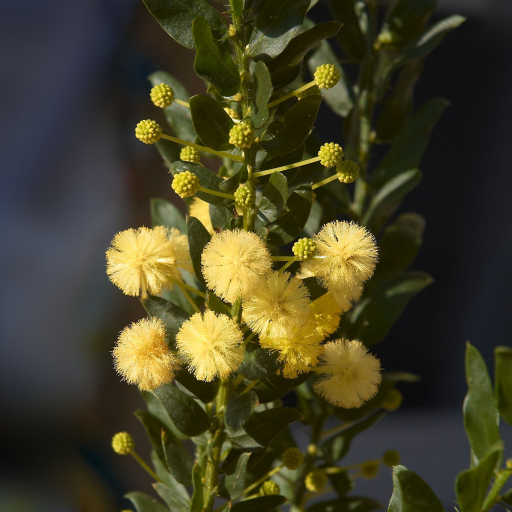
Plant Overview
Known as the Kangaroo Thorn, Acacia paradoxa is nature’s version of barbed wire. This resilient Australian native is famous for its "Dr. Jekyll and Mr. Hyde" personality: it produces soft, golden puffball flowers that smell like honey, but its branches are armed with needle-sharp spines. Historically, it was the go-to plant for early settlers looking to create a fence that no livestock—or intruder—could possibly breach.
🔍 How to Identify
- ⚔️ The Spines: The most defining feature is the pair of sharp, stiff thorns (stipules) located at the base of every "leaf." They are roughly 1-2 cm long and point outward.
- 🌿 Wavy Phyllodes: What look like leaves are actually "phyllodes" (flattened leaf stalks). They are small, dark green, and have a distinctively wavy or crinkled edge.
- 🟡 Golden Puffballs: During late winter and spring, the shrub is covered in individual, bright yellow spherical flower heads that look like tiny pom-poms.
🏡 In Your Garden
- 🛡️ The Living Fortress: This is the ultimate security plant. Because it grows into a dense, prickly thicket, it is perfect for planting under windows or along property lines where you want to discourage foot traffic.
- 🐦 Wildlife Sanctuary: Small birds, such as wrens and finches, absolutely love the Kangaroo Thorn. The dense, thorny interior provides a "predator-proof" zone where cats and larger hawks cannot reach them.
- 💪 Rugged Reliability: This acacia is a survivor. It is highly resistant to drought, frost, and salty coastal winds. It prefers well-draining soil and doesn't mind "neglect" once its root system is established.
⚠️ Safety & Toxicity
- 🩹 Physical Hazard: The primary risk is the thorns. They are incredibly sharp and can easily puncture skin or thin gardening gloves. Always wear heavy-duty leather gloves when pruning.
- 🐾 Pet Safety: While the plant is not considered chemically toxic to dogs or cats, the thorns can cause serious injury to eyes or paws if a pet tries to run through the bush.
- 🚲 Tire Warning: Be careful planting this near driveways; the fallen dried thorns are strong enough to puncture thin bicycle tires!
✨ Fun Fact
In the mid-1800s, the Kangaroo Thorn was so effective as a barrier that it was exported from Australia to places like California and South Africa specifically to be used as "biological fencing" before the invention of modern wire fences.

Detailed Care Instructions
To grow an Acacia paradoxa plant, follow these steps:
- Seed collection: Acacia paradoxa plants produce long seed pods. Collect the seeds from a mature plant by picking the pods when they are dry and brown.
- Seed preparation: Scarify the seeds to enhance germination by nicking the hard outer coat. You can use a file or sandpaper to lightly scratch the seed surface. Soak the seeds in hot water for 24 hours to soften the coat further.
- Germination: Sow the scarified seeds in a well-draining seed-raising mix or sandy soil. Place the seeds just below the soil surface and lightly cover them. Keep the soil moist but not waterlogged.
- Optimal conditions: Acacia paradoxa requires full sun exposure, so choose a sunny spot for planting. The plant thrives in well-draining sandy or loamy soil types. Make sure the location receives adequate air circulation.
- Watering: Water the seedlings regularly during the first few months until they establish a good root system. Once established, Acacia paradoxa is drought-tolerant and only requires occasional watering during dry periods.
- Maintenance: Acacia paradoxa plants generally don't require much maintenance. However, it's beneficial to prune them in early spring to maintain shape and size. Remove any dead or damaged branches.
- Protection: Protect young seedlings from pests like rabbits or larger herbivores by using plant guards or fences until they grow taller.
- Fertilization: Acacia paradoxa is generally low-maintenance and doesn't require frequent fertilization. However, you can apply a slow-release fertilizer in spring to promote healthy growth.
Starting from seeds, it may take a few years for your Acacia paradoxa plant to reach a mature size. Patience is key when growing this plant.

Place in a bright room that is sun drenched almost all day. Or directly in a south-facing window.

Acacia Paradoxa is a plant that belongs to the family Fabaceae. This plant requires regular watering to grow and thrive. To keep your plant healthy, you should follow some guidelines for watering it.
Firstly, you should water your plant once a week during the growing season. This is usually from spring to fall, when the plant is actively growing. However, if the weather is extremely hot or dry, you should increase the frequency of watering.
Secondly, you should check the soil moisture before you water the plant. You can do this by inserting your finger into the soil up to the first knuckle. If the soil is dry, it’s time to water the plant. However, if the soil is still moist, you should wait a few days before watering.
Thirdly, when you water the plant, make sure you water deeply. This means you should water until the soil is saturated to a depth of at least 6 inches. You can use a watering can or a garden hose to water the plant.
Lastly, you should avoid watering the plant too much. Overwatering can cause root rot and other diseases. It’s important to give the plant time to dry out between waterings. You can achieve this by watering less frequently or adjusting the amount of water you give the plant.
To fertilize this plant, use a balanced fertilizer with equal parts nitrogen, phosphorus, and potassium. Apply the fertilizer in early spring before new growth appears, and again in early summer. Make sure to water the plant well before and after fertilizing. Avoid over-fertilizing, as this can damage the plant.
Acacia Paradoxa plant requires a well-draining soil with a pH range of 6.0 to 7.5. The soil should be nutrient-rich, with a mix of sand, loam, and clay. The plant prefers soil with good water retention capacity as it can survive in dry conditions as well as periods of flooding. The soil should not be too compacted, and it should allow for good airflow and drainage. It is important to add organic matter such as compost or manure to the soil to increase its fertility. The soil should be kept moist, but not waterlogged, and should be allowed to dry out slightly between watering. Bacteria and fungi present in the soil are important for the plant's growth and development, so it is important to avoid using chemical fertilizers or pesticides.
Acacia Paradoxa can be propagated by collecting seeds from its pods in the autumn or winter. The seeds should be cleaned and soaked in warm water for 24 hours before planting in well-draining soil. The soil should be watered regularly to keep it moist, but not waterlogged. In addition, cuttings can also be taken from the plant in late summer or early autumn and rooted in propagation mix. The cuttings should be kept in a warm and moist environment until they have rooted.








