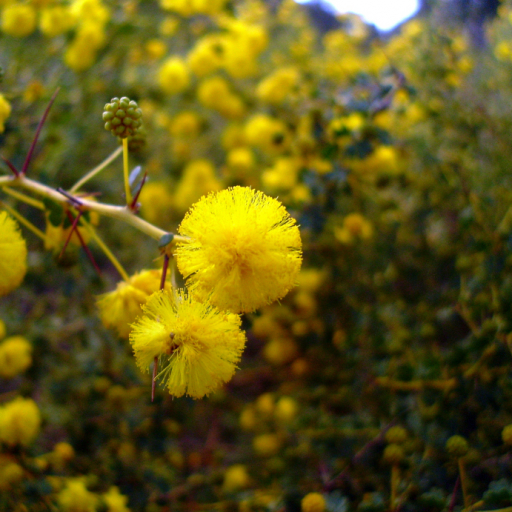
Plant Overview
Often called the Prickly Moses, this Western Australian native is a resilient survivor that brings a burst of sunshine to the scrubland. Its nickname is a clever play on its botanical name (pulchella means "beautiful") and its fierce, thorny personality. In the wild, it acts as a protector of the bush, providing a safe haven for small birds and fixing nitrogen back into the soil after fires.
🔍 How to Identify
- 🌵 The Spines: Look for sharp, slender thorns (stipules) at the base of the leaves. These are its primary defense against hungry herbivores.
- 🌿 Feathery Foliage: Unlike many other Acacias that have flattened leaf stalks (phyllodes), the Prickly Moses has true, bipinnate leaves that look soft and fern-like.
- 🟡 Golden Pom-poms: In late winter and spring, the plant is covered in bright yellow, spherical flower heads that look like tiny glowing suns.
🏡 In Your Garden
- 🧪 Soil Healer: This plant belongs to the legume family, meaning it has a special relationship with bacteria in its roots to "fix" nitrogen. It’s an excellent choice for rehabilitating poor, sandy soils.
- 🐦 Bird Guardian: Because of its dense, thorny nature, it is one of the best "habitat plants" you can grow. Small honeyeaters and wrens love to nest inside its branches where cats and larger predators can't reach them.
- ☀️ Sun Lover: It thrives in full sun and requires very little water once established. However, it has a relatively short lifespan (about 10-15 years), often giving its life to enrich the soil for the next generation of plants.
⚠️ Safety & Toxicity
- ⚔️ Physical Hazard: While not known to be chemically toxic to humans or common household pets, the thorns are incredibly sharp.
- 🧒 Placement: Avoid planting this near narrow walkways, play areas for children, or spots where pets frequently run, as the spines can cause painful scratches or skin irritation.
✨ Fun Fact
The Prickly Moses is more than just a pretty face; it’s a "forest doctor." Research has shown that this plant can actually help suppress Phytophthora cinnamomi, a devastating water mold that causes "dieback" in many other Australian trees.

Detailed Care Instructions
Here are some steps to help you grow Acacia Pulchella plant:
- Obtain seeds or seedlings: You can either collect seeds from existing plants or purchase them from a reputable nursery or online seed supplier.
- Prepare the soil: Acacia Pulchella prefers well-drained soil with a slightly acidic to neutral pH. Prepare the soil by removing any weeds or debris and loosen it to promote better root growth.
- Soak the seeds: If you're using seeds, you can enhance germination rates by soaking them in warm water for 24 hours before planting. This helps to soften the hard outer shell of the seeds and speed up germination.
- Sow the seeds: Plant the seeds in the prepared soil at a depth of around 1/4 to 1/2 inch. Space them out about 6-12 inches apart to allow for growth. If you're using seedlings, dig holes that are slightly larger than the root ball and place the seedlings in the holes.
- Provide proper watering: Water the seeds or seedlings immediately after planting to ensure good soil contact and to help settle the plant. Afterwards, water the plants regularly, keeping the soil consistently moist but not waterlogged. During hot and dry periods, increase the frequency of watering.
- Give adequate sunlight: Acacia Pulchella enjoys full sunlight, so choose a location that receives at least 6 hours of direct sunlight per day. Place the plants in an area where they won't be overshadowed by taller plants or structures.
- Provide support if necessary: If Acacia Pulchella grows tall and has weak stems, you may need to provide support, such as stakes or trellises, to prevent the plant from bending or breaking.
- Apply fertilizer: While Acacia Pulchella can tolerate poor soils, you can apply a slow-release fertilizer once or twice a year to promote growth and flowering. Use a balanced fertilizer with an NPK ratio of 10-10-10 or similar.
- Prune as needed: Acacia Pulchella doesn't require extensive pruning, but you can trim any damaged or dead branches. Pruning also helps maintain a desirable shape and encourages bushier growth.
- Protect from frost: This plant is not frost-tolerant, so if you live in a region with cold winters, consider protecting your Acacia Pulchella from frost by covering it with a blanket or moving it indoors when necessary.
By following these steps, you can successfully grow Acacia Pulchella plant in your garden or container.

Place in a bright room that is sun drenched almost all day. Or directly in a south-facing window.

1. Find a plant that has thin, delicate leaves and small, yellow flowers on spikes.
2. Determine the location of the plant. Is it inside or outside? Is it planted in a pot or in the ground?
3. Check the soil moisture by sticking your finger one inch into the soil. If it is dry, the plant needs water.
4. Use a watering can or hose to gently water the plant at the base. Do not get the leaves wet, as this can encourage disease.
5. Keep an eye on the soil moisture and adjust the watering schedule accordingly. During hot and dry weather, you may need to water more frequently.
6. If the plant is in a pot, make sure it has adequate drainage to prevent waterlogging.
7. Water during the morning or late afternoon to avoid evaporation and to allow the soil to soak up moisture before the heat of the day.
To fertilize this plant, use a balanced slow-release fertilizer with a 10-10-10 N-P-K ratio during the active growing season. Apply the fertilizer according to the manufacturer's instructions and avoid over-fertilizing, as this can damage the plant. Water the plant thoroughly before and after fertilizing. Additionally, incorporating organic matter into the soil can also provide necessary nutrients for the plant.
Acacia Pulchella is a plant that requires well-draining soil. The soil should be a mixture of sand, loam, and perlite. The pH of the soil should be slightly acidic to neutral, with a range of 6.0 to 7.5. The plant prefers a soil that is rich in nutrients, with a good balance of organic matter. It is important to avoid soil that is heavy in clay, as this can cause waterlogging and root rot. When planting Acacia Pulchella, it is recommended to add compost or aged manure to the soil, and to ensure that the soil is kept moist, but not waterlogged.
Acacia Pulchella plant can be propagated through various methods such as seed propagation, cutting propagation, and layering.
Seed propagation involves collecting the seeds from the plant and germinating them. The seeds should be collected when they are fully mature and dried before being sowed in well-drained soil. The soil should be kept moist until the seeds start to germinate, which usually takes around 14 to 21 days.
For cutting propagation, select stem cuttings from healthy, disease-free plants. Cuttings should be about 6 to 8 inches long and should include a few leaves. Remove the lower leaves and dip the cut end into rooting hormone. Place the cutting in soil, or water until they develop roots, and then transfer it to soil.
Layering is another method, where a small branch is bent and partially buried in soil, leaving the tip exposed. After a few weeks, the plant will develop roots and can be separated from the parent plant and transplanted.
Regardless of the propagation method chosen, it is essential to keep the plant moist and in indirect light until it has fully established itself in its new environment.








