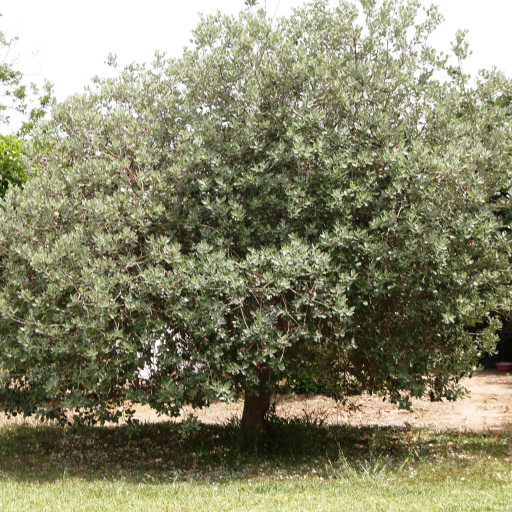
Plant Overview
Often called the "Pineapple Guava" or "Feijoa," this South American beauty is a rare triple threat for the home gardener. It functions as a hardy evergreen screen, produces stunning "firework" flowers, and yields a delicious tropical fruit that tastes like a blend of pineapple, strawberry, and mint. It is beloved in temperate and subtropical climates for being remarkably fuss-free while looking like a high-maintenance exotic.
🔍 How to Identify
- 🍃 The Foliage: Look for thick, leathery, egg-shaped leaves. They are a deep olive green on the top, but the undersides are a striking, fuzzy silvery-white that "shimmers" when the wind blows.
- 🌺 The Flowers: These are unmistakable. They feature fleshy, curled-back white petals with a cluster of dramatic, bright crimson-red stamens tipped with gold pollen.
- 🍏 The Fruit: The fruit is dull green and roughly the size of a chicken egg. Unlike most fruits, it doesn't change color when ripe; you’ll know it’s ready when it drops to the ground or yields to a gentle squeeze.
🏡 In Your Garden
- 🛡️ Coastal Champion: The Pineapple Guava is incredibly tough. It is highly resistant to salt spray and wind, making it an ideal choice for seaside gardens where other fruit trees might struggle.
- ✂️ Versatile Growth: Because it responds so well to pruning, it is often used as an "edible hedge." It can be kept as a tight, formal wall or allowed to grow into a multi-trunked, whimsical small tree.
- ☀️ Sun & Soil: While it is drought-tolerant once established, it needs consistent watering during the flowering and fruiting stage. If the soil dries out too much while the fruit is forming, the plant may drop its crop prematurely to save itself.
⚠️ Safety & Toxicity
- ✅ Pet Friendly: The Pineapple Guava is non-toxic to dogs, cats, and horses, making it a safe choice for family landscapes.
- 🍴 Edible Safety: Both the fruit and the flower petals are completely edible for humans. However, always ensure the plant hasn't been treated with systemic pesticides before snacking on the blooms.
✨ Fun Fact
The flower petals are actually a gourmet delicacy! They have a surprisingly sweet, spicy flavor—often compared to cinnamon-sugar or marshmallows. In their native habitat, birds are the primary pollinators because they love to eat these sugary petals.

Detailed Care Instructions
| Humidity | Dry |
| Lighting | Full Sun |
| Difficulty | Medium |
| Hibernation | Cold Period |
| Hardiness Zones | 8 - 11 |
To grow Acca sellowiana (Feijoa) plants, you can follow these steps:
- Choose the right location: Acca sellowiana plants prefer full sun but can tolerate partial shade. They prefer a fertile, well-draining soil with a pH level between 5.5 and 8.0.
- Planting: Dig a hole that is slightly larger than the root ball of the plant. Place the plant in the hole and backfill it with soil. Make sure the soil is firm around the plant, but not compacted.
- Watering: Acca sellowiana plants require regular watering, especially during dry periods. Water deeply but infrequently to encourage deep root growth.
- Mulching: Apply a layer of organic mulch around the base of the plant to regulate soil temperature, retain moisture, and prevent weeds.
- Fertilizing: Feijoa plants benefit from regular fertilization. Use a balanced fertilizer formulated for fruit trees or shrubs in early spring and again in mid-summer. Follow the manufacturer's instructions for dosage.
- Pruning: Prune the plant in late winter or early spring to maintain a desired shape and remove any dead or diseased branches. Thin out crowded branches to improve air circulation and sunlight penetration.
- Pest and disease control: Acca sellowiana plants are generally resistant to pests and diseases. However, keep an eye out for common issues like fruit fly, scale insects, or fungal diseases. If necessary, consult with a local garden center or extension service for appropriate control measures.
- Fruit production: Feijoa plants typically start producing fruits within 2-3 years of planting. The fruits are ready to harvest when they fall easily from the tree and have a slight give when gently squeezed.
Remember to research specific care recommendations for your local climate and soil conditions, as these can vary.

Place in a window with dappled sun or a spot in the middle of a room. Or directly in a window facing west or east.

To properly water this plant, you should first check the soil moisture by inserting your finger about 1 inch into the soil. If it feels dry to the touch, it's time to water. Use room temperature water and gently pour it onto the soil around the base of the plant until water starts to drain out the bottom of the pot. Avoid watering the leaves as this can lead to disease. The frequency of watering depends on factors such as temperature, humidity, and the size of the pot. Generally, it's better to underwater than overwater this plant as it is sensitive to root rot.
To fertilize this plant, apply a balanced fertilizer with a ratio of 10-10-10 in early spring before new growth appears. Repeat application every 6-8 weeks during the growing season until late summer. Avoid applying fertilizer in late fall and winter as this may promote tender growth that can be damaged by frost. Ensure the soil is moist before applying fertilizer, and water thoroughly after application to avoid burning the roots. Always follow manufacturer's instructions for dosage and application.
There are a few different soil options that can be used for this plant, but most growers suggest a well-draining soil that is rich in organic matter. Some possible ingredients to use in a custom soil mix might include a combination of peat moss, perlite, and vermiculite, along with some added compost or fertilizer. It is important to ensure that the soil is not too heavy or soggy, as Acca Sellowiana prefers a somewhat dry and well-aerated growing environment. Other factors to consider when selecting a soil type might include the climate in your region, the sunlight and humidity levels in your growing space, and the specific needs of your particular plant.
Acca sellowiana plant can be propagated from both seeds and cuttings.
To propagate from seeds, it is recommended to collect fresh seeds from mature fruits and sow them immediately. The seeds can be planted directly in a well-draining soil mix or in a seed-starting tray. Cover the seeds with a thin layer of soil and keep the soil moist. Germination usually occurs within 2 to 6 weeks.
To propagate from cuttings, choose a healthy stem from the parent plant and cut it at a 45-degree angle. Remove the leaves from the lower half of the stem and dip the cut end in a rooting hormone. Plant the cutting in a well-draining soil mix and keep the soil moist. Cover the cutting with a plastic bag or dome to maintain high humidity. The cutting should produce roots within 4 to 6 weeks.
Both methods of propagation require warm and humid conditions for successful growth. It is important to keep the soil moist, but not waterlogged, during the propagation process. After the seedlings or cuttings have rooted and established themselves, they can be transplanted to their permanent location in a well-draining soil mix with regular watering and fertilization.








