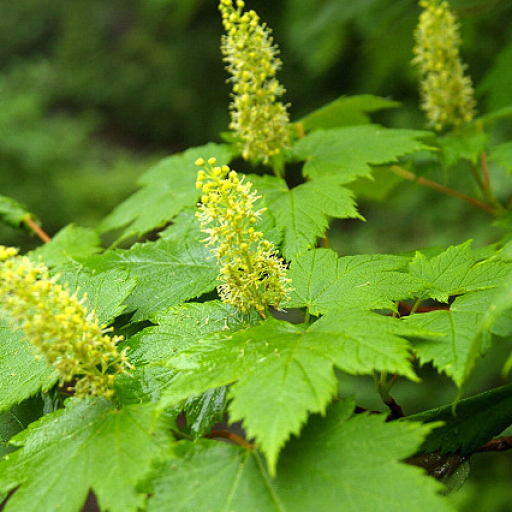
Plant Overview
The Tailed-leaf Maple, scientifically known as Acer caudatum, is a refined mountain dweller originating from the high-altitude forests of the Himalayas and parts of China. Often called the "Himalayan Maple," it is cherished by collectors for its elegant, slender foliage that looks as though a calligrapher carefully extended every leaf tip. It brings a touch of misty, high-mountain serenity to any cool-temperate landscape.
🔍 How to Identify
- 🍃 The "Tailed" Tips: The most striking feature is its 5 to 7-lobed leaves, where each lobe ends in a long, whip-like "tail" (acuminate tip) that gives the tree its name.
- 🎋 Upright Flowers: While many maples have drooping flower clusters, this species produces small, greenish-yellow blossoms that stand in stiff, upright spikes called panicles.
- 🪵 Purple Shoots: Look closely at the new growth; young twigs often sport a beautiful purplish-brown or reddish hue before maturing into a smooth, greyish bark.
🏡 In Your Garden
- 🏔️ Cool & Collected: Because its native home is high in the mountains (up to 12,000 feet!), it thrives in regions with cool summers. It is not a fan of "wet feet" or sweltering tropical humidity.
- 💧 Soil Preference: It appreciates acidic, well-drained soil that mimics the forest floor. Adding a layer of organic mulch helps keep its shallow root system cool and moist throughout the growing season.
⚠️ Safety & Toxicity
- ✅ Safe for Humans: This maple is considered non-toxic to humans and is safe to plant near walkways or patios.
- 🐾 Pet Safety: It is generally non-toxic to cats and dogs. However, as with many maple species, owners of horses should be cautious, as wilted maple leaves of various species can sometimes cause respiratory issues if ingested in large quantities by livestock.
✨ Fun Fact
The specific epithet caudatum comes from the Latin word cauda, meaning "tail." These long leaf tips aren't just for show; in its humid native habitat, they act as "drip tips," helping rainwater shed quickly off the leaf to prevent fungal growth and heavy water weight!

Detailed Care Instructions
To grow Acer caudatum, also known as the Tendril Maple, you can follow these steps:
- Choosing the right location: Acer caudatum prefers partial shade to full sun, so choose a location that receives sun for part of the day but is also protected from intense afternoon sun. Ensure the soil is well-draining.
- Soil preparation: Prepare the soil by loosening it with a garden fork or tiller to a depth of about 12 inches. Incorporate organic matter such as compost to improve fertility and drainage.
- Planting: Dig a hole that is slightly larger than the root ball of the Acer caudatum. Place the plant in the hole, ensuring the top of the root ball is level with or slightly above the soil surface. Backfill the hole with soil, gently firming it around the root ball.
- Watering: Water the newly planted Acer caudatum thoroughly immediately after planting. Water regularly to keep the soil consistently moist but not waterlogged. Avoid overwatering, as this can lead to root rot.
- Mulching: Apply a layer of organic mulch such as wood chips or bark around the base of the plant. This helps conserve moisture, suppress weed growth, and insulate the roots.
- Pruning: Prune Acer caudatum in late winter or early spring to remove any dead, damaged, or crossing branches. This will help maintain the plant's shape and overall health.
- Fertilizing: Apply a slow-release fertilizer in early spring to provide the Acer caudatum with necessary nutrients. Follow the instructions on the fertilizer packaging for proper application rates.
- Protection from extreme conditions: During periods of extreme heat or cold, you may need to provide additional protection to the plant. This can be done by providing shade or covering it with a frost cloth or protective cover.
- Monitoring and maintenance: Regularly monitor the plant for signs of pests or diseases. Keep an eye out for aphids, scale insects, or leaf spot diseases. If any issues arise, take appropriate measures to control and treat the problem.
By following these steps, you should be able to successfully grow Acer caudatum and enjoy its attractive foliage and unique characteristics.

Place in a window with dappled sun or a spot in the middle of a room. Or directly in a window facing west or east.

Acer caudatum plant requires regular watering to thrive, especially during the growing season. When watering, make sure that the soil is moist but not soaked. The frequency of watering depends on various factors such as the plant's age, size, and the time of the year.
Before watering, ensure that the soil surface is dry to the touch. Water the plant gently, making sure that the water reaches the root zone. Avoid splashing water on the foliage to prevent fungal diseases. Provide enough water to the point of runoff, ensuring that the plant is not sitting in stagnant water.
During the growth stage, Acer caudatum plant may require watering 3-4 times a week, while in winter, the frequency can be reduced to once a week. Always check the soil moisture content before watering to avoid overwatering.
In summary, Acer caudatum plant requires regular watering to keep the soil moist but not waterlogged. Water the plant deeply and infrequently, depending on the time of the year and the growth stage. Additionally, avoid splashing water on the foliage to prevent fungal diseases.
To fertilize Acer Caudatum plant, use a balanced fertilizer with equal amounts of nitrogen, phosphorus, and potassium. Apply the fertilizer in the spring before new growth appears and again in the fall after leaf drop. Follow the package instructions for the amount to apply based on the size of your plant. Do not over-fertilize as this can burn the roots and harm the plant. Also, avoid getting fertilizer on the leaves or other plant parts as this can cause damage. Water the plant thoroughly after fertilizing to help distribute the nutrients evenly throughout the soil.
When it comes to planting Acer caudatum, it is important to use soil that is well-draining, fertile, and slightly acidic. It should also have good moisture retention to prevent the plant from drying out too quickly.
Ideally, the soil should be composed of equal parts of peat moss, compost, and loam. This will provide a good balance of nutrients, drainage, and moisture retention. It may be necessary to amend the soil with sand or perlite to improve drainage if the soil is particularly heavy or clay-like.
It is important to avoid using soil that contains large amounts of lime, as this will increase the pH of the soil and make it too alkaline for the plant. Similarly, soil that is too sandy or nutrient-poor may result in stunted growth or poor health.
Overall, the key is to provide a well-balanced soil that allows the Acer caudatum to grow healthy roots and access the nutrients it needs to thrive.
To propagate this plant, you first need to find a healthy and mature specimen. Cut a stem from the plant using a clean and sharp pair of pruning shears. Make sure the stem is at least 6 inches long and has several nodes or buds.
Remove the leaves from the bottom half of the stem, leaving only a few leaves at the top. Dip the cut end of the stem into a rooting hormone powder to promote root growth.
Prepare a pot with a well-draining soil mix. Make a hole in the soil using a pencil or a finger and insert the stem into the hole, making sure that the bottom nodes are buried in the soil.
Water the soil well and place the pot in a bright but indirect light. Keep the soil moist but not waterlogged. You can cover the pot with a plastic bag to create a greenhouse effect and retain moisture.
Check the cutting regularly for any signs of root development. Once the roots have formed, you can transplant the cutting into a larger pot or a permanent location in your garden.








