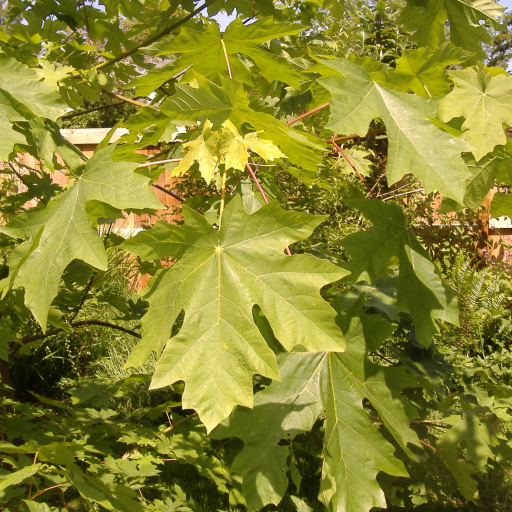
Plant Overview
Known as the "Giant of the Maples," the Bigleaf Maple (Acer macrophyllum) is a majestic cornerstone of the Pacific Northwest forests. It is famous for producing the largest leaves of any maple species in the world, sometimes reaching over a foot in diameter. In its native habitat, these trees are often so draped in moss and ferns that they look like green, shaggy monsters straight out of a fantasy novel.
🔍 How to Identify
- 🍃 The Foliage: Massive, deeply five-lobed leaves that can span 12 to 15 inches across. They turn a brilliant, warm gold in the autumn.
- 🌼 Spring Blooms: Long, drooping clusters (racemes) of fragrant, greenish-yellow flowers that appear just as the leaves begin to unfurl.
- 🚁 The "Helicopters": Paired winged seeds (samaras) that are distinctively hairy and joined at a sharp angle, designed to whirl away in the wind.
🏡 In Your Garden
- 🌳 Space Requirements: This is not a tree for a small suburban yard. Because of its massive canopy and aggressive, wide-spreading root system, it needs significant room to breathe away from pipes and foundations.
- 🌿 An "Epiphyte Apartment": If you live in a humid climate, the calcium-rich bark of the Bigleaf Maple acts as a perfect substrate. It often hosts "hanging gardens" of licorice ferns and mosses, which actually help the tree by capturing moisture and nutrients from the air.
⚠️ Safety & Toxicity
- ✅ Safe Status: Generally considered non-toxic to humans, cats, and dogs. Unlike the Red Maple (Acer rubrum), it does not have a high reputation for toxicity in horses, though caution is always advised with wilted leaves.
- 🧤 Skin Irritation: The fuzzy, stiff hairs on the seed pods (samaras) can be a mechanical irritant. If you are handling a large number of seeds, they might cause a "prickly" or itchy sensation on sensitive skin.
✨ Fun Fact
While the Sugar Maple of the East Coast gets all the fame, the Bigleaf Maple can also be tapped for syrup! It takes about 40 gallons of its sap to produce one gallon of syrup, which has a unique, earthy flavor profile with hints of vanilla and caramel.

Detailed Care Instructions
| Bloom Time | March To May |
| Plant Type | Deciduous Tree |
| Mature Size | From 20 Feet To 100 Feet Tall And Wide |
| Sun Exposure | Full Sun, Partial Shade, And Full Shade |
| Hardiness Zones | 5 To 9 |
To successfully grow Acer Macrophyllum (Bigleaf Maple) plants, follow these steps:
- Purchase seeds or plants: Obtain the seeds or seedlings of Acer Macrophyllum from a local nursery, garden center, or online retailer.
- Choose an appropriate planting site: Acer Macrophyllum performs best in well-drained soil with good moisture retention. Select a location that receives partial shade to full sun, preferably near a water source.
- Prepare the soil: The soil should be loosened and amended with organic matter, such as compost or leaf mold, to enhance drainage and moisture retention.
- Plant the seeds or seedlings:
- If planting seeds: Sow the seeds in the prepared soil, burying them about 1/4 inch deep. Water the soil gently to ensure good contact between the seeds and the soil. Use mulch to cover the area, which will help retain moisture and protect the seeds.
- If planting seedlings: Dig a hole slightly larger than the root ball of the seedling and place the plant into the hole. Backfill with soil, making sure the top of the root ball is level with the soil surface. Tamp the soil gently and water thoroughly.
- If planting seeds: Sow the seeds in the prepared soil, burying them about 1/4 inch deep. Water the soil gently to ensure good contact between the seeds and the soil. Use mulch to cover the area, which will help retain moisture and protect the seeds.
- Water regularly: Keep the soil consistently moist but not waterlogged. Water deeply once or twice a week, especially during dry spells or in the first year of growth. Monitor moisture levels by checking the soil with your finger.
- Mulch the planting area: Apply a layer of organic mulch around the base of the plant, leaving a small space around the stem to prevent rotting. Mulch will help retain moisture, regulate soil temperature, and suppress weed growth.
- Prune as necessary: Pruning is not typically required for Acer Macrophyllum. However, if you need to shape or remove damaged or dead branches, do so during the dormant season.
- Protect from pests and diseases: Inspect the plants regularly for signs of pests or diseases, such as aphids or powdery mildew. If detected, treat the issue promptly with appropriate organic insecticides or fungicides.
- Provide winter protection: In colder regions, protect young Acer Macrophyllum plants from heavy frost or freezing temperatures by covering them with frost blankets or burlap.
- Maintain regular care: Continue to water, monitor for pests and diseases, and provide fertilization if necessary following the manufacturer's instructions.
By following these steps, you can successfully grow Acer Macrophyllum plants and enjoy their beautiful foliage.

Place in a bright room that is sun drenched almost all day. Or directly in a south-facing window.

To water this plant, you should ensure that the soil is not too dry or too wet. To check this, put your finger a few inches into the soil to feel for moisture. If the soil is dry, it is time to water the plant. When watering, slowly pour water around the base of the plant and allow it to soak into the soil. Avoid getting water on the leaves as this can lead to disease and pest problems. The frequency of watering will depend on factors such as temperature, humidity, and the size of the pot or planting area. It is important not to overwater this plant as it can lead to root rot and other issues.
To fertilize this plant, use a slow-release fertilizer in the early spring before new growth appears. Apply the fertilizer around the base of the plant and water in well. Do not over-fertilize as this can lead to salt buildup in the soil. Additionally, you can also apply an organic mulch around the base of the plant to provide nutrients and help retain moisture in the soil.
When planting Acer Macrophyllum, it is important to use a specific type of soil to ensure optimal growth and health. The ideal soil should be well-draining and slightly acidic, with a pH range of 5.5 to 6.5. The soil should also be rich in organic matter and nutrients, including nitrogen, phosphorus, and potassium.
To achieve this type of soil, it is recommended to mix a high-quality potting mix with compost, peat moss, or well-rotted manure. This will help to improve the soil structure and increase the availability of nutrients for the plant.
It is important to avoid using heavy or compacted soils, as these can lead to poor drainage and waterlogged roots. Additionally, soils that are too alkaline can cause the plant to struggle with nutrient uptake and exhibit signs of stunted growth or yellowing leaves.
Proper soil preparation is key to ensuring healthy growth and a long lifespan for your Acer Macrophyllum plant. By providing the right type of soil, you can help your plant thrive and flourish for years to come.
Propagation of this plant can be accomplished through several methods, including seed propagation, cuttings, and layering. Seed propagation involves collecting seeds from mature plants and planting them in a suitable growing medium. Cuttings involve taking a stem or branch from a mature plant and propagating it by rooting it in a growing medium.
Layering is another method of propagation, which involves encouraging a branch or stem to create roots while still attached to the parent plant. This can traditionally be done by bending a low-lying branch into the soil and covering it with soil or a growing medium until it roots. Once propagated successfully, the parent plant can be severed from the new plant.
Propagation efforts require careful attention to detail regarding the appropriate growing medium, watering practices, and temperature conditions, among other factors. By following a careful and methodical approach, this plant can be effectively propagated to produce new plants.








