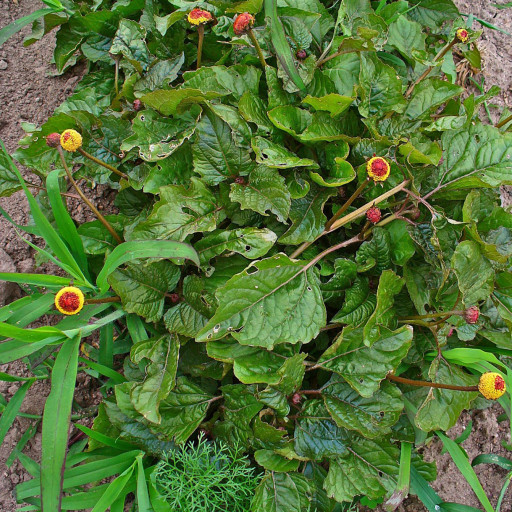
Plant Overview
Known as the "Toothache Plant," "Electric Daisy," or "Sichuan Buttons," Acmella oleracea is one of nature’s most sensory-rich surprises. Originating from the tropics of Brazil, this plant has gained worldwide fame not just for its bizarre, petal-less flowers, but for the "electric" buzzing sensation it produces when tasted. It is a favorite among avant-garde chefs and curious gardeners who want a plant that literally talks back.
🔍 How to Identify
- 🌼 The "Bull’s Eye" Bloom: Unlike traditional daisies, these flowers lack outer petals. They appear as yellow, olive-shaped "buttons" with a distinct dark maroon or brownish-red spot at the very top, giving them the appearance of a tiny eyeball.
- 🍃 Bronzed Foliage: The leaves are heart-shaped or triangular with wavy, serrated edges. In high light, the deep green veins can take on a beautiful bronze or purple hue.
- 🌱 Low-Slung Habit: The plant grows in a spreading, mounded fashion, rarely exceeding 12–15 inches in height, making it an excellent choice for the front of a garden border or a hanging basket.
🏡 In Your Garden
- 💧 Thirsty and Tropical: Because it hails from the rainforest, this plant is not drought-tolerant. It prefers consistently moist, well-draining soil; if the soil dries out completely, the plant will wilt dramatically, though it usually "faints" and recovers quickly once watered.
- ☀️ Heat Over Frost: The Electric Daisy thrives in the heat and humidity of summer. It is extremely sensitive to cold; even a light frost will end its season, so many gardeners treat it as an annual or bring it indoors for the winter.
⚠️ Safety & Toxicity
- 👅 The Numbing Effect: The plant contains spilanthol, a natural analgesic. While safe to touch and technically edible, chewing a flower head will cause an intense tingling, followed by a mouth-numbing sensation and increased salivation.
- 🐾 Pets and Kids: While not considered "deadly" toxic, the numbing sensation can be very distressing for dogs or cats if they decide to snack on it. It’s best to keep it in a raised pot or a spot where pets won't accidentally graze on the "buzzing" buttons.
✨ Fun Fact
The Acmella oleracea is often referred to as "Nature’s Botox." Because spilanthol can temporarily relax local muscles when applied topically, extracts from this plant are used in high-end organic skincare to help smooth out fine lines and wrinkles!

Detailed Care Instructions
To grow Acmella oleracea, also known as toothache plant or paracress, you can follow these steps:
- Choose a suitable location: Acmella oleracea prefers full sun to partial shade. Ensure that the location gets at least 4-6 hours of direct sunlight each day.
- Soil preparation: Prepare a well-draining soil mixture rich in organic matter. The pH level of the soil should be slightly acidic to neutral (around 6.0-7.0). If the soil is heavy clay, add some sand or perlite to improve drainage.
- Sow the seeds: Start by sowing the seeds indoors 4-6 weeks before the last frost date. Place the seeds on the soil surface and gently press them into the soil. Do not cover the seeds with soil, as they require light to germinate.
- Germination: Maintain a temperature of around 70°F (21°C) for germination. Mist the soil surface regularly to keep it moist. Germination usually takes 1-2 weeks.
- Transplanting: Once the seedlings have developed a few sets of true leaves, transplant them into larger pots or directly into the garden. Space the plants about 6-12 inches apart, as they can spread.
- Watering: Keep the soil consistently moist but not waterlogged. Acmella oleracea requires regular watering, especially during dry periods.
- Fertilization: Apply a balanced organic fertilizer once a month during the growing season to promote healthy growth.
- Pruning and maintenance: Trim back the stems occasionally to encourage bushier growth. Deadhead any spent flowers to prolong blooming.
- Harvesting: The leaves and flowers of Acmella oleracea have a unique numbing effect and are often used in culinary applications. You can start harvesting the leaves and flowers when the plant is about 6-8 inches tall. Simply pinch or cut off the desired amount of foliage.
By following these steps, you should be able to successfully grow Acmella oleracea and enjoy its unique flavor and medicinal properties.

Place in a bright room that is sun drenched almost all day. Or directly in a south-facing window.

To water this plant, it is recommended to use a watering can or hose with a gentle flow to prevent damage to the delicate foliage. The soil should be moist, but not waterlogged, so it is important to check the soil moisture level before watering. Watering frequency may depend on factors such as temperature, humidity, and sunlight, but generally, the plant should be watered once or twice a week. It is also important to avoid getting water on the leaves as it may cause damage or fungal growth. Finally, any excess water should be drained away to prevent waterlogging and promote healthy growth.
- Begin by selecting a balanced fertilizer suitable for flowering plants.
- Mix the fertilizer with water according to the instructions on the package.
- Apply the fertilizer to the soil around the base of the plant.
- Be sure to apply the fertilizer during the growing season when the plant is actively producing new growth.
- Do not over-fertilize the plant, as this can lead to nutrient burn and other issues.
- Repeat the fertilization process every four to six weeks during the growing season.
- Regularly monitor the plant for signs of stress or nutrient deficiencies, and adjust the fertilization schedule as needed.
A suitable soil for the Acmella Oleracea plant should be well-draining and loamy in texture. It should be rich in organic matter and have a pH level of around 5.5 to 6.5. The soil should also be moist but not waterlogged, as excessive moisture can lead to root rot in the plant. Adding perlite or vermiculite to the soil mix can help improve drainage. It is also recommended to fertilize the plant regularly with a balanced fertilizer to ensure healthy growth.
Acmella Oleracea can be propagated through stem cuttings or seeds. To propagate through stem cuttings, select a healthy stem with a matured leaf, and cut it from the mother plant using a sharp, sterilized blade. The cutting should be approximately 4-6 inches long with at least 2-3 leaves. Remove the lower leaves and dip the cutting into rooting hormone powder to encourage root growth.
Plant the cutting in a well-draining potting mix and keep it in a warm, bright location with high humidity. Mist the cutting regularly and keep the soil moist but not waterlogged. After a few weeks, the cutting should have established roots and can be transplanted into its permanent growing location.
To propagate through seeds, sow the seeds in a well-draining potting mix and keep the soil moist. The seedlings should germinate in 1-2 weeks. Keep the seedlings in a bright location with good airflow and water the soil when it becomes dry. Once the seedlings have matured and established themselves, they can be transplanted into their permanent growing location.
Common pests of the toothacheplant include Spider mites, aphids, thrips. Make a habit of checking your toothacheplant frequently for pests so that any infestations can be caught and managed early.








