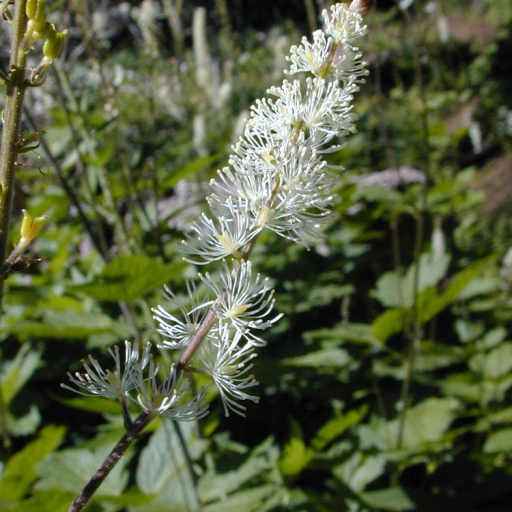
Plant Overview
Often called the "Ghost of the Old-Growth," the Tall Bugbane is a majestic woodland perennial native to the deep forests of the Pacific Northwest. In the dappled sunlight of ancient canopies, its towering white flower spikes glow like ethereal candles against the dark green undergrowth. Because it thrives in undisturbed habitats, seeing one in the wild is often a sign of a healthy, mature forest ecosystem.
🔍 How to Identify
- 📏 Stately Stature: True to its name, this plant can reach heights of 6 to 8 feet, standing head and shoulders above most other forest floor dwellers.
- ☁️ Cloud-like Blooms: The flowers lack traditional petals; instead, they consist of clusters of long, fuzzy white stamens that form a "bottle-brush" spike.
- 🍃 Lush Foliage: It features large, deeply lobed, and serrated dark green leaves that look like a mix between a maple leaf and a giant fern.
🏡 In Your Garden
- 🌳 The Deep Shade Diva: This plant is a specialist for heavy shade. It craves the cool, moist, and organic-rich soil found under a thick canopy of trees, making it a perfect architectural piece for a "north-facing" or woodland garden.
- ⏳ Patience is Key: The Tall Bugbane has a deep, sensitive root system and "sulks" if moved. It settles in slowly and should be left undisturbed once planted to allow its massive flower spikes to develop fully.
- 🐝 Pollinator Magnet: While it blooms in the late summer when many other forest plants have finished, it provides a vital nectar source for bumblebees and hoverflies.
⚠️ Safety & Toxicity
- 🚫 Toxic if Ingested: Like most members of the Buttercup family, all parts of the Tall Bugbane are poisonous if eaten. It contains protoanemonin, which can cause severe digestive distress.
- 🐾 Pet & Child Safety: Keep this plant in the back of the border where curious pets or children cannot reach it. Contact with the sap may also cause mild skin irritation or a rash in sensitive individuals.
✨ Fun Fact
The common name "Bugbane" (derived from the Old English bana, meaning "slayer") refers to the historical belief that the pungent odor of the crushed foliage and flowers of related species could drive away insects or even "banish" bedbugs when the dried leaves were stuffed into mattresses!

Detailed Care Instructions
To grow Actaea elata, also known as baneberry or doll's eyes, follow these steps:
- Climate: Baneberry plants grow best in cool, moist climates with partial to full shade. They prefer rich, well-draining soil.
- Planting: Choose a shaded spot in your garden with rich soil. Dig a hole that is slightly larger than the root ball of the plant. Place the plant in the hole and backfill it with soil, gently firming it around the roots. Make sure the crown of the plant (where the stem meets the roots) is level with or slightly above the soil surface.
- Watering: Keep the soil consistently moist, especially during the initial establishment period. Baneberry plants prefer a moist environment and can tolerate occasional wet conditions.
- Mulching: Apply a layer of organic mulch around the plant to help conserve soil moisture, suppress weeds, and provide additional nutrients as it breaks down over time.
- Fertilizing: Baneberry plants generally do not require regular fertilization if the soil is rich and well-draining. However, you can apply a balanced, slow-release fertilizer in the spring to provide any necessary nutrients.
- Pruning: Prune off any dead, damaged, or diseased branches as necessary throughout the growing season. Additionally, trim back any overgrown or unwanted branches in late winter before the new growth begins.
- Propagation: Actaea elata can be propagated by dividing the clumps in early spring or by collecting and planting the seeds in late autumn. Division should be done carefully to avoid damaging the roots.
- Pest and Disease Management: Baneberry plants are generally resistant to pests and diseases. However, keep an eye out for slugs, snails, and aphids. If needed, take appropriate measures to control these pests.
Remember to always consult local gardening resources or a nursery for specific advice tailored to your particular location and growing conditions.

Place in a window with dappled sun or a spot in the middle of a room. Or directly in a window facing west or east.

Actaea Elata is a plant that requires regular watering to thrive. Make sure to water the plant deeply and thoroughly, allowing the water to reach the roots. The plant prefers moist soil, so it is important to keep the soil moist but not waterlogged. Water the plant whenever the soil feels slightly dry to the touch. During periods of extreme heat or drought, you may need to water the plant more frequently. Be sure to water early in the day, as watering in the evening can lead to fungal growth. Avoid getting water on the foliage, as this can also promote fungal growth.
To fertilize Actaea Elata plant, apply a balanced fertilizer with equal amounts of nitrogen, phosphorus, and potassium in the spring before new growth appears. Use one tablespoon of fertilizer per gallon of water and apply it every two weeks during the growing season. Water the plant thoroughly before and after fertilizing and avoid getting the fertilizer on the leaves. Alternatively, you can use a slow-release fertilizer in the spring and reapply it every three months. Follow the instructions on the fertilizer packaging carefully and avoid over-fertilization, as it can damage the plant.
Actaea elata plant prefers a well-draining and rich soil that is moist but not waterlogged. The soil should be slightly acidic, with a pH level ranging from 5.5 to 6.5. It prefers a soil that is high in organic matter, such as compost or well-rotted manure. It is best to avoid using heavy clay soils as they tend to retain too much moisture, leading to root rot. Additionally, the soil should be kept consistently moist, but not wet or waterlogged, to prevent root damage and disease. Adding a layer of mulch around the plant can help retain moisture in the soil.
Actaea Elata plant can be propagated through several methods. One common method is by dividing the plant. To do this, wait until the plant has finished blooming and the foliage has yellowed or died back, typically in the fall or early winter. Carefully dig up the entire plant, being sure to keep the root system intact. Use a sharp, clean knife or shears to divide the clump into smaller sections, making sure each new section has roots and foliage attached. Replant the smaller sections in well-draining soil at the same depth they were growing before.
Another method of propagation is through seed. Wait until the plant has finished blooming and the flowers have turned into seed pods. Collect the pods and allow them to dry out completely. When the pods are completely dry, break them open and remove the seeds. Plant the seeds in well-draining soil in the fall or early spring and keep the soil consistently moist until the seedlings emerge.
A third method is by taking stem cuttings. Cut a stem from the plant that is about 4-6 inches long, and make sure it includes a few leaves. Remove the bottom leaves and dip the cut end in rooting hormone. Plant the cutting in well-draining soil and keep the soil consistently moist until roots form and new growth appears.








