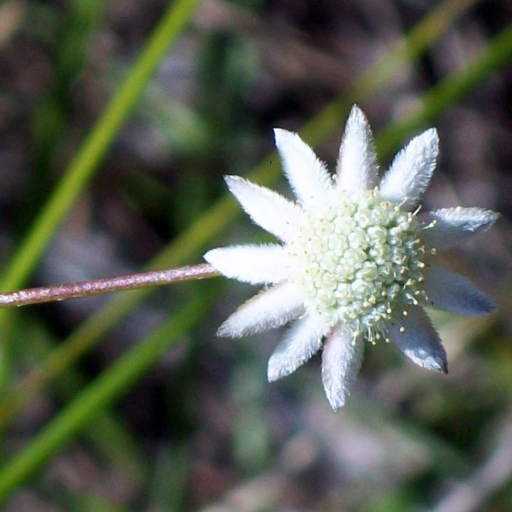
Plant Overview
Often called the Lesser Flannel Flower, this Australian native is like a miniature, felted star plucked straight from the wild bushland. While it looks like a delicate daisy, it is actually a hardy member of the carrot family, designed to survive in rugged, sandy heaths. It creates a soft, tactile experience in a native garden, appearing as if it was dusted with a fine layer of silver wool or white felt.
🔍 How to Identify
- 🌸 Star-Shaped Bracts: The "petals" are actually creamy-white, velvety bracts that surround a central cluster of tiny, true flowers.
- ☁️ Woolly Texture: True to its name, the stems and leaves are covered in soft, downy hairs that give the plant a distinct "flannel" feel and a silvery-grey glow.
- 🌿 Deeply Lobed Leaves: The foliage is small and intricately divided into narrow segments, allowing the plant to conserve moisture in windy coastal environments.
🏡 In Your Garden
- 💧 Drainage is Critical: This plant has a very sensitive root system and will quickly succumb to "wet feet." It thrives in sandy, free-draining soil and is much happier in a pot with specialized native potting mix than in heavy clay.
- 🔥 The Fire Connection: In the wild, the Lesser Flannel Flower is known as a "fire follower." Its seeds often remain dormant in the soil for years, only germinating after the heat and chemical signals of a bushfire clear the landscape.
- ☀️ Sun Seeker: To keep its growth compact and its "flannel" coating thick, it needs plenty of direct sunlight. In the shade, it can become leggy and lose its characteristic silver sheen.
⚠️ Safety & Toxicity
- ✅ Generally Safe: This plant is considered non-toxic to humans and common household pets like dogs and cats.
- 🧤 Skin Irritation: While not poisonous, the fine hairs that give the plant its soft texture can cause mild skin irritation or "itchiness" for people with sensitive skin. It is best to wear gloves when pruning large patches.
✨ Fun Fact
Despite its appearance, the Lesser Flannel Flower is in the family Apiaceae, making it a distant cousin to carrots, celery, and parsley! You can see the family resemblance if you look closely at the way its tiny central flowers are arranged in an "umbel" (umbrella-like) shape.

Detailed Care Instructions

Place in a bright room that is sun drenched almost all day. Or directly in a south-facing window.

When the top few inches of soil dry out, water your plants. If the top few inches of soil are still moist, do not water your plant. Wait a few days, then poke your finger into the soil to see if anything has changed. Overwatering poses a disease risk, such as the development of fungal diseases in the roots. These plants have adaptations in there leaves that allow them to survive in low water supply.








