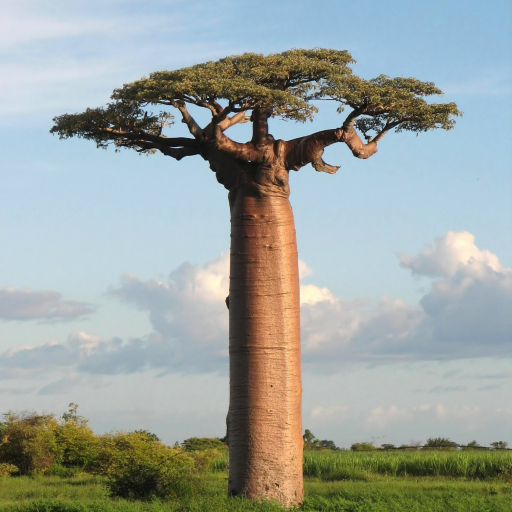
Plant Overview
Often called the "Mother of the Forest" (Renala) in its native Madagascar, Grandidier’s Baobab is the most iconic and majestic of all baobab species. Local legend says the gods planted these trees upside-down because they wouldn't stop complaining about their appearance, leaving their "roots" waving in the sky. These giants are living monuments, capable of surviving for over a thousand years by storing massive amounts of water in their swollen trunks.
🔍 How to Identify
- 🪵 The Trunk: Features a massive, smooth, cylindrical pillar of reddish-grey bark that can reach up to 10 feet in diameter.
- 🌳 The Crown: Unlike most trees, its branches are concentrated at the very top, forming a flat-topped, compact canopy that stays leafless for the majority of the year.
- 🌸 The Flowers: Produces large, spectacular white blossoms that open only at night, emitting a scent similar to fermenting fruit to attract nocturnal pollinators.
🏡 In Your Garden
- 🏜️ Water Management: These are succulent giants; their fibrous trunks act as internal reservoirs. If you are growing a juvenile or a bonsai version, you must use a gritty, desert-like soil mix, as they are extremely sensitive to "wet feet" and root rot.
- ☀️ Light & Space: They require intense, direct sunlight to develop their characteristic "bottle" shape. While they grow slowly, they develop a deep taproot early on, making them very difficult to transplant once they have settled into a spot or a large pot.
⚠️ Safety & Toxicity
- ✅ Non-Toxic: Grandidier’s Baobab is considered safe and non-toxic for humans, cats, and dogs.
- 🦴 Sturdy Nature: Because they are essentially giant water tanks, they do not drop heavy, brittle branches as often as traditional hardwood trees, making them relatively safe to walk near in the wild.
✨ Fun Fact
Grandidier's Baobabs have a secret partnership with the animal kingdom; they are primarily pollinated by Fork-marked Lemurs! These tiny primates scurry across the massive flowers at night to drink the nectar, getting their fur covered in pollen in the process.

Detailed Care Instructions
To grow Adansonia grandidieri, also known as the Grandidier's baobab, you can follow these steps:
- Climate: Make sure you live in a suitable climate. Adansonia grandidieri is native to Madagascar and grows best in warm, tropical or subtropical climates. It requires dry, hot summers and mild winters.
- Soil: The baobab tree prefers well-draining soil. Use a sandy or loamy soil mix that is slightly acidic to neutral in pH. Good drainage is essential to prevent waterlogged roots.
- Germination: Start by obtaining baobab seeds. Soak the seeds in water for 24 hours to soften the outer shell. Ensure the water is changed every few hours to prevent bacterial or fungal growth.
- Planting: Once the seeds have soaked, plant them in individual pots or directly into the ground if your climate permits. Sow the seeds about 1 inch deep, and cover lightly with soil. Ensure the pots or planting area receives full sunlight.
- Watering: Water the seeds or young seedlings sparingly, as too much water can cause root rot. Allow the soil to dry out slightly between waterings to mimic the natural cycles of rainfall and drought.
- Sunlight: Adansonia grandidieri requires full sun to thrive. Place the seedlings or plants in an area that receives at least 6-8 hours of direct sunlight each day.
- Transplanting: If you began growing the trees in pots, transplant them into larger containers or directly into the ground once they outgrow their current containers. The baobab tree has a large and deep root system, so ensure there is enough space for it to spread.
- Fertilizer: Baobab trees do not require much fertilizer. However, you can use a balanced, slow-release fertilizer once or twice a year during the growing season to provide essential nutrients. Follow the instructions on the fertilizer packaging for dosage and application instructions.
- Pruning: Minimal pruning is necessary for Adansonia grandidieri. Remove any dead or diseased branches, as well as any suckers that emerge from the base of the tree.
- Patience: Baobab trees grow slowly, especially in the early stages. Be patient and provide consistent care to allow your Adansonia grandidieri to develop into a magnificent tree over time.
Remember that growing a baobab tree requires dedication and long-term commitment. It may take several years before you see significant growth and size.
Watering the plant should be done with care and attention to detail. It is crucial to not overwater it, as this can lead to root rot and damage the plant. In general, the soil should be kept slightly moist but not saturated. The frequency of watering will depend on the season and the climate of the area it is grown in. During the hotter months or in a dry climate, the plant may require more frequent watering. On the other hand, during the cooler months or in a more humid climate, watering can be decreased. It is also important to ensure that the pot or container has proper drainage holes to allow excess water to drain away easily. Finally, it is recommended to water the plant in the morning or evening to reduce the risk of any water remaining on the leaves and potentially causing leaf burn.
To fertilize this plant, use a balanced fertilizer with equal amounts of nitrogen, phosphorus, and potassium. Apply the fertilizer once a month during the growing season, which is usually in the spring and summer. Be sure to follow the manufacturer's instructions for the specific fertilizer being used and avoid over-fertilizing, as this can damage the plant. Additionally, it is recommended to use organic fertilizers or slow-release fertilizers for best results.
Adansonia Grandidieri requires well-draining soil that is rich in organic matter. The soil should be slightly acidic to neutral with a pH range of 5.5 to 7.5. It is recommended to use a sandy or loamy soil with good drainage to prevent waterlogging. Adding perlite or sand can also help improve drainage. The soil should be kept moist, but not overly wet as this can lead to root rot. Fertilizer should be applied sparingly, as the plant does not require frequent feeding. It is best to use a slow-release fertilizer that is specifically formulated for succulent plants.
Adansonia Grandidieri can be propagated through several methods such as germinating seeds, stem cuttings, root cuttings, and grafting.
One method is collecting the seeds from mature fruit capsules and planting them in a well-draining soil mix with a layer of sand on top. The seeds should be kept warm and moist until they sprout, which can take up to several weeks.
Stem cuttings can also be taken from the plant and rooted in a moist soil mix. The cuttings should be treated with rooting hormone before planting to promote root growth.
Root cuttings involve taking a portion of the root system and planting it in a separate container with a moist soil mix. This method can take longer to establish new growth.
Grafting involves combining a cutting or scion of Adansonia Grandidieri onto a rootstock of a closely related plant to encourage faster growth and better fruit production.
Regardless of the method used, Adansonia Grandidieri should be propagated in warm, sunny areas with regular watering and well-draining soil.








