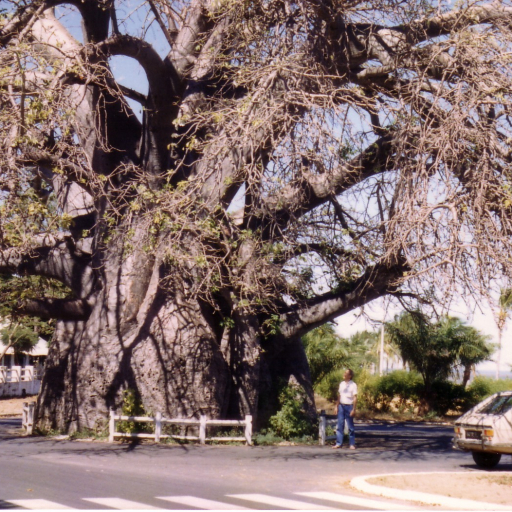
Plant Overview
Meet the Madagascar Baobab, a living monument of the dry forests often called the "Mother of the Forest" (Reniala) by locals. This iconic species is famous for its swollen, water-storing trunk and a surreal, alien-like silhouette that makes it look as though it was planted upside down. Found only on the island of Madagascar, it is a master of survival, engineered to thrive in some of the harshest, driest environments on Earth.
🔍 How to Identify
- 🌳 The Trunk: Cylindrical or slightly bottle-shaped, the trunk is covered in smooth, reddish-grey bark that often has a metallic sheen.
- 🍃 The Foliage: It features "palmate" leaves (shaped like a hand) with 5 to 7 leaflets, though the tree remains strikingly leafless for the majority of the year to conserve moisture.
- 🌸 The Blooms: It produces magnificent, large flowers with bright red to yellowish petals and long, spray-like stamens that burst open during the night.
🏡 In Your Garden
- 🏜️ The Taproot: Like its cousins, this baobab develops a deep, sensitive taproot very early in its life. It famously hates being moved or transplanted, so if you are growing one in a container or a tropical landscape, choose its "forever home" early to avoid shock.
- 💧 Dormancy Logic: This tree operates on a "boom and bust" cycle. During its dormant phase (when leaves drop), it requires almost zero water. Overwatering during this period is the most common cause of failure, as the fibrous trunk can rot from the inside out.
⚠️ Safety & Toxicity
- ✅ Non-Toxic: The Madagascar Baobab is considered safe for humans, dogs, and cats. It contains no known resins or saps that cause irritation.
- 🍈 Edible History: In its native habitat, various parts of the baobab—including the fruit pulp and seeds—are used for nutrition, though this specific species is more prized for its stature than its fruit.
✨ Fun Fact
Madagascar Baobabs are "bat-pollinated." Their flowers open at sunset and emit a heavy, musky scent specifically designed to attract fruit bats and long-tongued hawkmoths, who drink the nectar and carry pollen from tree to tree under the cover of night.

Detailed Care Instructions
To grow Adansonia madagascariensis, commonly known as the Madagascar Baobab or Giant Baobab, you can follow these steps:
- Climate and soil: Ensure you are in a climate suitable for Baobab growth. They thrive in tropical or subtropical regions with hot and dry climates. They are also adapted to grow in poor and well-draining soil.
- Seeds: Obtain Baobab seeds from a reliable source. Soak the seeds in warm water for 24 hours before planting.
- Pot or planting location: Choose a large pot with a good drainage system or select a planting spot with ample space for the tree to grow. Baobabs are known for their large size, so take this into consideration before planting.
- Planting: Fill the pot or planting spot with well-draining soil mixed with sand or perlite to improve drainage. Create a hole in the soil and plant the soaked seed, ensuring it is not planted too deep. Only a small portion of the seed should be visible above the soil.
- Watering: Water the seedling gently after planting and then only water sparingly. Baobabs are succulent-like plants, and overwatering can lead to root rot. Allow the soil to dry out between waterings, mimicking the tree's natural environment.
- Sunlight: Baobabs need full sun exposure, ideally for at least 6-8 hours a day. Place the potted Baobab plant in a location that receives abundant sunlight or select a planting spot in your garden that gets full sun.
- Fertilization: Baobabs generally grow in nutrient-poor soils, so they do not require regular fertilization. However, if you notice slow growth or yellowing leaves, you can apply a slow-release, balanced fertilizer according to the manufacturer's instructions.
- Pruning: Prune young Baobabs sparingly to shape the plant or remove crossed branches. As they grow, Baobabs should develop their iconic, unique shape naturally.
- Protection: Protect your Baobab from cold temperatures if they drop below its tolerance level, usually around 50°F (10°C). If required, move potted Baobabs indoors during colder seasons or provide winter protection to young trees planted in the ground.
- Patience: Growing a Baobab plant takes time. It can take several years for them to establish and grow, so be patient with the process.
Remember that Baobabs can become enormous and may require significant space when fully grown. Consider this when planting and ensure you are prepared for a tree of such size.

Place in a bright room that is sun drenched almost all day. Or directly in a south-facing window.

Adansonia Madagascariensis is a unique type of plant that requires specific care when it comes to watering. When watering this plant, it's important to understand that it comes from a region that experiences seasonal rainfall. This means that it prefers a long dry season followed by a short, intense rainy season.
To water Adansonia Madagascariensis, you should start by monitoring the soil moisture level. This can be done by inserting a finger about 2 inches into the soil. If the soil feels dry, it's time to water.
When watering, it's important to give the plant a deep soak. This means watering it until the water runs out of the drainage holes. However, you should only water the plant when the soil is dry, as overwatering can cause the roots to rot.
During the dry season, you should water the plant once a week. However, during the rainy season, you may not need to water the plant at all. It's important to be aware of the local climate and weather patterns to know when to water.
Finally, it's important to avoid getting the leaves wet when watering this plant, as it can cause them to rot. Instead, aim the water at the soil around the base of the plant.
Overall, watering Adansonia Madagascariensis requires careful monitoring of soil moisture levels and a deep, infrequent watering schedule to mimic its natural environment.
To fertilize this plant, use a balanced fertilizer with equal amounts of nitrogen, phosphorus, and potassium. Alternatively, use a slow-release fertilizer formulated for trees. Apply the fertilizer in the early spring and again in midsummer, following the package directions for amounts. Avoid over-fertilizing, as it can damage the plant. Water the plant thoroughly after fertilizing to help the nutrients penetrate the soil.
The soil type suitable for the plant in question should have good drainage and be capable of retaining moisture. It should also have a slightly acidic pH level ranging from 6.0-7.0. A mix of peat moss, sand, and perlite or vermiculite would be an ideal combination as it can provide adequate drainage while still retaining enough moisture for the plant's needs. It is important to ensure that the soil is well-aerated and free from any pathogens that can cause damage to the plants. The use of compost or organic matter may also be beneficial in enhancing the soil's fertility and overall health.
To propagate this plant, it is recommended to take stem cuttings from a mature and healthy parent plant. The cuttings should be approximately 6-8 inches long and at least ½ inch in diameter with several nodes along the stem. The cuttings should be taken in the early spring or late fall when the plant is dormant.
The cuttings should be allowed to dry and callus for several days before planting in a well-draining soil mix. The soil should be kept moist but not wet and the cuttings should be kept in a warm and humid environment with bright, indirect light.
Rooting hormone can be used to increase the chances of successful propagation, but it is not necessary. After several weeks, the cuttings should start to develop roots and new growth. Once the new growth appears, the plant can be transplanted into a larger pot or directly into the ground.
It is important to note that Adansonia Madagascariensis is a slow-growing plant and may take several years to reach maturity, even when propagated successfully. Additionally, this plant requires a warm, tropical climate and may not be suitable for all growing conditions.








