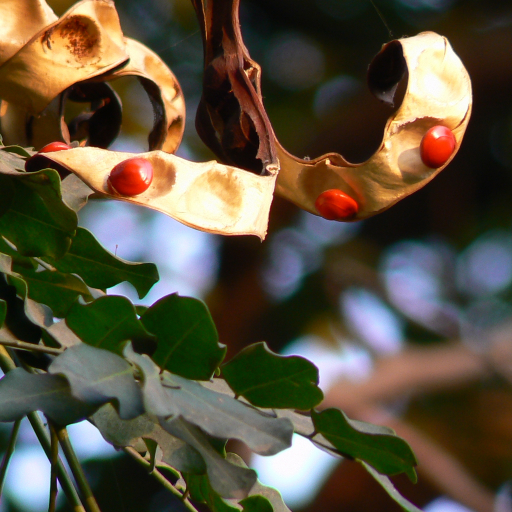
Plant Overview
Known as the "Saga Seed" or the "Circassian Seed," this deciduous tree is a titan of the tropical world. While its feathery foliage provides a cooling canopy, it is most famous for its glossy, crimson seeds that look like polished rubies. In many cultures, these seeds are symbols of love and have been used for centuries as natural beads for jewelry and even as precise weights for gold.
🔍 How to Identify
- 🌿 Feathery Foliage: The leaves are "bipinnate," meaning they branch out into smaller leaflets that give the tree a soft, fern-like appearance similar to a Mimosa.
- 🕯️ Fragrant Blooms: It produces narrow, spike-like clusters of small, creamy-yellow flowers that emit a subtle, sweet scent.
- 🌀 Twisted Pods: As the fruit matures, the long green pods turn brown and twist into elegant spirals, eventually splitting open to reveal the bright red seeds.
- 🔴 The "Saga" Seeds: The seeds are unmistakably heart-shaped, hard as stone, and maintain their brilliant red color even after many years.
🏡 In Your Garden
- 🌳 Fast-Growing Shade: This tree is a sprint-runner in the plant world, growing very quickly to provide dense shade. Because it is a legume, it actually improves the soil around it by "fixing" nitrogen.
- 🌬️ Wind & Space: Due to its height and brittle wood, it should be planted away from power lines or structures. It thrives in deep, well-draining soil and absolutely craves the humidity of a tropical climate.
- 🧹 The Litter Factor: Be prepared for "nature’s confetti." This tree drops a significant amount of leaves, pods, and seeds, which might be a chore for a manicured lawn but is excellent for natural mulching.
⚠️ Safety & Toxicity
- 🚫 Status: Toxic if Raw. While the seeds are beautiful, they contain a toxic protein (abrin-related toxalbumins).
- 🐾 Pets & Kids: The seeds are highly attractive to children because they look like candy. If swallowed whole, the hard shell often prevents poisoning, but if chewed or crushed, they can cause severe gastrointestinal distress. Always keep fallen seeds away from curious pets and toddlers.
✨ Fun Fact
In ancient India and Southeast Asia, these seeds were so remarkably uniform in weight that they were used as the standard measurement for gold and silver. One "Saga" seed was roughly equivalent to four grains of rice!

Detailed Care Instructions
Here are some tips on growing Adenanthera pavonina plants:
- Climate: Adenanthera pavonina thrives in tropical and subtropical climates. It prefers warm temperatures between 20-30°C (68-86°F) and ample sunlight.
- Soil: It grows well in a variety of soil types, including sandy, loamy, or clayey soil. Ensure that the soil is well-draining to prevent waterlogging.
- Seed Scarification: Adenanthera pavonina seeds have a hard seed coat that needs scarification to help with germination. Soak the seeds in hot water (not boiling) and let them soak overnight. Alternatively, you can lightly sand or nick the seed coat using sandpaper or a file to help water penetration.
- Germination: Sow the scarified seeds in pots or directly in the ground. Plant the seeds at a depth of 1-2 cm (0.4-0.8 inches). Keep the soil consistently moist but avoid overwatering.
- Sunlight: Adenanthera pavonina requires full sun exposure to thrive. Ensure that the plant receives at least 6-8 hours of direct sunlight each day.
- Watering: Once the seedlings are established, water them regularly to keep the soil moist but not waterlogged. Watering frequency may vary depending on the climate and soil conditions, but typically water every 2-3 days.
- Fertilization: Apply a balanced, slow-release fertilizer during the growing season to provide essential nutrients. Follow the manufacturer's instructions for application rates.
- Pruning: Adenanthera pavonina has a naturally attractive shape and rarely requires pruning. However, you can prune to remove dead or damaged branches if needed.
- Pest and Disease Control: Adenanthera pavonina is generally resistant to pests and diseases. However, be on the lookout for common pests like aphids, mealybugs, or spider mites. Treat any infestations with appropriate insecticides or organic pest control methods.
- Propagation: In addition to growing from seeds, Adenanthera pavonina can also be propagated through stem cuttings. Take 10-15 cm (4-6 inches) long cuttings from an established plant, remove the lower leaves, and plant them in a well-draining potting mix. Keep the soil moist until roots develop.
Remember to be patient, as Adenanthera pavonina can take several years to reach maturity and produce its distinctive red seeds.

Place in a bright room that is sun drenched almost all day. Or directly in a south-facing window.

Adenanthera Pavonina is a plant that requires regular watering to help it grow and thrive. When watering this plant, it is important to avoid overwatering as this can lead to root rot and other issues. The amount of water needed by this plant will vary depending on the climate and weather conditions in your area, as well as the size and maturity of the plant.
To water an Adenanthera Pavonina plant, it is best to use a watering can or hose with a gentle spray nozzle. Avoid using a strong spray as this can damage the leaves and stems of the plant. Water the soil around the base of the plant, being careful not to splash water on the leaves or flowers as this can cause damage.
During the growing season, water your Adenanthera Pavonina plant once or twice a week, allowing the soil to dry out slightly between waterings. In the winter months, you can reduce the frequency of watering to once every two weeks or so.
If you are unsure whether your plant needs watering, you can check the soil moisture level by sticking your finger into the soil up to your second knuckle. If the soil feels dry, it is time to water your plant. Over time, you will become more familiar with your plant's needs and will be able to tell when it needs watering just by looking at it.
To properly fertilize the Adenanthera Pavonina plant, use a balanced fertilizer with equal amounts of nitrogen, phosphorus, and potassium. Fertilize the plant once a month during the growing season, which is typically from spring to fall. Use a water-soluble or granular fertilizer and follow the manufacturer's instructions for dosage and application. Be sure not to over-fertilize the plant as this can lead to decreased growth and yellowing of the leaves. Finally, water the plant thoroughly after fertilization to ensure that the nutrients are absorbed properly.
Adenanthera Pavonina plant requires a well-draining soil that is rich in nutrients and organic matter. The soil should have a pH level of 6.0 to 7.5 and should be able to hold moisture without becoming waterlogged. Sandy loam or clay loam soil is suitable for this plant. It is recommended to use a soil mix that includes perlite, vermiculite, and coarse sand to ensure good drainage. Additionally, the soil should be regularly fertilized with a balanced fertilizer to promote healthy growth and blooming. Avoid using heavy or compact soils, as they can lead to root rot and other issues.
One way to propagate this plant is through seed propagation. The seeds should be first soaked in warm water for 24 hours before planting. Plant the seeds in well-draining soil and water thoroughly. It is recommended to keep the soil evenly moist until the seedlings emerge. The Adenanthera Pavonina plant can also be propagated through stem cuttings. Take a stem cutting that is about 4-6 inches long, remove the lower leaves, and plant it in well-draining soil. Keep the soil moist and place the cutting in a bright, but indirect light. It is important to keep the soil moist, but not soggy, until the cutting establishes roots.








