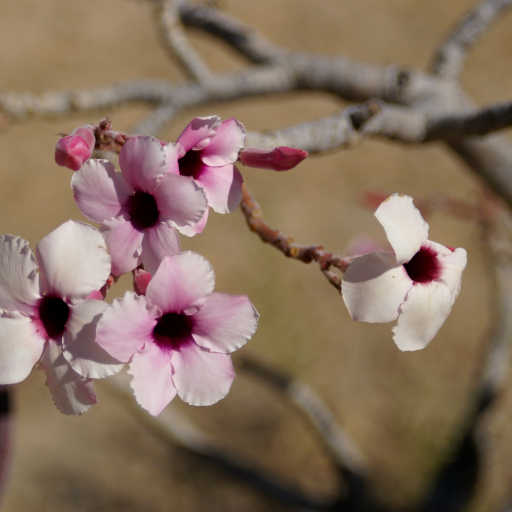
Plant Overview
Commonly known as Bushman’s Poison or the Namibia Desert Rose, this rare succulent is a sculptural masterpiece of the dry African savannas. While it shares the "Desert Rose" moniker with its popular cousin Adenium obesum, it carries a much darker history, having been used for centuries to tip hunting arrows. It is a slow-growing beauty that rewards the patient gardener with delicate, trumpet-shaped blooms and a magnificent, swollen trunk.
🔍 How to Identify
- 🌿 The Caudex: It features a thick, fleshy, swollen trunk (caudex) that acts as a water reservoir, giving it a natural bonsai-like appearance.
- 🍃 Broad Foliage: The leaves are notably wider at the tips than at the base (obovate) and have a slightly grayish-green, leathery texture. They are typically larger than those of other Adenium species.
- 🌸 Pale Blooms: The flowers are a soft, pale pink to light mauve, often featuring a much darker magenta or purple "throat" at the center.
🏡 In Your Garden
- 🏜️ Dormancy Logic: Because it hails from the arid regions of Namibia and Angola, it has a strictly defined "sleep" schedule. It will drop all its leaves in the winter; during this time, it requires almost no water to prevent the caudex from rotting.
- ☀️ Light Requirements: To maintain its stout, compact shape, it needs intense, direct sunlight. If grown in the shade, the plant will become "leggy" and weak, losing the iconic swollen look that collectors prize.
- 🪨 Gritty Substrate: It hates "wet feet." Use a very gritty, cactus-leaning soil mix to ensure that water moves past the roots quickly, mimicking the rocky slopes of its homeland.
⚠️ Safety & Toxicity
- 🚫 High Toxicity: WARNING. This plant is highly poisonous. It contains potent cardiac glycosides that affect the heart.
- 🐾 Pets & Children: Keep this plant strictly out of reach. Ingestion of any part (leaves, stems, or sap) is extremely dangerous for cats, dogs, and humans.
- 🧤 Sap Caution: Always wear gloves when pruning or repotting, as the milky sap can cause significant skin irritation and should never come into contact with your eyes or open cuts.
✨ Fun Fact
🏹 Ancient Weaponry: The San people (Bushmen) of Namibia traditionally boiled the sap and roots of this plant to create a thick, toxic latex. They used this potent mixture to coat the tips of their hunting arrows, capable of taking down large game like antelope!

Detailed Care Instructions
To grow Adenium boehmianum, also known as desert rose, you can follow these general guidelines:
- Choose a suitable location: Adenium boehmianum requires bright sunlight, so make sure to choose a location with at least six hours of direct sunlight per day.
- Select a well-draining pot or container: A suitable pot should have drainage holes to prevent waterlogging.
- Use well-draining soil: Adenium boehmianum prefers a sandy or cactus potting mix that allows excess water to drain quickly.
- Plant the seeds or cuttings: If using seeds, soak them in water for 24-48 hours before planting. Plant the seeds or cuttings at a depth of 1/4 inch in the potting mix.
- Watering: Initially, water the plant lightly, ensuring that the soil is evenly moist but not soggy. Once the plant is established, water sparingly and allow the soil to dry out slightly between waterings to prevent rot.
- Fertilizing: Use a balanced, water-soluble fertilizer with equal parts nitrogen, phosphorus, and potassium during the growing season (spring and summer) once a month. Reduce the frequency to every 2-3 months during fall and winter.
- Pruning: Prune Adenium boehmianum to shape and promote bushier growth. Prune after blooming or during the dormant season.
- Provide support: As the plant grows, you may need to provide support, such as a stake or trellis, to help it stand upright.
- Protect from extreme temperatures: Adenium boehmianum is susceptible to cold temperatures, so protect it from frost by moving it indoors or providing frost protection during winter.
- Keep an eye out for pests and diseases: Watch for common pests like spider mites and mealybugs. Treat any infestations promptly with an appropriate insecticide or by using organic methods like neem oil.
Remember to research specific care requirements for Adenium boehmianum to ensure optimal growth in your specific climate and conditions.

Place in a bright room that is sun drenched almost all day. Or directly in a south-facing window.

Adenium Boehmianum plants require a watering routine that is tailored to their specific needs. In general, it is best to water these plants regularly during the growing season, which is typically in the spring and summer months. However, it is important to avoid overwatering the plant, as this can cause it to become waterlogged and develop root rot.
The best way to water an Adenium Boehmianum plant is to wait until the soil has fully dried out before watering it again. This will allow you to avoid overwatering the plant and prevent it from developing any issues. When watering your Adenium Boehmianum, it is best to use a watering can or a hose with a gentle stream to avoid damaging the plant.
To determine whether your plant needs watering, you can check the moisture level of the soil by sticking your finger into the soil. If the soil feels dry to the touch, it is time to water the plant. Conversely, if the soil feels damp or moist, you can wait a few days before watering again.
It is also important to note that Adenium Boehmianum plants prefer well-draining soil, which will allow water to pass through the soil quickly and efficiently. If your soil is heavy and retains water, you may need to amend it with a soil mix that is designed for cactus and succulent plants.
In summary, the key to watering an Adenium Boehmianum plant is to wait until the soil has fully dried out before watering again. Water the plant gently using a watering can or hose and ensure that the soil is well-draining to avoid overwatering and root rot.
To fertilize the Adenium Boehmianum plant, use a balanced and low-nitrogen fertilizer with a nutrient ratio of 5-10-10. Apply the fertilizer every two weeks during the growing season, and once a month during the dormant period. Dilute the fertilizer with water according to the instructions on the package and apply it to the soil around the base of the plant, taking care not to get it on the foliage. Additionally, provide the plant with regular watering to keep the soil moist but not waterlogged.
The recommended soil for growing Adenium Boehmianum plant should be loose, well-draining, and porous. A mixture of coarse sand, perlite, and peat moss is ideal, which allows excess water to drain away from the roots and provides good aeration. The soil should also be slightly acidic with a pH range between 6.0 to 7.5. Adding some organic matter, such as compost or well-rotted manure, can help to improve the soil fertility and provide nutrients for the plant. It is important to avoid using heavy or compacted soils that retain too much moisture, as this can lead to root rot and other fungal diseases.
To propagate this plant, you will need to take a cutting from the parent plant. Select a healthy stem that is at least 6 inches long and has no signs of damage or disease. Using a sterilized pair of pruning shears, cut the stem at a 45-degree angle just below a node (where a leaf attaches to the stem). Remove any leaves from the bottom two-thirds of the stem.
Next, dip the cut end of the stem in rooting hormone powder and gently tap off any excess. Plant the cutting in a pot filled with well-draining soil mix, making sure the bottom third of the stem is underground. Water the soil thoroughly and cover the pot with a plastic bag or cover to create a humid environment. Place the pot in a bright, warm spot out of direct sunlight.
Monitor the cutting closely and keep the soil moist but not waterlogged. After a few weeks, new growth should begin to emerge from the top of the cutting, indicating that root growth has occurred. At this point, you can remove the plastic cover and gradually acclimate the new plant to brighter light and less humidity. Congratulations, you have successfully propagated your Adenium Boehmianum plant!
Common pests of the bushman's-poison include Scale insect, mealybugs, spider mites. Make a habit of checking your bushman's-poison frequently for pests so that any infestations can be caught and managed early.








