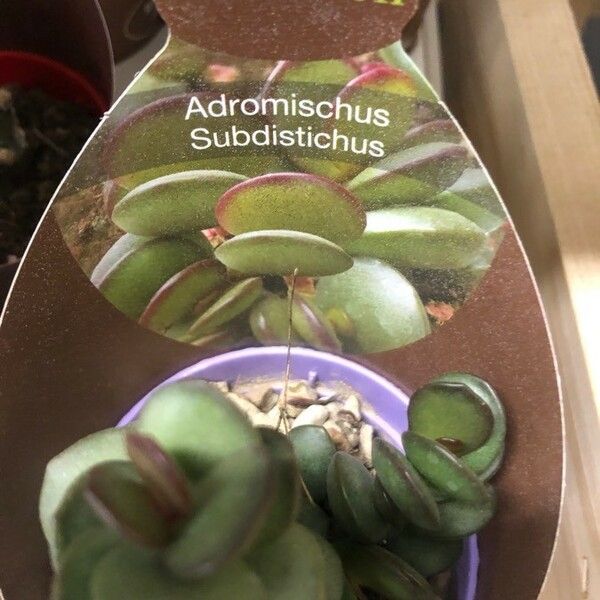
Plant Overview
Known as a rare gem of the succulent world, Adromischus subdistichus is a slow-growing beauty native to the arid Karoo region of South Africa. Often described as a "living sculpture," its name refers to the way its leaves are precisely arranged in two neat vertical rows. This plant is a favorite among minimalist collectors who appreciate its architectural form and muted, dusty colors.
🔍 How to Identify
- 🍃 The Leaves: Thick, fleshy, and somewhat wedge-shaped (triangular). They typically have a glaucous, gray-green color with a waxy coating that protects them from the sun.
- 📐 Growth Pattern: The "subdistichous" arrangement means the leaves grow mostly in two opposite ranks, though they may twist slightly as the plant matures.
- 🌸 The Blooms: It produces tall, thin flower stalks that rise high above the foliage, featuring tiny, tubular, greenish-white flowers that are quite subtle.
🏡 In Your Garden
- 🏜️ Mimic the Karoo: This plant is adapted to very rocky, mineral-heavy soils. It thrives in a "gritty" mix (lots of pumice or perlite) rather than standard potting soil, as its roots are highly sensitive to standing water.
- ☀️ Light & Color: While it loves bright, indirect light, giving it a bit of cool morning sun can bring out deeper hues. However, be careful with sudden moves to high heat; its leaves can scorch if they haven't been "hardened off" to the sun.
- 🍃 Propagation Patience: Like many of its cousins, it can be grown from a single leaf. If a leaf accidentally knocks off, don't throw it away—place it on dry soil, and it will eventually sprout a tiny new plantlet.
⚠️ Safety & Toxicity
- 🟢 Status: Generally considered non-toxic to humans and common pets.
- 🐱 Details: While not inherently poisonous like some of its Crassulaceae relatives (such as Cotyledon), ingesting the thick, waxy leaves can still cause mild stomach upset or vomiting in curious cats and dogs. It’s always best to keep it on a high shelf.
✨ Fun Fact
The genus name Adromischus comes from the Greek words "adros" (thick) and "mischos" (stem), but the real star is the waxy "farina" on the leaves, which acts as a natural sunscreen, reflecting harsh UV rays to keep the plant cool!

Detailed Care Instructions

Place in a bright room that is sun drenched almost all day. Or directly in a south-facing window.

When the top few inches of soil dry out, water your plants. If the top few inches of soil are still moist, do not water your plant. Wait a few days, then poke your finger into the soil to see if anything has changed. Overwatering poses a disease risk, such as the development of fungal diseases in the roots. These plants have adaptations in there leaves that allow them to survive in low water supply.
Without the need of fertilizer, these plants can thrive and bloom. If a plant requires fertilization, it will display indicators of nutrient insufficiency, such as yellowing leaves. It is safe to apply slightly diluted fertilizers in these circumstances. Over fertilizing, on the other hand, should be avoided because excess nutrients might cause plant mortality. Slow-release fertilizers are therefore advised for these plants.
You may use Cactus Fertilizer for your Adromischus Subdistichus








