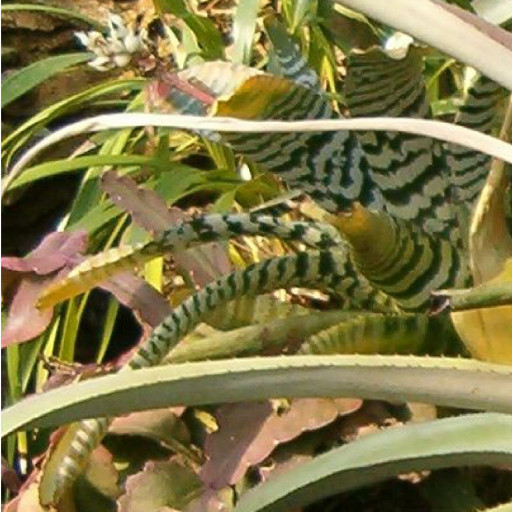
Plant Overview
Often called the "Amazonian Zebra Plant," this striking bromeliad is a true showstopper in any tropical collection. Hailing from the deep, humid rainforests of the Amazon basin, it has been a favorite of botanical collectors since the 19th century. Its dramatic, contrasting patterns and neon-bright "torch" make it look less like a living thing and more like a piece of living jungle art.
🔍 How to Identify
- 🦓 The Foliage: Broad, stiff leaves arranged in a funnel-shaped rosette, featuring bold, horizontal silver-grey stripes over a deep olive or grey-green base.
- 🔥 The Inflorescence: A tall, branched flower spike that rises from the center, boasting brilliant red or orange bracts (leaf-like structures) that cradle tiny, waxy yellow flowers.
- 🦷 The Edges: The leaf margins are lined with small, sharp black spines that act as a natural defense mechanism.
🏡 In Your Garden
- 💧 The Central Tank: This plant is a "tank" bromeliad, meaning it forms a natural cup at its center. In the wild, this collects rainwater and debris; at home, you must keep this reservoir filled with fresh, distilled, or rainwater to keep the plant hydrated.
- 🌳 Epiphytic Nature: Because it naturally grows on tree branches rather than in the ground, its root system is small and hates being "wet." It thrives best in a very airy, orchid-like bark mix or even mounted directly onto a piece of driftwood.
⚠️ Safety & Toxicity
- 🛡️ Pet & Child Safe: Aechmea chantinii is considered non-toxic to cats, dogs, and humans, making it a safe choice for indoor decorating.
- ⚔️ Physical Hazard: While not chemically poisonous, the "teeth" along the edges of the leaves are quite sharp. It is best to place this plant on a high shelf or away from narrow hallways where skin might brush against the serrated foliage.
✨ Fun Fact
✨ The Slow Burn: While the tiny yellow flowers only last a few days, the vibrant red and orange bracts (the "spike") are incredibly durable and can stay bright and beautiful for up to six months before the plant begins to produce "pups" (offsets) for the next generation!

Detailed Care Instructions
To grow an Aechmea Chantinii plant, you can follow these steps:
- Choose the right location: Aechmea Chantinii plants prefer bright, indirect light. Place them near a window or in a spot with filtered sunlight.
- Provide optimal temperature and humidity: These plants thrive in temperate to warm environments with temperatures ranging from 60-85°F (15-29°C). They also prefer relatively high humidity levels, so consider using a humidifier or placing the pot on a tray filled with water and pebbles.
- Select the right pot and soil: Use a well-draining pot with a mixture of potting soil and orchid bark. The pot must have drainage holes to prevent waterlogging, which can lead to root rot.
- Water appropriately: Aechmea Chantinii plants have a central rosette-like structure that holds water, so they can tolerate some periods of drought. However, they still require consistent watering. Water the plant when the top inch of soil feels dry, allowing excess water to drain away.
- Fertilize regularly: Use a balanced, water-soluble fertilizer formulated for bromeliads once a month during the growing season (spring and summer) following the instructions on the product.
- Maintain airflow: Adequate air circulation helps prevent pests and disease. Avoid placing the plant in stagnant air or overly humid areas.
- Repot when necessary: Aechmea Chantinii plants typically do not require frequent repotting. However, if the plant becomes root-bound or overgrown, transfer it to a slightly larger pot with fresh soil during springtime.
- Watch for pests and diseases: Common pests include aphids, mealybugs, and scale insects. Inspect the plant regularly and treat with an appropriate natural or chemical remedy if necessary.
- Keep an eye on the leaves: Aechmea Chantinii plants produce beautiful leaves that can collect debris and dust. Wipe the leaves gently with a damp cloth periodically to keep them clean and allow them to absorb light effectively.
By following these steps, you can help your Aechmea Chantinii plant grow and thrive.

Place in a window with dappled sun or a spot in the middle of a room. Or directly in a window facing west or east.

To water this plant, wait until the top inch of the soil is dry to the touch and then thoroughly water the soil around the base of the plant. Avoid getting water on the leaves or in the central cup of the plant, as this can lead to rot. Allow excess water to drain out of the pot, and empty any standing water from the saucer underneath. This plant prefers to be watered with filtered or rainwater rather than tap water. Watering frequency will depend on factors such as humidity, light levels, and temperature, but generally, this plant will need to be watered every 1-2 weeks.
To fertilize this plant, use a balanced, water-soluble fertilizer with an N-P-K ratio of 20-20-20. Dissolve the fertilizer in water according to package instructions and apply it to the plant's soil every two weeks during the growing season (spring and summer). Avoid fertilizing during the winter months when the plant is dormant. Dilute the fertilizer solution by half if the plant is young or if there is a risk of fertilizer burn. Make sure to water the plant thoroughly after fertilizing.
A suitable soil mix for the Aechmea Chantinii plant should be well-draining and rich in organic matter. It should not hold on to excess moisture, as this can lead to root rot. A mix of peat moss, perlite, and coarse sand or vermiculite is recommended to provide good drainage and aeration. Additionally, adding a slow-release fertilizer to the soil mix can help provide the necessary nutrients for the plant's growth. Avoid using heavy clay soils or soils that have a high pH level, as this can inhibit the plant's ability to absorb nutrients and water.
To propagate this plant, you will need to remove offsets (baby plants) that have formed at the base of the mother plant. Carefully cut these offsets away from the main plant using a sharp, sterile knife or pair of scissors. Make sure to take a small portion of the mother plant's root system with the offset.
Next, you will need to prepare a pot with well-draining soil that is enriched with organic matter. Place the offset in the soil and gently press it down so that it is secure. Water the soil thoroughly, and place the pot in a warm, bright location. Keep the soil moist, but not waterlogged, and avoid direct sunlight.
Within a few weeks, the offset will begin to establish roots in the soil. At this time, you can move it to a slightly larger pot and begin to fertilize it with a balanced fertilizer. With proper care and attention, your propagated Aechmea Chantinii plant should grow into a healthy, mature plant in no time!
Common pests of the amazon zebra plant include Scale insect, mealybugs, spider mites. Make a habit of checking your amazon zebra plant frequently for pests so that any infestations can be caught and managed early.








