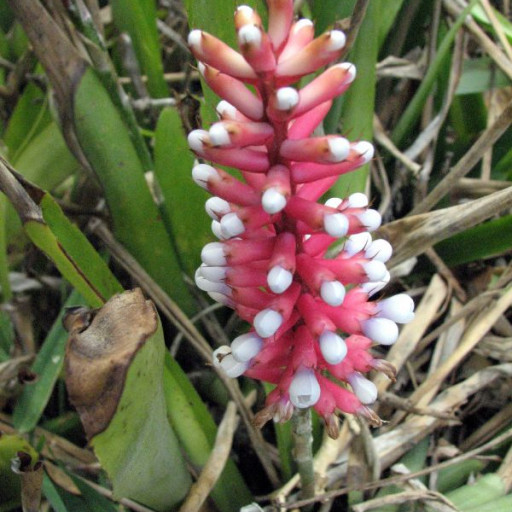
Plant Overview
Known affectionately as the "Matchstick Bromeliad," this Brazilian native looks like it was plucked straight from a retro-futuristic garden. Its name comes from its spectacular flower spikes, which feature bright pink stalks topped with iridescent blue "heads" that resemble neon matches. It is a hardy, architectural plant that adds a splash of electric color to shady garden corners or bright indoor spaces.
🔍 How to Identify
- 🌸 The "Matches": The most iconic feature is the upright flower spike. Tiny, tubular flowers emerge with hot pink sepals and striking violet-blue tips.
- 🍃 The Rosette: It grows in a classic "urn" shape with stiff, smooth, strap-like green leaves that arch gracefully outward.
- 📐 Growth Habit: Unlike many fussy tropicals, this plant is a "clumper." It will eventually form a dense colony of rosettes by producing "pups" (offsets) at its base.
🏡 In Your Garden & Home
- 💧 The Central Tank: Because it is an epiphyte (a "tree-dweller" in the wild), it drinks through its center. Keep the "cup" or "tank" formed by the leaves filled with fresh rainwater or distilled water, but keep the soil relatively dry.
- ⛅ Light Nuance: While it loves bright, filtered light, the "Matchstick" is surprisingly tough. It can handle deeper shade than other bromeliads, though its colors will be most vibrant when it gets plenty of indirect glow.
- 🌡️ Temperature Resilience: It is one of the most cold-hardy Aechmeas. While most bromeliads shiver at the sight of a breeze, a mature Gamosepala can often survive brief dips near freezing if kept dry.
⚠️ Safety & Toxicity
- ✅ Pet & Child Safe: This plant is generally considered non-toxic to cats, dogs, and humans. It is a "friendly" choice for households with curious nibblers.
- 🌵 Physical Warning: While not "sharp" like a cactus, the edges of the leaves can be slightly stiff and serrated. Be careful when reaching into the center of a large clump to avoid minor skin scratches.
✨ Fun Fact
The Aechmea gamosepala is a favorite of hummingbirds! In its native Brazil, the iridescent blue tips serve as high-visibility "landing lights" for pollinators, who are rewarded with nectar hidden deep within the pink matchstick tubes.

Detailed Care Instructions
| Lighting | Part Sun |
| Hardiness Zones | Min 9A |
To grow Aechmea gamosepala, also known as the Matchstick Bromeliad, follow these steps:
- Choose a suitable location: Aechmea gamosepala thrives in bright but indirect sunlight. Place it near a window or in a spot with filtered light.
- Provide the right temperature: This plant prefers temperatures between 60-75°F (15-24°C). Avoid exposing it to temperatures below 50°F (10°C).
- Water properly: Aechmea gamosepala requires regular watering. Ideally, use distilled or rainwater, as they are less likely to contain chemicals that can harm the plant. Keep the soil consistently moist but avoid overwatering or letting the plant sit in standing water.
- Use well-draining soil: The plant does well in a well-draining potting mix specifically formulated for bromeliads or orchids. This ensures proper aeration and prevents waterlogging, which can lead to root rot.
- Fertilize occasionally: Apply a balanced, water-soluble fertilizer specifically designed for bromeliads during the growing season (spring to early fall). Follow the instructions on the package for the correct dosage and frequency.
- Proper humidity: Aechmea gamosepala thrives in a humid environment. You can increase humidity levels by placing a tray filled with water near the plant or using a humidifier.
- Rotate the plant: Every few weeks, rotate the plant to ensure even growth and prevent it from leaning toward the light.
- Avoid direct sunlight: While the plant enjoys bright light, direct sunlight can scorch the leaves. Filtered or indirect sunlight is best.
- Pruning: Remove any dead or yellowing leaves to maintain the plant's appearance and overall health. Be cautious when handling the plant, as the leaves have sharp edges.
- Propagation: You can propagate Aechmea gamosepala by separating the plant's offsets, or "pups," from the mother plant once they have grown to a reasonable size. Gently remove the pup and plant it in a separate pot with suitable soil, then care for it using the same method as the adult plant.
Remember, Bromeliads are relatively slow-growing plants, so patience is key when growing Aechmea gamosepala.

Place in a window with dappled sun or a spot in the middle of a room. Or directly in a window facing west or east.

To water this plant, it is essential to ensure that the soil is well-drained and never becomes waterlogged. It is crucial to water the soil deeply and thoroughly, but less frequently, as overwatering can harm the plant's roots and cause them to rot. One way to determine if the plant needs water is by checking the soil's moisture level. The top inch of soil should feel dry to the touch before watering, and it is recommended to water until water runs out of the drainage holes. During the winter months, it is necessary to reduce watering and allow the soil to dry out slightly. Additionally, avoid watering the center cup of the plant, as this can lead to the formation of fungal diseases or rot. It is best to use room temperature tap water or rainwater rather than cold water to avoid shocking the plant's roots.
To fertilize this plant, use a balanced fertilizer with an N-P-K ratio of 10-10-10. Dilute the fertilizer to half strength and apply every two weeks during the growing season (spring and summer). Reduce fertilization to once a month during the fall and winter. Always water the plant before fertilizing to prevent root burn. Avoid getting fertilizer on the leaves or in the center of the plant.
Aechmea Gamosepala is a type of bromeliad which requires well-draining soil that is rich in organic matter. The ideal soil composition includes one part loam or potting soil, one part peat moss or coconut coir, and one part sand or perlite. This type of soil will ensure that the plant's roots have access to the nutrients and moisture they need without becoming waterlogged. It is also important to ensure that the soil pH is between 5.5 and 6.5, as this will provide the optimal conditions for the plant's growth.
Propagation of this plant can be done through the separation of offsets or pups. These are new plantlets that grow from the base of the mother plant. Once they are large enough, they can be gently pulled away from the base and planted into individual pots with well-draining soil. It is important to keep the soil moist but not overly wet, and to place the young plant in an area with bright, indirect sunlight. Roots should begin to develop within a few weeks and the plant can be slowly acclimated to more direct sunlight over time.








