Plant Overview
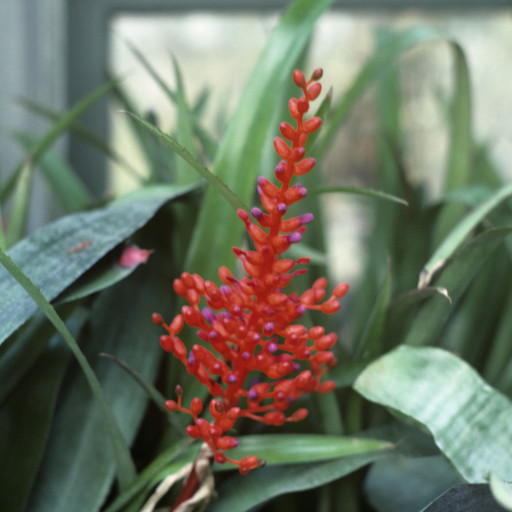
Commonly known as the Coral Berry Bromeliad, Aechmea miniata is a stunning Brazilian native that brings the vibrant energy of the rainforest into the home. Unlike many houseplants that rely on their roots for everything, this "tank" plant creates its own miniature ecosystem, catching water and nutrients in its central urn. It is beloved by collectors for its long-lasting, jewel-like berries that look almost too perfect to be real.
🔍 How to Identify
- 🌿 The Rosette: It features wide, strap-shaped leaves that arch gracefully outward from a central "cup" or urn. The leaves are typically a glossy olive green, though some varieties (like discolor) have a deep burgundy underside.
- 🪸 The Inflorescence: A sturdy flower spike rises from the center, sporting a cluster of coral-red bracts. These are topped with tiny, delicate flowers that transition from pale blue to deep purple.
- 🍒 The Berries: After the flowers fade, the plant produces globe-shaped, bright red berries that remain decorative for several months, giving it its "Coral Berry" moniker.
🏡 In Your Garden
- 💧 The Tank Strategy: Because this plant is an epiphyte (it grows on trees in the wild), it prefers to "drink" from its center. You should keep the central reservoir filled with fresh rainwater or distilled water, flushing it out occasionally to prevent stagnation.
- 🪴 Soil Nuance: Avoid heavy, dense potting soil. This Aechmea thrives in a chunky, airy mix—like orchid bark or a peat-perlite blend—because its roots are primarily used for anchoring rather than heavy water absorption.
- ☀️ Light Logic: It loves bright, filtered light. Too much direct sun will scorch the leaves, but too little light will prevent that iconic coral flower spike from ever emerging.
⚠️ Safety & Toxicity
- ✅ Status: Non-toxic and generally safe.
- 🐾 Details: This plant is considered safe for cats, dogs, and children. However, the leaf edges can be quite stiff and slightly serrated; while not "spiny" like some of its cousins, it’s best placed where it won't be brushed against frequently to avoid minor skin scratches.
✨ Fun Fact
The Aechmea miniata is a "monocarpic" plant, meaning the mother plant blooms only once in its lifetime. However, don't be sad when the flower fades—the plant will spend its final months producing "pups" (offsets) around its base, allowing you to start the cycle all over again!

Detailed Care Instructions
To grow an Aechmea Miniata plant, follow these steps:
- Choose a suitable pot: Select a pot that is at least 8-10 inches in diameter and has drainage holes at the bottom. Aechmea Miniata plants prefer to be slightly root-bound, so avoid using a pot that is too large.
- Potting mix: Use a well-draining soil mixture. You can create a mix by combining equal parts of potting soil, peat moss, and perlite or orchid bark.
- Planting: Gently remove the Aechmea Miniata plant from its nursery pot, then place it in the center of the new pot. Ensure that the plant sits at the same level it was previously growing and that the roots are spread out evenly.
- Light: Place the Aechmea Miniata plant in a location where it will receive bright indirect light. Avoid direct sunlight as it can scorch the leaves.
- Temperature: This plant thrives in temperatures between 65-80°F (18-27°C). Protect it from cold drafts or extreme temperature changes.
- Watering: Water the Aechmea Miniata plant thoroughly, allowing excess water to drain from the bottom of the pot. Once the top inch of soil feels dry, it's time to water again. Ensure the water does not collect in the center of the plant as it may cause rot.
- Humidity: Aechmea Miniata plants appreciate high humidity. You can place a tray of water near the plant or use a room humidifier to maintain proper humidity levels.
- Fertilizing: Feed the plant with a balanced liquid fertilizer diluted to half strength every two to three months during the growing season (spring and summer).
- Pruning: Remove any dead or yellow leaves from the plant to maintain its appearance and prevent pests.
- Propagation: Aechmea Miniata plants can be propagated through offsets or pups. Once the pup has grown to about 1/3 of the size of the mother plant, carefully remove it and plant it in a separate pot.
With proper care and regular maintenance, your Aechmea Miniata plant should grow and thrive beautifully.

Place in a window with dappled sun or a spot in the middle of a room. Or directly in a window facing west or east.

The ideal way to water this plant is letting the top inch of soil to dry out before watering it again. It's important not to overwater or underwater it, since waterlogging or drought can be detrimental to its growth. When watering, be sure to thoroughly saturate the soil until it drips out from the drainage holes at the bottom of the container. If the plant is grown in a container with no drainage holes, ensure that the soil is not completely soaked through. Watering frequency will depend on various factors like humidity, temperature, and light. It's recommended to use lukewarm water and avoid using cold water. Watering this plant from the top can cause the water to accumulate in the middle rosette, leading to the rotting of the plant, therefore, water should be directed to the soil.
To fertilize this plant, use a balanced liquid fertilizer that is diluted to half strength. Apply the fertilizer every two to three weeks during the growing season, which is typically spring and summer. Avoid fertilizing during the winter months when the plant is dormant. Be sure to thoroughly saturate the soil with the fertilizer solution, but do not leave any standing water in the tray or saucer beneath the pot.
To successfully grow a particular species of plant, it is important to choose the right type of soil. For the Aechmea Miniata plant, a well-draining soil mixture is crucial. The soil should be able to retain moisture while also allowing for excess water to drain away, as the plant does not tolerate being waterlogged. A mixture of peat moss, perlite, and sand is commonly used for growing the Aechmea Miniata. This soil should be light and fluffy, allowing air to circulate around the roots. Using a soil that is too compacted can lead to the plant's root system becoming waterlogged and ultimately lead to a decline in its health. Additionally, regularly fertilizing the plant with a balanced, water-soluble fertilizer can help it to thrive.
To propagate this plant, one can remove offsets that have grown at the base of the mother plant. It is important to allow these offsets to grow roots before planting them in their own separate pots. A rooting hormone can be applied to the cut end of the offset to encourage the growth of roots. Ensure that the potting soil is moist but not waterlogged, and place the offset in a bright, indirect light spot. Water the plant sparingly until it has established itself in its new pot.
Common pests of the aechmea miniata include Scale insect, mealybugs, spider mites. Make a habit of checking your aechmea miniata frequently for pests so that any infestations can be caught and managed early.








