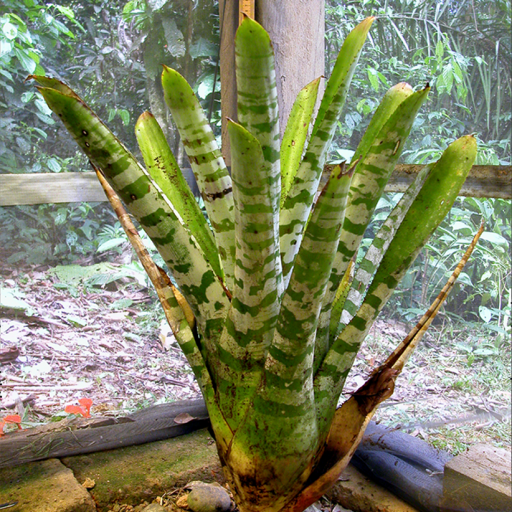
Plant Overview
Known as the Zebra Bromeliad, this Amazonian beauty looks as if it were hand-painted by nature. Originating from the high canopy of the rainforests in Ecuador and Colombia, it is a master of adaptation, living high above the ground on the branches of massive trees.
🔍 How to Identify
- 🦓 Leaf Patterns: Its most striking feature is the bold, horizontal silver-white bands that wrap around deep green or burgundy-tinted leaves.
- 🛡️ Architecture: The stiff, leathery leaves grow in a tight rosette, forming a central "urn" or tank designed to catch and hold rainwater.
- 🌵 Serrated Edges: Take care when handling; the margins of the leaves are lined with small, sharp spines that help protect it from herbivores in the wild.
- 🌺 Dramatic Bloom: When mature, it sends up a tall, waxy flower spike adorned with bright red or orange bracts and tiny purple-blue flowers.
🏡 In Your Garden
- 💧 The "Top-Down" Drink: Because this plant is an epiphyte (air plant), its roots are mainly for anchoring. It drinks primarily through its central cup. Ensure the "tank" always has fresh water, but flush it out every few weeks to prevent bacterial buildup.
- ☀️ Light for Contrast: To maintain the vivid "zebra" stripes, provide very bright, indirect light. If the light is too low, the silver banding may fade, and the plant will stretch out and lose its compact shape.
- 🪴 Airy Substrate: Never plant this in heavy garden soil. It requires a very loose, chunky mix—like orchid bark or perlite—to mimic the airy tree branches of its native home.
⚠️ Safety & Toxicity
- ✅ Status: Non-toxic and generally safe for households.
- 🐾 Pets & Kids: While the plant is not poisonous if nibbled by cats or dogs, the serrated leaf edges can cause physical scratches. It’s best kept on a high shelf or pedestal away from curious noses and grasping hands.
✨ Fun Fact
In the wild, Aechmea zebrina acts as a "mini-ecosystem." Its central tank can hold so much water that entire generations of tiny tropical tree frogs spend their whole lives inside a single plant, never once touching the forest floor!

Detailed Care Instructions
To grow Aechmea Zebrina (also known as Zebra Plant), follow these steps:
- Start with a healthy plant: Purchase a healthy Aechmea Zebrina plant from a reputable nursery or garden center. Look for a plant with vibrant green leaves and no signs of disease or pests.
- Provide the right lighting: Aechmea Zebrina plants prefer bright but indirect light. Place the plant near a window where it can receive filtered light or provide artificial lighting if natural light is limited.
- Maintain optimal temperature and humidity: Aechmea Zebrina plants thrive in temperatures between 60-75°F (15-24°C) during the day and 50-60°F (10-15°C) at night. They enjoy higher humidity levels, so misting the leaves regularly or placing the plant on a humidity tray can help maintain moisture.
- Water properly: Water your Aechmea Zebrina plant regularly to keep the soil slightly moist but not waterlogged. Use room temperature water and allow any excess water to drain away to prevent root rot. Avoid letting the plant sit in standing water.
- Fertilize regularly: Apply a diluted liquid fertilizer formulated for bromeliads every two to three months during the growing season (spring to early fall). Follow the package instructions for the appropriate dilution and frequency.
- Repot when necessary: Aechmea Zebrina plants generally do not require frequent repotting. However, if the plant outgrows its current pot or the soil becomes too compacted, repot it into a slightly larger container with well-draining soil specifically formulated for bromeliads or orchids.
- Provide good air circulation: Adequate airflow around the plant helps prevent the onset of fungal diseases. Avoid placing the plant in a stagnant, closed environment and ensure good ventilation.
- Propagation: Aechmea Zebrina plants can be propagated by division, which involves separating offsets (pups) that grow around the base of the parent plant. Wait until the pups have grown to approximately one-third the size of the parent plant before carefully removing and potting them.
- Watch for pests and diseases: Keep an eye out for common pests like mealybugs and scale insects. Treat any infestations promptly using an appropriate insecticidal soap or horticultural oil, following the product instructions. Maintain good hygiene by removing dead leaves and debris from the plant.
Remember to tailor your care routine to the specific needs of your Aechmea Zebrina plant, as individual plants can have slightly different requirements. With proper care, your Aechmea Zebrina should grow and thrive beautifully.
- The Aechmea Zebrina plant belongs to the Bromeliad family and is native to the tropical rainforests of Brazil.
- When it comes to watering this plant, it is crucial to mimic the natural conditions of its habitat. It typically grows in the ground but can also be found growing on trees, similar to an epiphyte.
- To water the Aechmea Zebrina plant, it is recommended to avoid watering the soil directly as this can cause root rot. Instead, focus on the central cup of the plant, which is formed by the overlapping leaves.
- Fill the central cup of the plant with water until it is about one-third full. Ensure that the water level is not too high to prevent it from getting stagnant.
- It is important to use purified or rainwater for this plant as it is sensitive to the chemicals and minerals present in tap water. This helps to prevent damage to the leaves and ensures the plant receives clean water.
- Monitor the moisture level of the central cup and refill it as needed. As a general guideline, it is advisable to empty and refill the cup every one to two weeks.
- Additionally, to create a humid environment for the Aechmea Zebrina plant, mist the leaves regularly using a spray bottle filled with purified or rainwater.
- While watering, it is important to avoid wetting the foliage excessively, as this can lead to fungal diseases. Instead, aim the water at the central cup, allowing it to trickle down over the leaves.
- It is best to water this plant in the morning or early afternoon, giving it enough time to dry before nightfall. This helps to reduce the risk of fungal growth and rot.
- During periods of active growth, such as spring and summer, the Aechmea Zebrina may require more frequent watering. However, during the winter months or dormant stage, reduce the watering frequency to prevent overhydration.
- Lastly, pay attention to the plant's overall health and adjust the watering schedule based on its specific needs. Factors such as temperature, humidity, and light levels can influence the watering requirements of the Aechmea Zebrina plant.
To fertilize the Aechmea Zebrina plant, follow these instructions:
- Choose a balanced, water-soluble fertilizer formulated for houseplants. Look for one with equal amounts of nitrogen, phosphorus, and potassium (NPK).
- Dilute the fertilizer according to the instructions on the package. Usually, a concentration of 1/4 to 1/2 teaspoon of fertilizer per gallon of water is recommended.
- Water the plant thoroughly before fertilizing to ensure the soil is moist.
- Pour the diluted fertilizer solution evenly over the soil surface, avoiding direct contact with the plant's leaves or central rosette.
- Repeat the fertilization every four to six weeks during the active growing season, which is typically from spring through fall. Reduce or stop fertilizing during the dormant period in winter.
- Monitor the plant's response to the fertilizer. If you notice any signs of fertilizer burn, such as yellowing or wilting leaves, dilute the fertilizer concentration even further or reduce the frequency of application.
- Flush the soil occasionally with plain water to prevent the accumulation of excess salts from the fertilizer.
Remember, it's crucial to follow the specific instructions provided by the fertilizer manufacturer as different brands may have slightly different guidelines.
Aechmea Zebrina is a type of bromeliad plant that has specific soil requirements to thrive. It is typically recommended to use a well-draining potting mix that is specially formulated for epiphytic plants like bromeliads. The soil composition should have a good balance of organic matter, moisture retention, and aeration.
The ideal soil for Aechmea Zebrina should typically include ingredients such as sphagnum or orchid bark, perlite, and peat moss. These components ensure proper air circulation, moisture drainage, and nutrient availability for the plant's roots.
Sphagnum or orchid bark helps create a loose and airy texture in the soil, allowing excess water to drain effectively and preventing the risk of root rot. Perlite is a lightweight volcanic rock that enhances drainage while retaining some moisture. Peat moss adds moisture retention capacity to the soil mix, which is important for ensuring adequate hydration to the plant.
By using a well-draining soil mix, the plant's roots can access the required oxygen while preventing waterlogging. This soil composition also mimics the natural growing conditions of Aechmea Zebrina, as it is an epiphytic plant that typically grows on trees or other surfaces rather than in the ground.
It is important to note that Aechmea Zebrina can also grow in a soilless mix, such as a mixture of sphagnum moss and perlite or a bromeliad-specific potting mix available in nurseries. These alternatives retain moisture while maintaining good drainage.
Overall, providing the appropriate soil mix for your Aechmea Zebrina plant is essential for its healthy growth, as it ensures proper aeration, moisture balance, and nutrient availability for the roots.
To propagate the Aechmea Zebrina plant, follow these steps:
- Select a healthy mother plant: Choose a mature Aechmea Zebrina plant that is free from any diseases or pests.
- Prepare the tools and materials: Gather a sharp pair of pruning shears, a clean container for planting, well-draining potting mix, and a plastic bag or propagator to create a humid environment.
- Identify the offsets: Look for offsets, also known as pups or babies, growing at the base of the mother plant. These are smaller plants that can be separated and propagated.
- Prepare the mother plant: Carefully remove the offsets by cutting them away from the mother plant. Make sure to leave a small section of the offset attached to the mother plant.
- Trim the roots: Trim any long, overgrown roots from the offset, making sure to leave some intact. This will encourage the plant to develop new roots after propagation.
- Prepare the planting container: Fill a clean container with well-draining potting mix, leaving some space at the top for the plant.
- Plant the offset: Dig a small hole in the potting mix and gently place the offset into it. Make sure the remaining section of the offset, known as the basal plate, is covered with soil and the leaves are above the surface.
- Provide a humid environment: To promote growth, cover the planting container with a plastic bag or propagator to create a humid environment. This helps the plant retain moisture and encourages root development.
- Provide indirect light: Place the container in an area with bright, indirect light. Avoid exposing the plant to direct sunlight, as it may cause damage or wilting.
- Watering and care: Keep the potting mix consistently moist but not waterlogged. It's important to avoid overwatering, as this can lead to root rot. Check the soil moisture regularly and water accordingly.
- Monitor growth: Over time, the Aechmea Zebrina plant will start to establish its roots and grow new leaves. Ensure that the plant is healthy by inspecting for any signs of pests or diseases.
- Transplanting: Once the Aechmea Zebrina plant has developed a strong root system and several new leaves, it is ready to be transplanted into a larger container filled with a suitable potting mix. Follow the instructions for general care to promote further growth and health.
Remember, propagation can also be done by seeds, division, or tissue culture, but the most common method for Aechmea Zebrina is through offsets.








