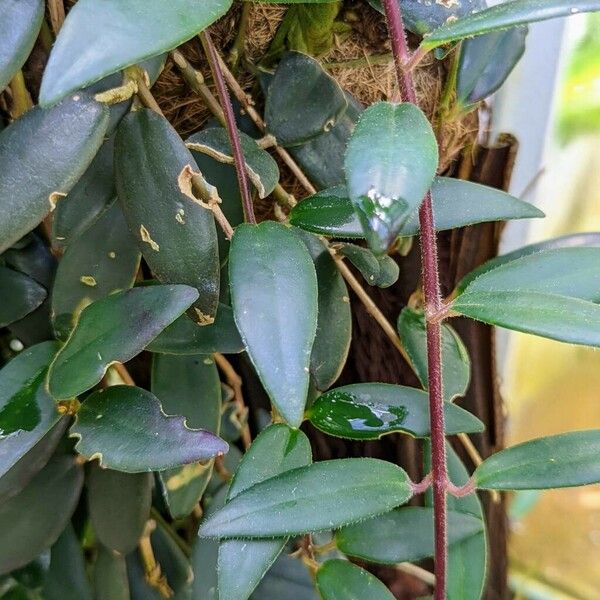
Plant Overview
Known as the "Himalayan Lipstick Plant," Aeschynanthus micranthus is the dainty, delicate cousin of the more common, large-leafed lipstick vines. Originating from the misty forests of the Himalayas, this epiphytic beauty is prized for its trailing habit and vibrant, tubular flowers that look like tiny tubes of crimson lipstick being pushed out of their cases. It is a favorite for hanging baskets where its "fountain" of foliage can truly shine.
🔍 How to Identify
- 🌿 Lance-Shaped Foliage: The leaves are small, pointed, and a deep, glossy green. They grow in opposite pairs along slender, cascading stems, creating a much finer texture than other lipstick plant varieties.
- 💄 Micro-Blooms: True to its name (Micranthus means "small flower"), the blossoms are petite but striking. They are bright scarlet or deep red, featuring a curved tubular shape designed for bird beaks.
- 🪴 Trailing Habit: Unlike upright houseplants, this species naturally wants to drape. Its stems are flexible and can grow several feet long, forming a dense, leafy curtain over time.
🏡 In Your Garden
- ☁️ The Epiphytic Edge: In the wild, this plant grows on tree branches rather than in the soil. Because of this, it absolutely hates "wet feet." Ensure you use a chunky, airy mix (like orchid bark and perlite) to keep the roots breathing.
- 💧 Humidity is Key: Coming from cloud forests, it craves moisture in the air. If the leaf tips turn brown or the flower buds drop before opening (bud blast), it’s likely signaling that your indoor air is too dry.
- ☀️ Light for Color: While it can survive in lower light, you’ll need bright, filtered sunlight to trigger blooming. A spot near an east-facing window is usually the "sweet spot" for consistent red flowers.
⚠️ Safety & Toxicity
- 🐾 Pet Friendly: Good news for animal lovers! Aeschynanthus micranthus is generally considered non-toxic to cats and dogs.
- 👶 Safe for Humans: It is non-poisonous to humans, making it a safe choice for households with curious children, though it's always best to discourage nibbling on any houseplant.
✨ Fun Fact
In its native Himalayan habitat, the Aeschynanthus micranthus has a specific partnership with sunbirds. The flowers are perfectly curved and lack a strong scent because birds hunt by sight (attracted to the red color) rather than smell, and their long, curved beaks fit perfectly into the "lipstick" tube to reach the nectar!

Detailed Care Instructions
To grow Aeschynanthus micranthus, also known as lipstick plant, you can follow these steps:
- Choose a suitable location: Select a spot that receives bright, indirect sunlight. Aeschynanthus micranthus prefers warm temperatures between 65-80°F (18-27°C). It also thrives in a slightly humid environment.
- Planting: Use well-draining soil that retains some moisture but does not become waterlogged. A mixture of regular potting soil and peat moss or perlite can work well.
- Watering: Water the plant thoroughly when the soil feels dry to the touch. Do not let the soil dry out completely but avoid overwatering, as it can lead to root rot. During winter, reduce watering frequency slightly, allowing the top inch of soil to dry out between waterings.
- Fertilization: Apply a balanced, water-soluble houseplant fertilizer every two weeks during the growing season (spring and summer) to promote healthy growth. Follow the instructions on the fertilizer packaging for proper dosage.
- Pruning: Trim back leggy or unruly growth to maintain a compact, bushy shape. Pruning after flowering encourages branching and can help promote future blooms.
- Propagation: Aeschynanthus micranthus can be propagated through stem cuttings. Take a 4-6 inch cutting from a healthy, established plant, making sure it has at least two or three sets of leaves. Remove the lower leaves and dip the cut end into a rooting hormone powder. Place the cutting in a well-draining soil mix and keep it moist. After a few weeks, roots should develop, and you can transfer it to a slightly larger pot.
- Humidity: Increase humidity around the plant by misting it with water regularly, placing a humidity tray nearby or using a humidifier. This helps the plant thrive, especially in drier indoor environments.
- Pests and diseases: Monitor the plant for common houseplant pests like aphids, mealybugs, or spider mites. If detected, treat them with an appropriate insecticide or insecticidal soap. Additionally, avoid overwatering to prevent root rot.
- Support: As the plant grows, it may benefit from a support structure such as a trellis or stakes to encourage upward growth and prevent sprawling.
By following these guidelines, you should be able to successfully grow Aeschynanthus micranthus and enjoy its beautiful foliage and vibrant flowers.

Place in a window with dappled sun or a spot in the middle of a room. Or directly in a window facing west or east.

To properly water this plant, you should first check the soil moisture level by sticking your finger about an inch deep into the soil. If the soil feels dry, it's time to water. When watering, use a watering can or pitcher to pour water directly onto the soil around the plant, avoiding getting water on the leaves. Water until excess water drains out of the bottom of the pot. Allow the soil to drain completely before placing the plant back into its spot. Avoid overwatering, as this can lead to root rot and other issues. It's best to water less frequently but deeply to promote healthy growth.
To fertilize this plant, you should use a well-balanced fertilizer with equal parts of nitrogen, phosphorus, and potassium. Ensure the fertilizer is diluted at half strength and apply it to the soil every two weeks during the growing season. Avoid fertilizing during winter when the plant is dormant. Also, make sure to water the plant before applying the fertilizer to prevent root burn.
The ideal soil for growing this plant is a well-draining soil mix that is enriched with organic matter. It should not be too rich in nutrients and should not be too compact. The pH level of the soil should be slightly acidic, between 6.0 and 7.0. Aeschynanthus Micranthus prefers a soil that is slightly moist but not too wet, as it is susceptible to root rot if not given proper drainage. Peat moss or coconut coir can be added to the soil mix to improve water retention. Avoid using heavy clay soils or soils that are prone to flooding.
Propagation of this plant involves taking stem cuttings. The best time to take cuttings is in the spring or summer when the plant is actively growing. Select a healthy stem that is at least 4 inches long and has several leaves. Make a clean cut with a sharp knife or pruning shears just below a node.
Remove the lower leaves from the cutting, leaving only a few at the top. Dip the cut end of the stem into rooting hormone powder to encourage root growth. Insert the cutting into a pot of well-draining soil or a mixture of perlite and peat moss.
Keep the soil moist but not soggy, and place the pot in a warm, bright location out of direct sunlight. You can cover the pot with a plastic bag or dome to create a humid environment, which will help the cutting root faster.
Check the cutting regularly for signs of growth, such as new leaves or the appearance of roots. Once the cutting has rooted and is established, you can transplant it into its own pot and care for it like an adult plant.
Common pests of the aeschynanthus micranthus include Scale insect, mealybugs, spider mites, thrips. Make a habit of checking your aeschynanthus micranthus frequently for pests so that any infestations can be caught and managed early.








