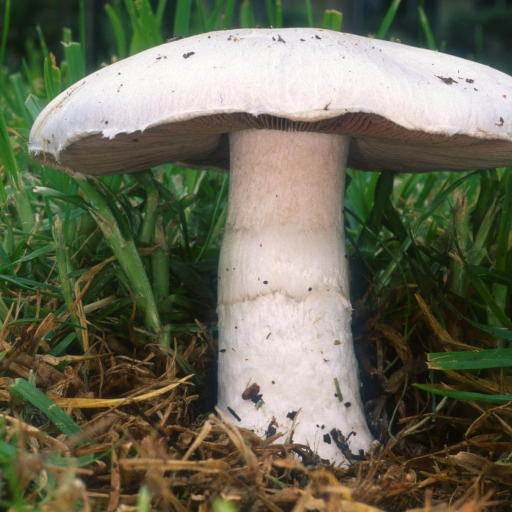
Plant Overview
Known as the Field Mushroom or Meadow Mushroom, Agaricus campestris is the wild, untamed cousin of the common button mushroom found in grocery stores. It is a classic "fairytale" fungus that often appears overnight in lush green pastures after a warm autumn rain, seemingly popping out of nowhere as if by magic. While it is a prized find for foragers, it belongs to a family with several dangerous "double-gangers," making it a plant that demands respect and careful study.
🔍 How to Identify
- 🍄 The Cap: Starts as a white, rounded button and expands into a flattened disk, 5–10 cm wide. The texture is usually smooth or slightly silky to the touch.
- 💗 The Gills: This is the most vital identifier. Young specimens have beautiful vivid pink gills, which eventually turn a deep, dark chocolate brown as the spores mature. They are never white in adulthood.
- 💍 The Stem and Ring: The stem is sturdy and white, featuring a delicate, thin "skirt" or ring around the middle. This ring is often fragile and may fall off as the mushroom ages.
🌲 Habitat & Ecology
- 🐎 The Meadow Dweller: Unlike many mushrooms that prefer deep forests, this species loves open spaces. It is most commonly found in grassy fields, meadows, and lawns, especially those enriched by horse or cow manure.
- ⭕ Fairy Rings: It is famous for growing in "fairy rings"—large circles of mushrooms that expand outward year after year as the underground fungal network (mycelium) searches for new nutrients.
⚠️ Safety & Toxicity
- 🛑 WARNING: While Agaricus campestris is edible and delicious, it has a deadly look-alike called the Destroying Angel (Amanita bisporigera), which always has white gills and a "cup" at the base.
- 🧪 The Ink Test: Another common mimic is the Yellow Stainer (Agaricus xanthodermus). To tell them apart, scratch the base of the stem; if it turns bright chrome yellow and smells like ink or chemicals, it is toxic and should be discarded immediately.
- 🐾 Pets & Kids: Wild mushrooms should never be consumed by pets or children, as their digestive systems are more sensitive to the heavy metals mushrooms can absorb from the soil.
✨ Fun Fact
In the Victorian era, "mushrooming" parties were a popular social event. Young couples would head into the meadows at dawn to harvest Agaricus campestris, as these mushrooms are at their most flavorful before the morning sun causes them to dry out or the gills to turn black!

Detailed Care Instructions
To grow Agaricus campestris, also known as the field mushroom or meadow mushroom, follow these steps:
- Prepare the growing medium: Agaricus campestris grows best in a mixture of composted manure and straw. You can buy pre-made mushroom growing substrate or make your own by composting horse or cow manure mixed with straw.
- Sterilize the growing medium: To prevent contamination, it is important to sterilize the substrate. You can achieve this by heating it in an oven at 160-180°F (71-82°C) for at least one hour or by using a pressure cooker.
- Inoculate the substrate: Once the substrate has cooled down, you can add Agaricus campestris spores or spawn. Spores can be obtained from a reputable supplier, or you can start with spawn, which is a more developed form of the fungus. Distribute the spores or spawn evenly throughout the substrate.
- Maintain optimal conditions: Agaricus campestris thrives in cool and humid environments. Keep the temperature around 55-65°F (13-18°C) and maintain a humidity level of 80-90%. You can use a humidifier or mist the growing area regularly to maintain the required humidity.
- Provide appropriate lighting: While Agaricus campestris does not require direct sunlight, it does need some light to trigger fruiting. Indirect, ambient light from a nearby window or a fluorescent light fixture can be sufficient.
- Monitor moisture levels: Agaricus campestris needs consistent moisture to grow well. Ensure that the substrate remains moist but not overly wet. Regularly check and adjust the moisture level if necessary.
- Harvest the mushrooms: After about 10-14 days, small mushroom caps will start to form. Allow them to grow until the caps flatten out, indicating that the mushrooms are ready for harvesting. Cut the mushrooms off at the base to avoid damaging the substrate.
Remember to provide proper ventilation to prevent the growth of mold or other contaminants. Growing Agaricus campestris requires attention to detail and maintaining specific environmental conditions.
Agaricus Campestris plants require moisture to thrive; watering should be done regularly to maintain soil moisture without creating waterlogging. It is essential to water the plant when the soil feels dry to the touch. Over-watering can cause root rot and damage the plant. On the other hand, insufficient watering can cause stunted growth and dryness.
To water the plant, use a watering can with a narrow spout or a spray bottle to avoid splashing the leaves. The water should be directed at the base of the plant, and the soil around the roots should be adequately moistened. Avoid soaking the plant's foliage to prevent fungal diseases and sunburn.
If the plant is in a pot, ensure it has proper drainage holes that allow excess water to escape. The pot should also be placed on a tray or saucer to prevent water from seeping out and damaging surfaces.
It is recommended to water Agaricus Campestris plants early in the morning or late in the evening when the temperature is cooler and the plant can absorb water effectively. During hot and dry weather conditions, the plant may require more frequent watering.
Regularly checking the soil moisture and adjusting watering according to plant needs is essential for ensuring that the Agaricus Campestris plant has adequate water to grow and produce a healthy yield.
For optimum growth and yield, apply a balanced fertilizer with equal parts of nitrogen, phosphorus, and potassium. Apply the fertilizer in the early spring before planting or during the growing season in split applications. Avoid overfertilization as it may lead to excess vegetative growth and reduce the size of the fruiting body. Water the plant thoroughly after fertilization.
The ideal soil for growing the Agaricus Campestris plant should be rich and fertile, with good drainage and a pH level between 6 and 7. The soil should be free of any contaminants or pathogens that could harm the plant, and should be sterilized before use to ensure it is clean and healthy. Organic matter such as compost, peat moss, or well-rotted manure can be added to the soil to improve its nutrient content and water-holding capacity. It is important to maintain good soil moisture levels without overwatering, as excess moisture can lead to fungal infections. Additionally, the Agaricus Campestris plant benefits from regular fertilization with a balanced, slow-release fertilizer.
To propagate this mushroom plant, one can take a mature specimen and collect its spores. The spores can be harvested by gently tapping the cap into a sterile container. The spores can then be added to a nutrient-rich substrate, such as compost or sterilized grains. The substrate can be placed in a warm, moist location and monitored for the growth of mycelium. Once the mycelium has colonized the substrate, it can be inoculated into a larger growing container or bed. Under proper growing conditions, the mycelium will fruit and produce edible mushrooms. It is important to maintain a sterile growing environment throughout the process to prevent contamination from harmful bacteria or fungi.







