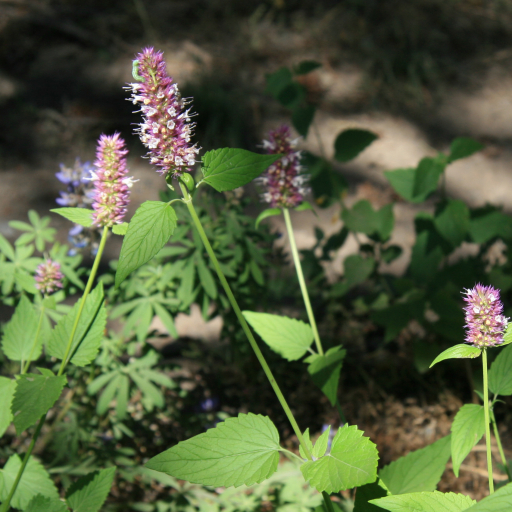
Plant Overview
Often called the Nettle-leaf Giant Hyssop, this tall, aromatic beauty is a master of disguise. While its foliage looks remarkably like the common stinging nettle, it lacks any of the painful "hairs," offering instead a refreshing scent of licorice and mint. Native to the mountain meadows of Western North America, it is a cornerstone of the wild garden, acting as a high-rise apartment for local pollinators.
🔍 How to Identify
- 🌿 The Foliage: The leaves are heart-shaped with coarsely toothed edges, mimicking the look of a stinging nettle. However, they are soft to the touch and release a spicy, minty aroma when bruised.
- 🌸 The Blooms: Densely packed flower spikes rise at the top of the stems, featuring hundreds of tiny tubular flowers ranging from pale lavender to rose-purple or occasionally white.
- 📏 The Framework: As a member of the mint family, it features distinctive square stems and can reach impressive heights of up to 5 feet, creating a vertical "cloud" of color in late summer.
🏡 In Your Garden
- 🐝 Pollinator Magnet: This plant is legendary for its ability to attract "the big three"—bees, butterflies, and hummingbirds. If you want a garden that hums with life, this is your primary candidate.
- 💧 Resilient Roots: While it appreciates a drink during heatwaves, it is surprisingly drought-tolerant once established. It prefers well-draining soil and hates "wet feet" during the winter, which can lead to root rot.
- ✂️ Low Maintenance: It is naturally deer-resistant due to its strong fragrance, meaning you won't need to protect it with fencing. Simply cut it back in early spring to make room for new growth.
⚠️ Safety & Toxicity
- ✅ Safe for All: Agastache urticifolia is generally considered non-toxic to humans, cats, and dogs. Unlike the stinging nettles it resembles, it is completely safe to touch with bare hands.
- 🍵 Herbal History: The leaves have historically been used to make refreshing teas or as a seasoning. However, as with any wild plant, ensure it hasn't been treated with pesticides before considering any culinary use.
✨ Fun Fact
Despite its intimidating "nettle" name, Indigenous peoples across the West used this plant as a natural deodorant and a soothing wash for sores, proving that its bark is much worse than its bite!

Detailed Care Instructions
To grow Agastache urticifolia, also known as nettleleaf giant hyssop, follow these steps:
- Choose the right location: Agastache urticifolia prefers full sun but can tolerate partial shade. Ensure the planting site has well-draining soil.
- Prepare the soil: Remove any weeds or grass from the planting area. Loosen the soil and amend it with organic matter, such as compost, to improve drainage and fertility.
- Sow the seeds: In early spring or fall, sow the seeds about 1/8 inch deep in the prepared soil. Space them about 18-24 inches apart. Gently tamp the soil down over the seeds.
- Watering: Keep the soil consistently moist but not soggy. Water the plants whenever the soil feels dry to the touch.
- Fertilizing: Agastache urticifolia does not require heavy fertilization. However, you can apply a balanced organic fertilizer in spring to promote healthy growth.
- Mulching: Apply a layer of organic mulch around the plants to help conserve moisture and suppress weed growth.
- Pruning: Once the plant has reached a height of about 6-8 inches, pinch or prune the tips to encourage bushier growth. This will also promote more flowering.
- Pests and diseases: Agastache urticifolia is generally resistant to pests and diseases. However, keeping the plants well-spaced and providing good air circulation can help prevent any potential issues.
- Harvesting: The leaves of Agastache urticifolia can be harvested and used in teas or salads. Harvest the leaves when the plant is in full bloom for the best flavor and aroma.
- Winter care: In colder regions, Agastache urticifolia may die back in winter. Provide a layer of mulch around the base of the plant to protect the roots during freezing temperatures.
By following these steps, you can successfully grow Agastache urticifolia and enjoy its beautiful foliage and fragrant flowers.

Place in a bright room that is sun drenched almost all day. Or directly in a south-facing window.

To water this plant, ensure that the soil is dry before watering. Use a watering can or hose with a gentle flow to avoid damaging the roots. Water around the base of the plant and avoid wetting the leaves. The plant requires good drainage, so allow excess water to drain away. Avoid overwatering as it can lead to root rot and fungal diseases. The amount and frequency of watering primarily depend on the climate and soil conditions. Monitor the soil moisture level, and adjust watering accordingly.
Agastache Urticifolia requires a balanced fertilizer with equal parts nitrogen, phosphorus, and potassium. Use a slow-release granular fertilizer during the growing season, following the instructions on the package. Apply the fertilizer evenly around the base of the plant and water it in well. Be careful not to over-fertilize, as this can lead to excessive growth and reduced flowering.
Agastache urticifolia plant prefers soil that is well-drained and rich in organic matter. It does well in slightly acidic to neutral soil pH levels. A mixture of loam, sand, and compost works well for the plant. It is also important to make sure that the soil is moist but not waterlogged, as the plant may suffer in waterlogged conditions. Additionally, adding a layer of mulch around the plant will help to retain moisture in the soil and prevent weeds from growing.
Agastache urticifolia is a perennial plant that can be propagated through seeds or vegetative propagation. To propagate through seeds, collect seeds from mature plants in autumn and propagate them in the following spring. Sow them in a seed-starting mix and keep them moist until they germinate. Once the seedlings are a few inches tall, transplant them into individual containers or directly into the garden.
To propagate through vegetative propagation, take stem cuttings from healthy plants in the early summer. Choose non-flowering stems and cut them to a length of around 3-4 inches. Remove the leaves from the bottom half of the stem and dip the cut end into rooting hormone powder. Plant the stem in a container filled with a well-draining potting mix, and keep it in a warm and humid location until new growth appears. Once the cutting has developed roots, transplant it into a larger pot or directly into the garden.
Agastache urticifolia prefers well-draining soil in full sun to partial shade. It is drought-tolerant and attracts pollinators such as bees and butterflies.








